
Starting an Extended Essay can feel strangely backward. You are expected to write a research question before you know exactly what your research will reveal.
That uncertainty is normal. A good EE research question is not a miniature conclusion. It is a focused, answerable question that tells you what evidence to collect, which method to use, and what kind of argument you might eventually make.
For the updated IB Extended Essay model, first assessed in May 2027, students follow either a subject-focused pathway or an interdisciplinary pathway. In both cases, the question needs to fit the chosen pathway, support genuine analysis, and remain manageable within the 4,000-word limit.
If you are in DP1, your goal is not to produce perfect wording immediately. It is to develop a promising question, test it against available evidence, and refine it as your understanding improves.
The EE research question checklist
Before committing to a question, ask whether it is:
- Focused: It identifies a specific issue, case, text, population, place, or period.
- Analytical: It requires interpretation, evaluation, comparison, or explanation.
- Researchable: Credible and appropriate evidence is realistically available.
- Method-aware: You can explain how you would investigate it.
- Pathway-aligned: It fits either one DP subject or a purposeful combination of two.
- Manageable: It can be answered convincingly within 4,000 words.
- Open to argument: A reasonable researcher could reach a different conclusion.
A question can sound sophisticated and still fail this test. Elegant wording cannot rescue an investigation with insufficient evidence or an unworkable scope.
Understand the May 2027 Extended Essay pathways
The revised model offers two routes. The subject-focused pathway investigates a topic through the concepts and methods of one DP subject. The interdisciplinary pathway uses knowledge and methods from two DP subjects because the question genuinely needs both.
This choice affects how you build your question. A subject-focused History question should invite historical investigation. A Biology question needs a design that permits meaningful biological analysis. An interdisciplinary question must do more than place two subjects beside each other.
For example, analysing a novel and then mentioning psychology does not automatically create an interdisciplinary investigation. The two disciplinary perspectives need to help answer the same question in a connected way. Read RevisionDojo's guide to the two Extended Essay pathways for 2027 before fixing your direction.
Choosing one subject is not a lesser option. The IB presents both pathways as valid. Your decision should follow the needs of the question, not the apparent complexity of the label.
Move from an interest to a research problem
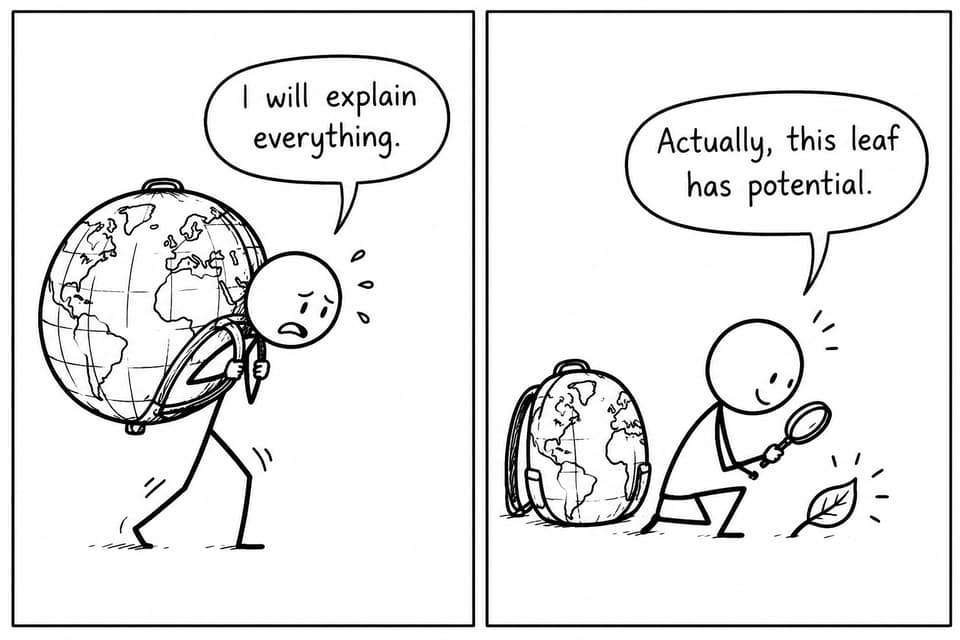
Students often begin with a noun: memory, climate change, advertising, antibiotics, migration. That is an interest, not yet a research problem.
To create a problem, add tension. Look for a change, disagreement, effect, contrast, limitation, relationship, or unexpected pattern. Instead of asking what happened, ask what requires explanation.
A useful narrowing sequence is:
Interest → subject lens → specific case → problem → evidence → question
Suppose your initial interest is social media. Through an Economics lens, you might examine price discrimination by a particular platform. Through Psychology, you might investigate an established cognitive process within an appropriate population. Through English A, you could analyse how selected posts construct identity through language and imagery.
The topic becomes workable only when you decide what you will actually examine. RevisionDojo's guide to choosing an EE topic you can sustain can help you move beyond ideas that are merely fashionable or familiar.
How to write an EE research question that invites analysis
Question stems shape the kind of thinking your essay will require. What is and when did often lead toward description. How, why, and to what extent can invite analysis, although no phrase guarantees a strong investigation.
Use a working structure such as:
To what extent did factor X influence outcome Y in defined context Z during time period T?
Or:
How does creator A use technique B to present idea C in defined work or works?
These are scaffolds, not formulas. A natural, precise question is better than one forced into academic-sounding language.
The key is to identify the relationship being investigated. Ask yourself:
- What will I analyse rather than merely describe?
- Which terms require definition?
- What evidence could challenge my initial position?
- What would count as a convincing answer?
If you cannot explain what an answer might contain, the question may still be too vague.
Strong and weak EE research question examples
The examples below are illustrative. Suitability still depends on subject requirements, ethical considerations, available evidence, and your supervisor's guidance.
| Subject | Weak question | Stronger working question | Why it improves |
|---|---|---|---|
| History | What caused the Cuban Missile Crisis? | To what extent did domestic political pressures influence Kennedy's handling of the Cuban Missile Crisis in October 1962? | It defines an actor, factor, event, and period while leaving room to weigh competing explanations. |
| English A | How is power shown in Macbeth? | How does Shakespeare's use of sleep imagery develop the relationship between guilt and political power in Macbeth? | It links a precise authorial choice to an arguable interpretation. |
| Economics | Does tourism help local people? | To what extent has tourism growth affected rental affordability for permanent residents in a defined municipality from 2019-2025? | It identifies a measurable effect, population, location, and period. |
| Biology | How does light affect plants? | How does variation in blue-light intensity affect the mean germination rate of a specified plant species under controlled conditions? | It identifies variables, an organism, and a possible experimental method. |
| Interdisciplinary | How does climate change affect society? | How can Environmental Systems and Societies and Economics explain changes in household water consumption following a defined drought policy in a selected region? | Both disciplinary perspectives contribute to one bounded problem. |
A longer question is not automatically stronger. Precision matters more than length. Every added phrase should clarify scope, method, evidence, or analytical direction.
Test feasibility before falling in love with the wording
Research questions are cheap. Evidence is expensive.
Before seeking approval, spend a short research session testing whether the project can actually be completed. Locate several credible sources, identify possible primary or secondary evidence, and note any access barriers. For an experiment, consider equipment, safety, time, controls, and sample size. For a literature-based essay, confirm that the chosen material supports sustained close analysis rather than a few repeated observations.
Complete this feasibility test:
- Can I access enough suitable evidence?
- Can I apply an accepted method from my chosen subject or subjects?
- Is the proposed period, sample, text selection, or case narrow enough?
- Are there ethical, safety, privacy, or consent concerns?
- Can I explain the project's value without exaggerating its originality?
- Do I understand the key terms in my question?
This is also the right moment to consult your supervisor. Bring two or three developed options rather than asking whether a broad topic is “good.” RevisionDojo explains what to bring to your first EE supervision meeting and clarifies the responsibilities of an EE supervisor.
Use the question to design your investigation
A strong question and a suitable method belong together. If your question asks about an effect, you need a defensible way to examine that effect. If it asks how a writer creates meaning, close analysis of textual choices should sit at the centre. If it asks to what extent one historical factor mattered, you need evidence that lets you evaluate that factor against plausible alternatives.
Write a one-sentence method statement beneath each draft:
I will answer this question by analysing ___ using ___ and evaluating the findings against ___.
If the blanks are impossible to complete, revise the question. This simple exercise exposes projects built around an interesting idea but no clear route to an answer.
RevisionDojo's Coursework Library can help you study the structure of successful academic investigations without copying their questions or language. Study Notes and Flashcards can strengthen the subject knowledge behind your proposed method, while Tutors can help when a disciplinary approach remains unclear. The aim is not to imitate an existing essay. It is to understand what focused research looks like.
Treat your first question as a draft
Students sometimes protect their first wording because changing it feels like losing progress. Usually, the opposite is true. Revision is evidence that the research process is working.
You may discover that a source base is too thin, a variable cannot be controlled, or two terms in the question hide several different meanings. Narrowing or redirecting the question can preserve useful work while preventing a weak essay. Learn why revising an EE research question matters and what to do when an EE research question stops working.
Keep a short decision log containing:
- Each version of the question
- What changed and why
- Sources or practical constraints that influenced the revision
- Feedback you accepted or rejected
- Your next research action
This record will make supervision conversations more productive and help you reflect honestly on your decisions.
Your practical next step
Write three versions of your question today. Make one narrower by case, one narrower by period or sample, and one narrower by the relationship being investigated. Add a method sentence and three possible sources beneath each version.
Then ask your supervisor which version offers the strongest combination of focus, evidence, and disciplinary fit. You can also use the eight research-question refinement tips as a final check.
RevisionDojo gives you one place to save those drafts and ask Jojo for feedback on clarity, scope, and feasibility. AI feedback should support your thinking, not replace your supervisor or write the question for you. Used carefully, it can reveal an undefined term or an overlarge scope before you invest weeks of research.
A strong EE rarely begins with certainty. It begins with a question small enough to investigate, difficult enough to matter, and flexible enough to improve.