
There’s a moment in almost every IB Math IA where you can feel the trap closing.
You’ve done the regression. The graphs look clean. The algebra is correct. And yet the draft still reads like a machine wrote it: input data, output results, move on. If an examiner can’t see you thinking, your marks can quietly leak away.
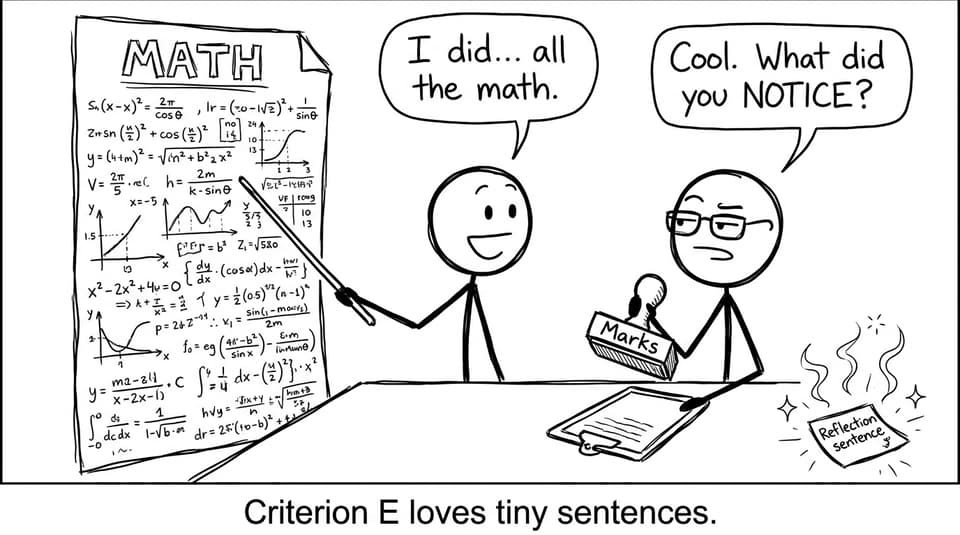
That’s why IB students who score highly in Criterion E learn a surprisingly small skill: writing short, deliberate reflection sentences that show judgement. Not a long diary entry. Not a dramatic conclusion. Just 1-2 lines placed at the exact moments where your maths becomes a decision.
Quick checklist: reflection sentences that earn IB marks
Use this mini-checklist as you edit your draft:
-
Add 1-2 reflection sentences after every major result (model choice, parameter estimate, test, graph, or conclusion).
-
Make each sentence do more than summarise: it must evaluate or interpret.
-
Link your reflection to evidence (residual pattern, R² change, domain restriction, measurement error, or an assumption).
-
Keep the tone analytical, not emotional.
-
Repeat the loop: notice, explain, consequence.
If you want a full rubric-level map of what matters, open the criteria breakdown in Unpacking the IB Math IA Assessment Criteria and keep it beside your draft.
What Criterion E reflection is really testing in IB
In IB marking, reflection is where your mathematics stops being a pile of steps and becomes an argument. Examiners are looking for signs that you can:
-
judge whether a method fits the situation,
-
spot limitations and assumptions,
-
interpret what a result means in context,
-
propose realistic improvements.
That’s also why reflection works best when it’s integrated, not dumped at the end. If you only reflect in the conclusion, you’re basically saying you did all the thinking after you finished.
For a wider view of how to weave reflection across the exploration, see How to Use Reflection to Strengthen Your IB Math IA Grade.
The 3-part reflection sentence formula (steal this)
Most high-scoring IB reflection sentences follow a simple structure:
Notice
State what you observed, using evidence.
Explain
Interpret why that happened (mathematically).
Consequence
Say what it implies for your aim, your model, or your reliability.
Example you can adapt:
“Residuals increase for larger x-values, which suggests the variance is not constant. This weakens the reliability of predictions at high x and supports restricting the domain to the observed data range.”
This one sentence does three things: it points to evidence, interprets it, and changes the reader’s trust level. That’s reflection.
Where to place reflection sentences in your IB Math IA
A good rule: if a reader could ask “why did you do that?” or “so what?” then you need a reflection sentence.
After you choose a model
Model choice is a decision, so treat it like one.
“A logarithmic model was selected because the rate of increase decreases over time, which matches the curvature in the scatter plot better than a linear trend.”
After you calculate parameters
Don’t just compute parameters; comment on what they do.
“The parameter k controls the steepness of the curve, and its value indicates the system changes rapidly at first before stabilising.”
After you validate (or fail to validate)
This is where Criterion E lives.
“Although the R² is high, the non-random residual pattern suggests the model captures overall trend but misses structure, so the fit may be misleading.”
If you’re still building the IA structure itself, How to Write a Top-Scoring Math IA (2025 Guide) is a helpful blueprint.
Reflection sentences that target common IB mark opportunities
Below are reflection sentence types you can reuse. They’re short on purpose. In an IB IA, brevity looks like control.
Limitations and assumptions (high-value marks)
Reflection doesn’t mean apologising. It means bounding your claims.
“Since the model assumes ideal conditions, it likely overestimates values in real settings where friction is present; however, this simplification is reasonable within the short time interval measured.”
For a deeper set of limitation angles, use How to Reflect on Model Limitations in the IB Math IA.
Technology reflection (not “I used software”)
Technology earns reflection marks when it changes your understanding.
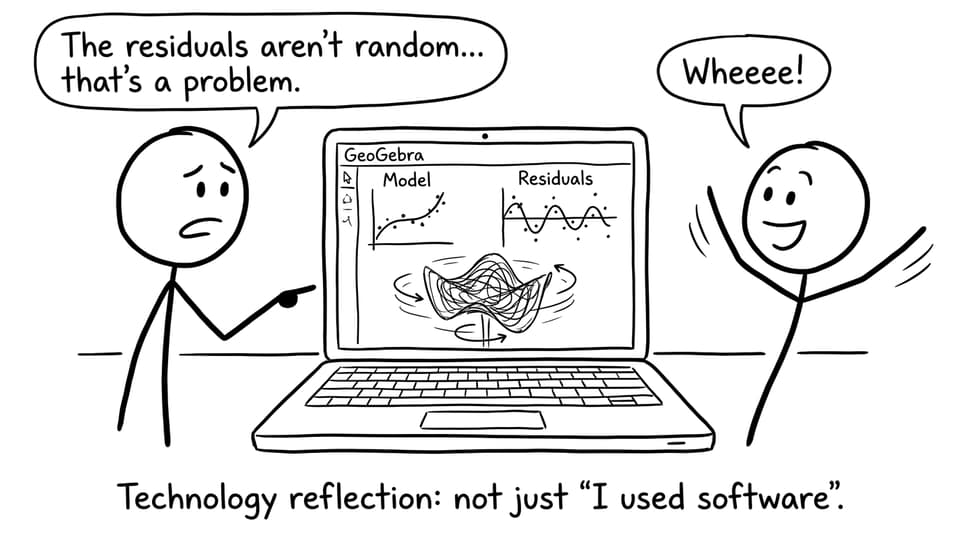
“Graphing the function revealed the turning point occurs earlier than expected, which explains why the linear approximation fails beyond the midpoint of the dataset.”
Improvement and extension (without rewriting your whole IA)
You’re not required to do the improvement, but you should show you can see it.
“A piecewise model could better represent the change in behaviour after x = 10, as the data shows a clear shift in trend.”
Real-world meaning (make the maths feel purposeful)
This is where your IA becomes memorable.
“The saturation effect suggests there is a practical upper bound, which matches the real constraint that resources cannot increase indefinitely.”
For more on connecting results to context, read How to Reflect on Real-World Applications in the IB Math IA.
How RevisionDojo helps IB students build reflection fast
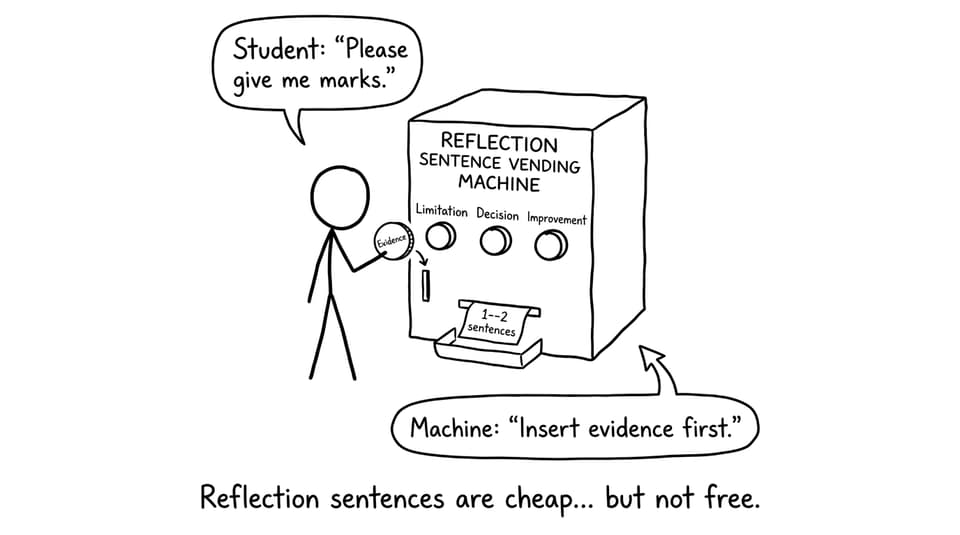
The hardest part of reflection isn’t intelligence. It’s momentum. When you’re tired, you default to summary.
RevisionDojo is built to prevent that.
-
The Coursework Library and Study Notes help you restate key concepts accurately when you’re explaining what a result means.
-
The AI Chat can challenge you with “so what?” prompts until your reflection sentence has consequence.
-
The Grading tools help you spot where your writing sounds like description instead of evaluation.
-
The Coursework Guide (with rubric descriptors) keeps your reflection aligned to what IB examiners actually reward: see IB Mathematics AA IA Guide and Essentials of the Internal Assessment.
And because most IB students are also juggling exam prep, you can pair IA work with exam-style practice using the RevisionDojo Questionbank, then simulate timing and stamina with Mathematics Analysis and Approaches Predicted Papers or the main IB Predicted Papers.
Closing: your smallest IB upgrade
The quiet truth about IB coursework is that small sentences can carry heavy marks.
A reflection sentence is tiny, but it tells the examiner: I’m not just calculating. I’m evaluating, interpreting, and thinking like a mathematician.
If you want a simple next step, open your IA draft and highlight every place you made a choice. Then add one reflection sentence using notice, explain, consequence. Do that consistently, and Criterion E stops being mysterious.
Build the habit with RevisionDojo’s tools: Study Notes for clarity, Flashcards for quick concept recall, AI Chat for prompt-driven evaluation, Grading tools for rubric alignment, Mock Exams and Predicted Papers for exam readiness, plus the Coursework Library and Tutors when you need a human checkpoint. That’s how IB students turn “I did the math” into “I earned the marks.”