
If you have ever stared at your IB Math IA and thought, “The math is fine. Why does it still feel… flat?” you are not alone.
Most IB students treat reflection like an afterthought: a paragraph you paste into the conclusion once the graphs are done and your calculator battery is on life support. But in a strong IB exploration, reflection is the moment your work starts to sound like a mathematician instead of a machine. It is where you prove you understand your choices, your results, and your blind spots.
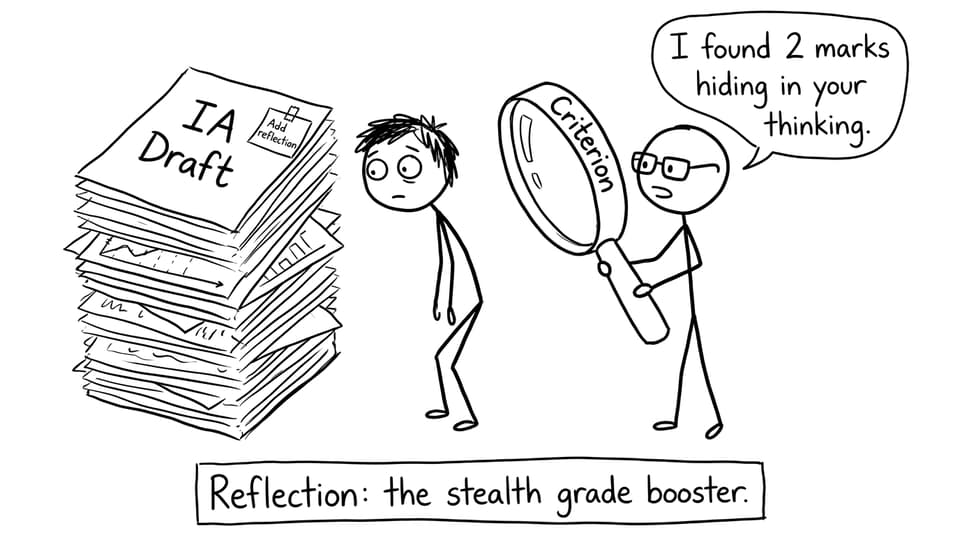
Reflection is also one of the most controllable ways to lift an IB Math IA grade. You cannot always make your dataset perfect. You can always make your thinking clearer.
A quick IB reflection checklist (save this before you edit)
Use this as a fast scan before you do a final polish:
-
You mention IB reflection expectations explicitly (you know what is being assessed).
-
You reflect throughout the IA, not only at the end.
-
Your reflections explain why you chose a method, not only what you did.
-
You evaluate limitations, assumptions, and reliability with math-based reasons.
-
You show at least one meaningful revision or turning point in your approach.
-
You connect results back to the real context (without drifting into personal diary mode).
For structure guidance while you do this, it helps to skim How to Structure Your IB Math IA Logically and keep the rubric language close.
What reflection actually means in an IB Math IA
In IB terms, reflection is not “I enjoyed this topic” or “this was challenging.” It is closer to: I can justify decisions, interpret outcomes, and evaluate weaknesses like someone who understands the mathematics.
A reflective IB student does three things repeatedly:
-
Justifies: why this model, why this variable, why this technology.
-
Interprets: what the result means in the context.
-
Evaluates: how reliable the result is, and what would improve it.
If you want a clean rubric-aligned overview, keep Essentials of the Internal Assessment open while you edit. Then compare your draft against high-scoring examples using Using IA/EE Exemplars to Improve Your IB Math IA.
Put IB reflection everywhere (not just in the conclusion)
A good IB Math IA reads like a guided walk: you show the reader where you are going, why each step exists, and what you learned when the path got steep.
That is why reflection belongs in small, frequent sentences:
-
after you define variables
-
after you select a model
-
after you run regression or transformations
-
after you check residuals or error
-
after you switch approaches
This is the idea behind How to Include Reflection Throughout Your IA. The advantage is subtle but huge: examiners do not have to “hunt” for your thinking.
Micro-reflection template you can reuse
After any major mathematical step, add 1-2 lines using this structure:
-
Decision: I used ___ because ___.
-
Check: This works well when ___, but weakens when ___.
-
Consequence: That means my result is most reliable for ___.
That kind of writing sounds unmistakably IB.
Focus on the “why” that earns IB marks
A common IB trap is summarizing your process like a lab report: “First I did regression, then I calculated r, then I graphed it.” That is narration, not reflection.
Instead, connect every choice to a reason the examiner can respect:
-
Why a logarithmic model fits diminishing returns.
-
Why a piecewise function is justified by behavior changes.
-
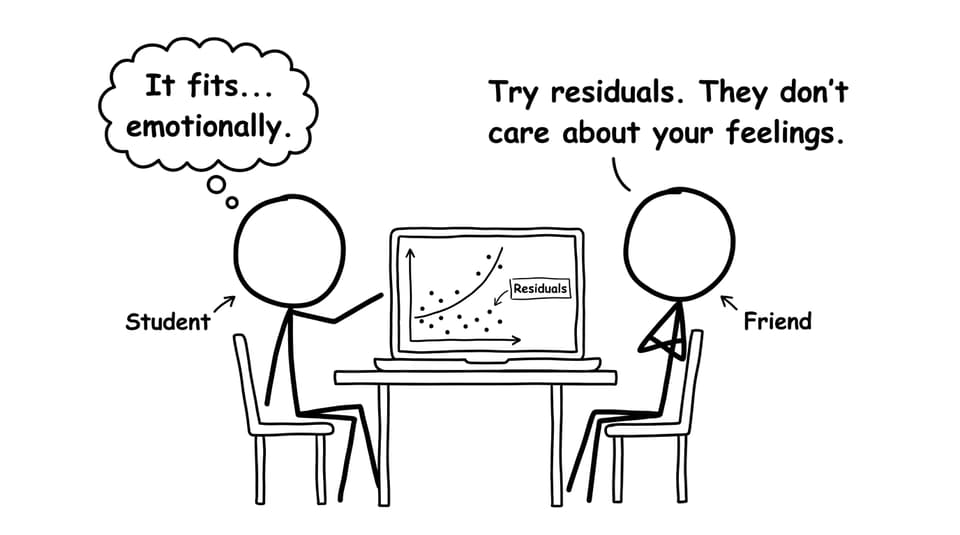
Why a quadratic is suggested by residual curvature.
If you want more wording patterns for strong commentary, IB Math: 10 Tips for a Strong IA Commentary is a useful edit companion.
Reflect on mistakes and revisions (IB examiners like honest thinking)
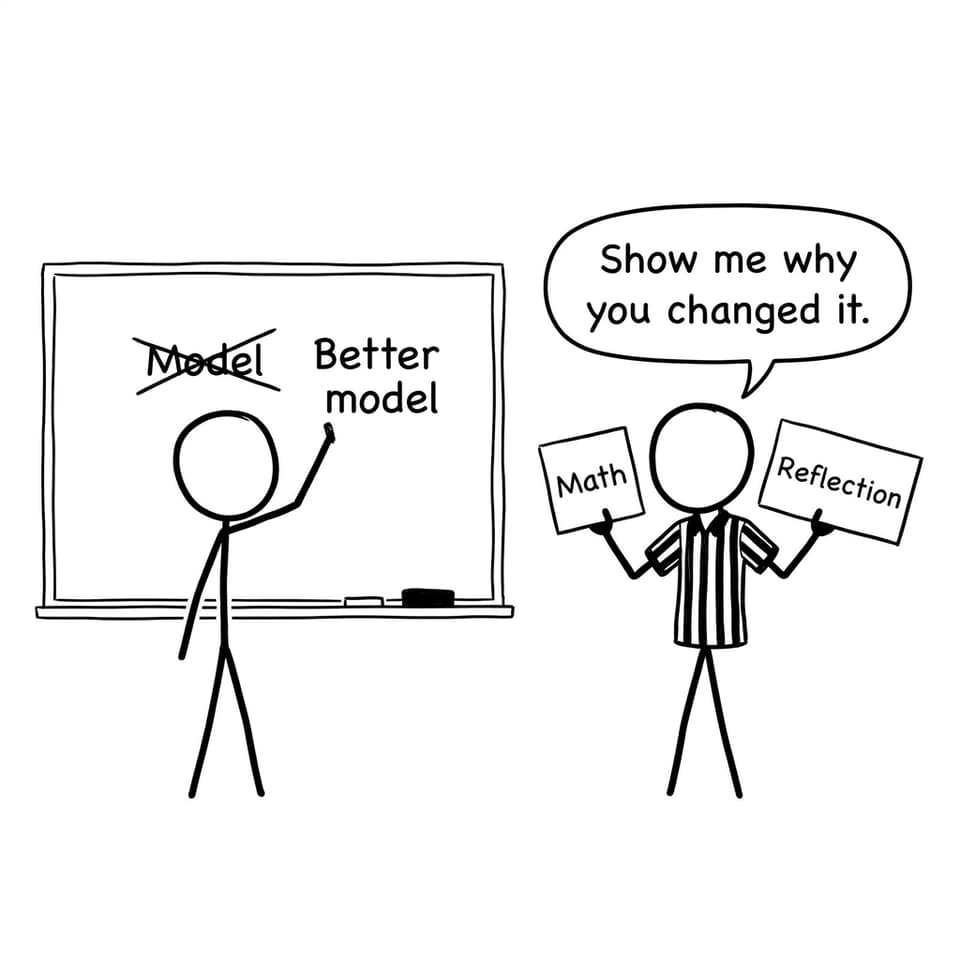
Some students hide their false starts because they fear it looks “weak.” In IB marking, thoughtful course correction often looks stronger than pretending your first attempt was perfect.
What to include:
-
what you tried first
-
what evidence showed it was flawed (a graph feature, residual pattern, parameter instability)
-
what you changed and why
This creates a narrative of mathematical judgment, not just computation. If you need a clear way to discuss weaknesses without sounding defensive, use the structure in How to Reflect on Model Limitations in the IB Math IA.
Evaluate strengths, limitations, and improvements like an IB mathematician
Strong IB reflection is balanced: you point out what worked, then you quantify or explain what did not.
Useful angles to evaluate:
-
Assumptions: What conditions must be true for the model to hold?
-
Data quality: Measurement error, sample size, bias, missing values.
-
Domain limits: Where does the model stop matching reality?
-
Sensitivity: Which parameter changes the output most?
Then finish with one realistic improvement: more data in a specific range, a different model class, or a better error measure.
For a broader IA overview (especially if you are still drafting), How to Write a Top-Scoring Math IA (2025 Guide) connects reflection to the rest of the criteria.
Reflect on technology use (without turning it into a software review)
In IB Math IAs, technology is allowed and expected. The reflection opportunity is explaining what it did to your understanding.
Consider sentences like:
-
“Using technology to fit parameters helped me test models quickly, but I verified the behavior by checking ___ manually.”
-
“The graphing tool made it clear where the model diverged, especially around ___, which led me to ___.”
This also connects nicely to academic integrity. If you are using AI tools, be careful: IB expects your understanding to be visible on the page. Read IB Mathematics Internal Assessment: Avoiding Common Integrity Pitfalls before final submission.
How RevisionDojo helps you build IB-level reflection (and exam confidence)
Reflection is a writing skill, but it is also a practice skill: you cannot evaluate what you do not understand.
RevisionDojo supports both sides of the IB workload:
-
Study Notes and Flashcards help you regain clarity on the math you are using (try Flashcards for Internal Assessment (IA) - IB - RevisionDojo).
-
The Questionbank builds the fluency that makes your IA explanations cleaner, and helps you speak in markscheme-style reasoning (see IB Math AA Calculus Questionbank and How to Use the Questionbank for Targeted Math Revision).
-
AI Chat helps you stress-test your reasoning with “why” questions before you submit.
-
Grading tools help you check whether your reflection sounds analytical (and rubric-aligned) rather than vague.
-
Mock Exams and Predicted Papers keep your exam prep moving while your IA is being polished.
-
The Coursework Library and Tutors help when you are stuck on structure, clarity, or model choice.
In other words: you can write better IB reflection when your math foundation is calmer.
Conclusion: turn your IB Math IA into a story of thinking
The best IB Math IAs are not the ones with the most complicated formulas. They are the ones that show judgment: why a method fits, where it fails, and what the results actually mean.
If you want to strengthen your IB grade quickly, do not just edit your graphs. Edit your thinking on the page. Use RevisionDojo’s IA Guides, Exemplars, Questionbank, Study Notes, Flashcards, and AI Chat to build the mathematical confidence that makes reflection natural, not forced.
Your IA is already a piece of work. Reflection is what makes it a piece of understanding.