
If you have ever stared at a graph that mostly fits and thought, “Please don’t ask about that weird bend near the end,” you are already standing at the doorway of top-band IB reflection.
In an IB Math IA, the point of a model is not to look flawless. It is to show you can build something useful, notice where it stops being useful, and explain why with mathematical honesty. Examiners are not looking for perfection. They are looking for awareness: the ability to see the edges of your own work.
That is exactly what reflecting on model limitations is: not apologizing, but demonstrating control.
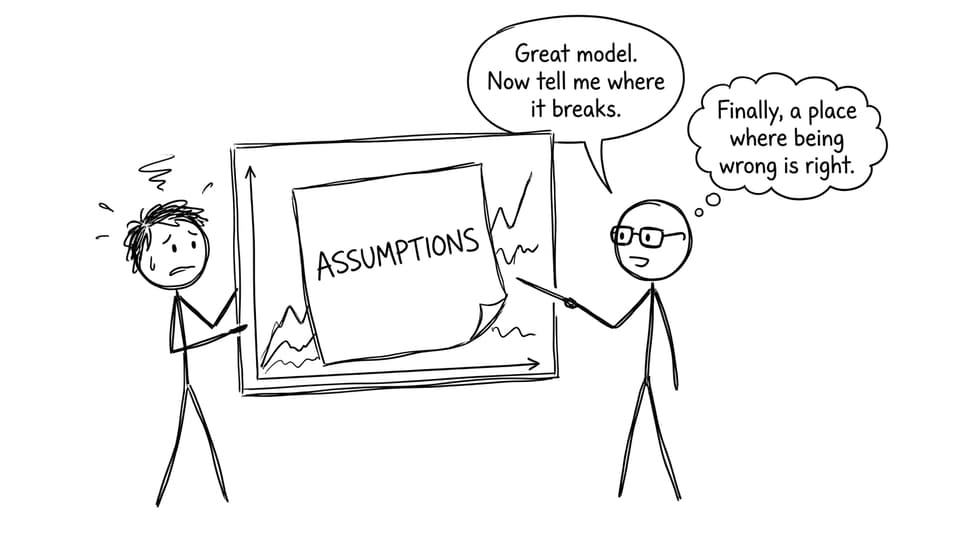
IB model limitations: a quick checklist you can copy
Use this mini-structure whenever you write about a limitation in your IB Math IA:
-
Name the limitation (what goes wrong?)
-
Locate it (where in the domain, dataset, or method does it appear?)
-
Explain the cause mathematically (assumption, function choice, regression constraints, error propagation)
-
Show the impact (how big is the mismatch? what does it change?)
-
Suggest a realistic improvement (new model, extra variable, better data, restricted domain)
If you want a rubric-aligned sense of what “reflection” actually means, skim Unpacking the IB Math IA Assessment Criteria and the practical IA checklist. Those pages make the examiner perspective feel less mysterious.
Why IB examiners reward limitation reflection
A model is a decision. In the IB, you earn credit when you show you understand the consequences of that decision.
A student who says, “My regression gave an R² of 0.97” is reporting.
A student who says, “My regression gave an R² of 0.97, but residuals grow for large x, suggesting nonlinearity or a missing variable” is thinking.
That difference is often what separates competent IAs from memorable ones. If you want a broader look at how reflection is assessed and phrased, How to Write a Strong Reflection Section in the IB Math IA pairs well with this limitation-focused approach.
Common types of IB model limitations (and how to write them)
Mathematical mismatch limitations
This is the classic case: the math you chose cannot represent the pattern you observed.
Examples:
-
A linear model forcing curvature into a straight line
-
A quadratic model failing to capture asymptotic behavior
-
An exponential model ignoring saturation or ceiling effects
Strong IB phrasing sounds like:
“The linear model fits the initial trend, but the residual plot shows increasing deviation as x increases, indicating curvature that a first-degree function cannot capture.”
If you are worried you are “forcing” a function, read How to Avoid Common Mistakes in IB Math IA Modeling. It will save you hours of rewriting later.
Data and measurement limitations
Even great math collapses if the data is noisy, imprecise, or inconsistent.
In IB writing, avoid vague lines like “human error affected results.” Instead, name the measurement constraint and connect it to your output.
“Time was recorded to the nearest 0.1 s, so rounding introduced random error that weakened the correlation and inflated the uncertainty of the fitted parameter.”
If your dataset has strange points, treat them as information, not embarrassment. How to Handle Outliers and Anomalies in the IB Math IA shows how to discuss them without sounding defensive.
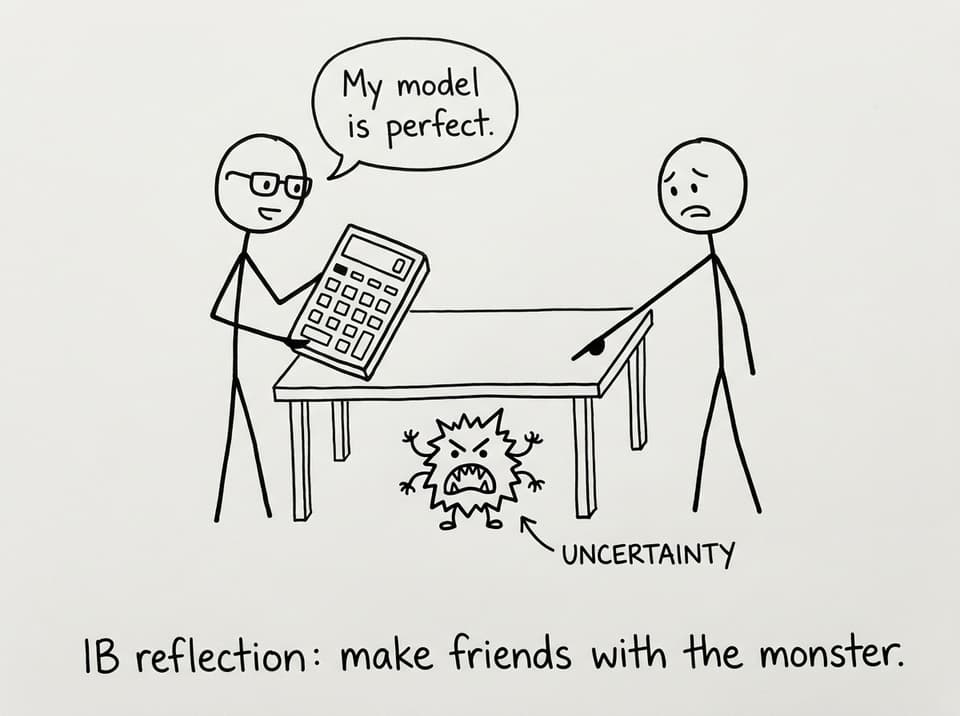
Assumption-driven limitations
Assumptions are not a problem. Unexamined assumptions are.
Good IB reflection names the assumption and then evaluates its realism:
“Assuming constant temperature simplified the derivation, but it likely fails over longer periods, which would explain the model diverging from observed values after 20 minutes.”
A practical trick: after every major step, write one short reflection sentence. Then your final reflection section becomes a collection of already-polished insights. How to Use Reflection Sentences to Earn Marks in IB Math IA (Criterion E) teaches that habit.
Range and domain limitations
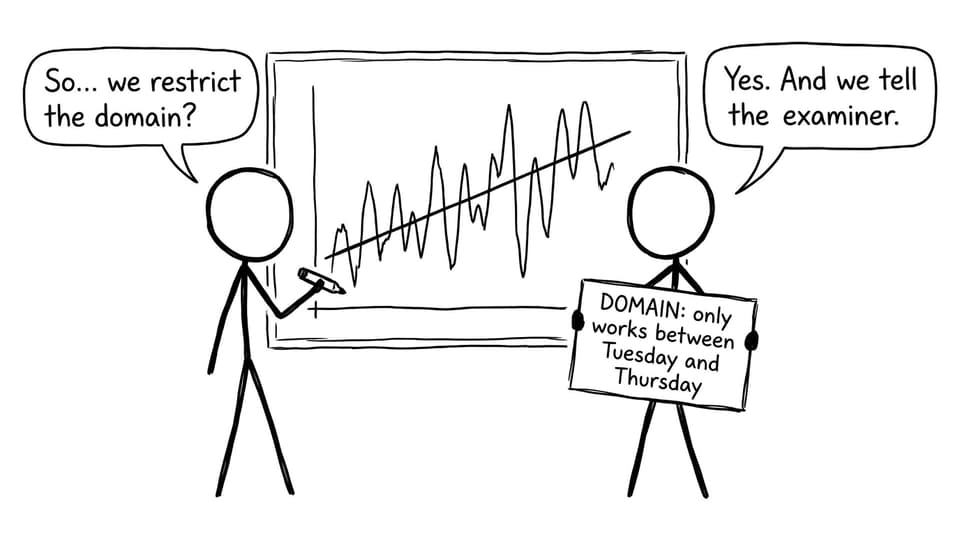
Many IB models are “true” only in a specific interval. Saying that clearly is not a weakness. It is responsible modeling.
“The model is valid for 0 ≤ x ≤ 12, where the underlying process remains stable. Outside this interval, extrapolation becomes unreliable because the context changes.”
This is also where you can earn easy communication points by labeling domain restrictions directly on your graphs.
Turning limitations into higher IB marks: the improvement move
A limitation becomes high-scoring reflection when you show what you would do next.
That “next step” should be realistic:
-
Add a variable only if you can justify and source/collect it
-
Change the model only if you can explain why the new form fits the behavior
-
Restrict the domain only if you can defend the interval mathematically and contextually
When you write this section, you are basically doing examiner-friendly evaluation. If you want a clean structure for that final piece, use How to Write an IB Math IA Evaluation That Impresses Examiners.
How RevisionDojo helps you reflect like an IB examiner
Most students do not struggle with “doing math.” They struggle with describing their thinking in IB language.
RevisionDojo is built for that gap:
-
Use the Coursework Library to compare how strong IAs phrase limitations and improvements.
-
Use the Grading tools (like the IB Maths AI IA Grader) to check whether your reflection is specific enough to earn marks.
-
Use AI Chat to pressure-test your assumptions: “What would make this model invalid?”
-
Use Study Notes and Flashcards to tighten the concepts you reference in reflection (regression, residuals, error, domain).
-
Use the Questionbank, Mock Exams, and Predicted Papers to build exam confidence while your IA is being finalized.
-
If you want a human checkpoint, Tutors can help you turn “I think it’s limited” into “Here is the quantified reason it’s limited.”
And if you need a bigger picture of how to weave reflection throughout the whole process, not only at the end, How to Include Reflection Throughout Your IA is worth a read.
Closing: the IB skill hiding inside your limitations
In the IB, reflection on model limitations is not a side quest. It is the quiet skill underneath everything else: the ability to say, “This works, here is where it stops working, and here is what I would change.”
If you want your reflection to sound like an examiner wrote it (without losing your own voice), build it on RevisionDojo: practice the underlying concepts with Study Notes and Flashcards, test your clarity with AI Chat, sanity-check your write-up with Grading tools, and keep your exam preparation moving with the Questionbank, Mock Exams, and Predicted Papers.
Limitations do not weaken your IA. In the IB, they are often where your best thinking finally becomes visible.