
Mathematical language is the quiet part of your IB Math IA that examiners listen to the loudest.
You can have a clever model, neat graphs, and correct calculations, and still lose marks because your notation feels improvised. It is the academic version of turning up to an interview in running shoes: maybe you are talented, but you are asking the reader to doubt your seriousness.
In an IB exploration, mathematical language is not decoration. It is the system that makes your thinking traceable. It supports marks in communication and in the use of mathematics, and it signals that you understand what your symbols actually mean.
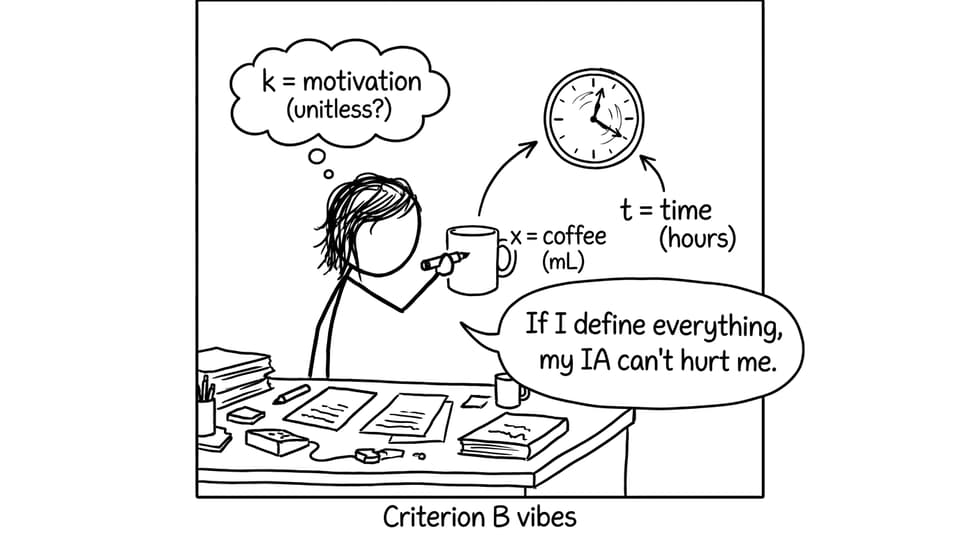
A quick IB checklist for mathematical language
Use this as a final pass before you submit your IB Math IA:
-
Define every variable, parameter, and function before first use.
-
Keep notation consistent from start to finish.
-
Use standard function, derivative, and vector conventions.
-
Write equations as part of sentences (and explain what they do).
-
Label all graphs and tables with units.
-
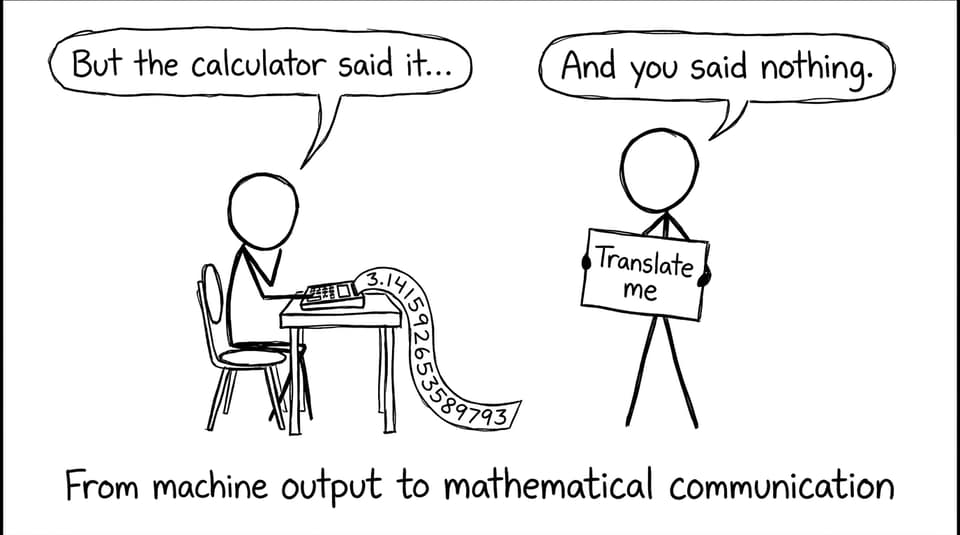
Translate calculator output into rounded, interpreted results.
If you want the examiner-focused version of this checklist, keep RevisionDojo’s IA Guides hub open while you edit.
Why IB examiners care about notation more than you think
In the IB, the examiner is not grading your intentions. They are grading what is on the page.
Notation is how they verify that:
-
your variables are not shifting meaning,
-
your functions are defined as functions (not vibes), and
-
each step follows logically from the last.
The clearest way to align with that is to learn what the rubric actually rewards. RevisionDojo breaks this down in Unpacking the IB Math IA Assessment Criteria and goes deeper on notation expectations in Criterion B: Mathematical Communication.
Define variables and symbols like you are teaching a tired reader
A practical rule for any IB Math IA: if a symbol appears, it must earn its place.
When you introduce a variable, define:
-
what it represents,
-
its unit (if applicable), and
-
its domain or constraints (if relevant).
Example phrasing that reads professionally:
Let (t) be time in seconds, where (t \ge 0). Let (v(t)) denote velocity in (\text{m s}^{-1}).
This is simple, but it saves you later. It stops the common problem where you quietly switch from (x) meaning “distance” to (x) meaning “data point number.”
For structure that makes these definitions feel natural, use How to Structure Your IB Math IA Logically as a template.
Use standard IB conventions (and avoid shorthand)
Most notation mistakes are not “wrong math.” They are “machine language” leaking into human writing.
Use conventions your IB reader expects:
-
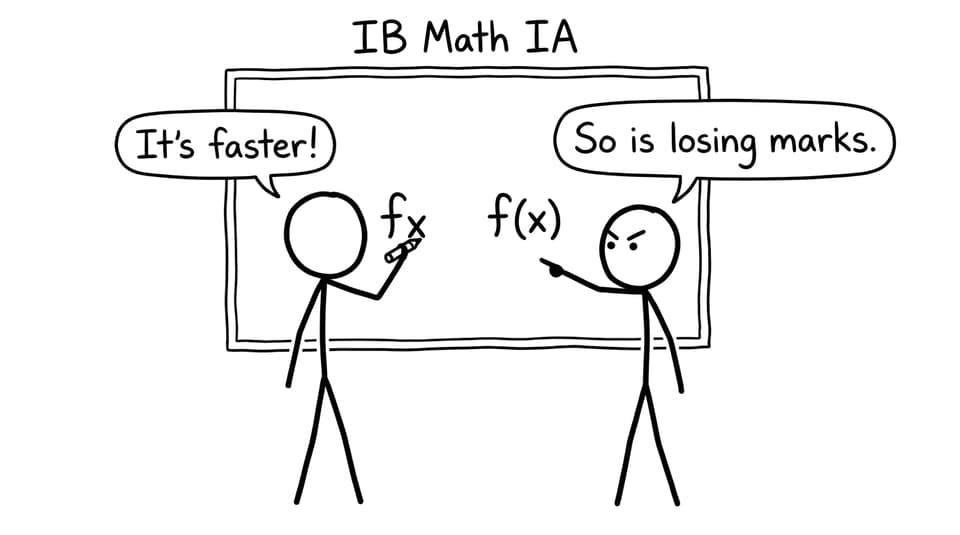
Function notation: (f(x)), not (fx).
-
Derivatives: (f'(x)) or (\frac{dy}{dx}), consistently.
-
Multiplication: (\cdot) or juxtaposition, not calculator symbols like (*).
-
Vectors: choose bold (\mathbf{v}) or arrow (\vec{v}), then stick to it.
If function notation is a weak spot, it is worth revisiting the idea that (f(x)) is a process, not a product. RevisionDojo explains this cleanly in Why Is Function Notation f(x) So Confusing in IB Maths?.
Keep your notation consistent across the whole IA
Consistency is not just neatness. In an IB Math IA, it is part of validity.
If you define (k) as a decay constant and later redefine (k) as “a scaling factor,” you have created ambiguity. The examiner now has to guess what you mean, and guessing is never where marks come from.
A clean tactic:
-
Make a mini “Notation list” at the start of the exploration or right after the introduction.
-
When you add a new parameter, add it to the list.
To align your tone and flow with what earns marks, compare your draft to How to Communicate Mathematical Ideas Clearly in the IB Math IA.
Write equations inside sentences, not as isolated monuments
Many IB students place an equation, then move on, hoping the mathematics speaks for itself. It rarely does.
A better approach is to make every equation answer one of these questions:
-
What is this equation doing?
-
Why is it appropriate here?
-
What does each term represent in context?
Example:
Using the quadratic model (h(t)=at^2+bt+c), the coefficient (a) represents half the constant acceleration (with sign), which allows the model to reflect deceleration after launch.
When you write like this, the mathematics becomes a story the examiner can follow.
Units and calculator outputs: translate, interpret, round
Units are part of mathematical meaning. In the IB, missing units can make correct work look unfinished.
Also, calculator output is not communication. A line like “(r=0.984738294)” is an unfinished thought unless you interpret it.
RevisionDojo makes this point sharply in Why Does Calculator Notation Lose Marks in IB Maths Exams?.
How RevisionDojo helps you polish language while you revise for IB exams
It is hard to edit notation when you are also trying to improve your accuracy under exam pressure. This is where RevisionDojo fits into an IB routine.
-
Use the Study Notes and Flashcards to standardize definitions and notation across topics.
-
Use the Questionbank to see how markscheme-style solutions present notation and working. Start with IB Math AA Calculus Questionbank or IB Math AI Calculus Questionbank.
-
Use AI Chat to sanity-check whether your variable definitions are unambiguous.
-
Use the Grading tools, including the IB Maths AI IA Grader, to see where your communication is slipping.
-
When you need models of what “good” looks like, browse the Coursework Library like IB Maths AI IA Examples.
-
If you are stuck, RevisionDojo Tutors can help you rewrite a messy section into examiner-friendly mathematical sentences.
Closing: write like a mathematician, score like a mathematician
In the IB, mathematical language is not just how you present your work. It is how you prove you own it.
If you want your IA to feel calm, credible, and easy to award marks to, treat notation as part of the mathematics itself. Then reinforce that standard through your revision routine: practice in RevisionDojo’s Questionbank, tighten definitions with Flashcards and Study Notes, and use AI Chat and the Grading tools to catch what you no longer notice.
When you are ready to polish, start with How to Write a Top-Scoring Math IA (2025 Guide) and edit your draft until every symbol feels inevitable.