

Function notation is one of those IB Math moments where you can feel perfectly capable… and still stare at f(x) like it’s written in a secret alphabet.
You see f(2) and your brain thinks “okay, a number.” Then the exam slides in f(a + h), and suddenly it feels like you’re being asked to evaluate a function and your life choices at the same time. The frustrating part is that the underlying idea is simple. The confusion comes from the way it’s written.
The one idea that fixes most IB Math function notation
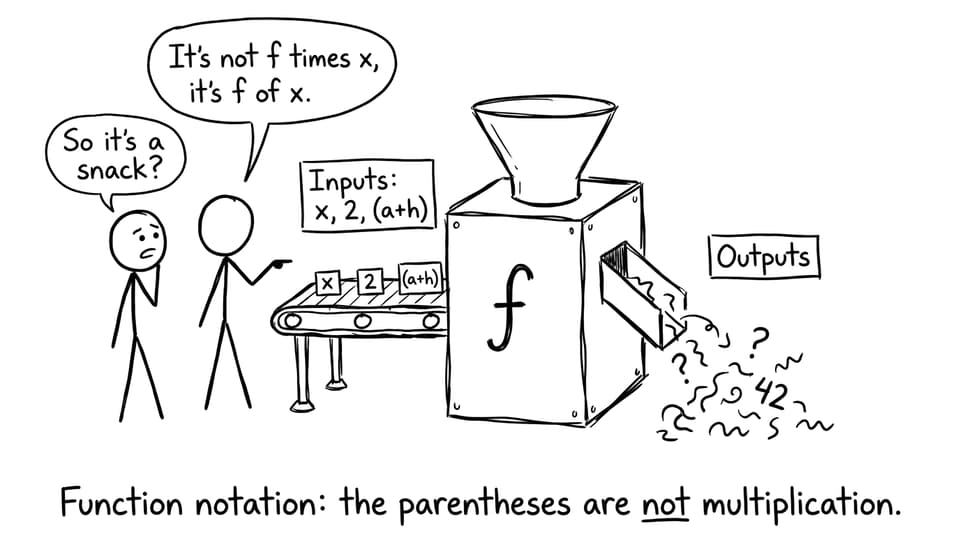
In IB Math, a function is best treated as a process: it takes an input, applies a rule, and produces an output.
So:
-
f is the name of the process.
-
(x) tells you the input.
-
f(x) is the output after the rule acts on that input.
That’s it. And yet it keeps feeling hard because the notation looks like multiplication. In algebra, we’re trained to see letters next to parentheses and think “multiply.” But f(x) does not mean f times x. It means “f of x” -- the result you get when x goes through the function machine.
If you want a clean foundation (especially for AA), start with RevisionDojo’s notes on function notation, domain, range, and inverse ideas: Functions notation, domain, range and inverse as reflection (AA SL 2.2).
A quick checklist for f(x) questions in IB Math
Before you do anything fancy, run this mini-checklist:
-
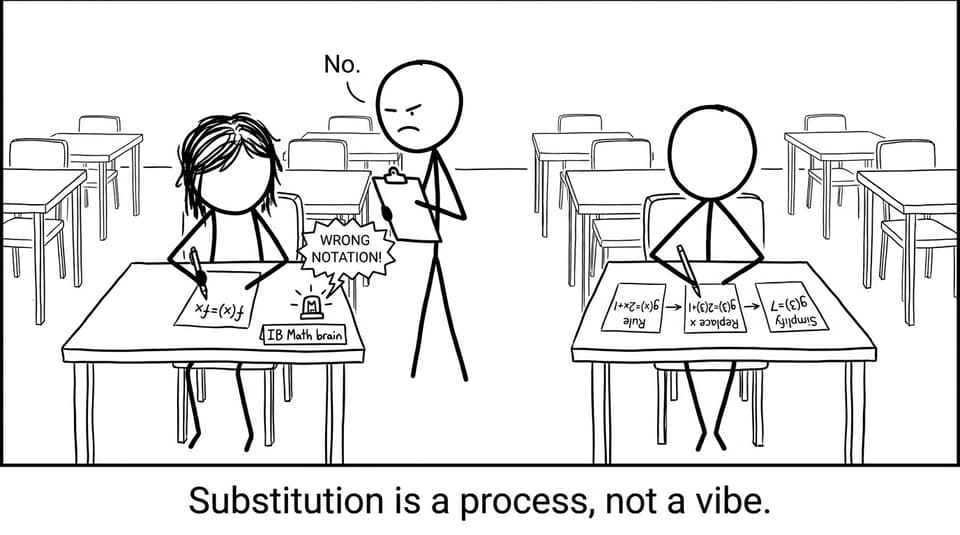
Identify the rule (what is f(x) defined as?).
-
Rewrite the rule clearly.
-
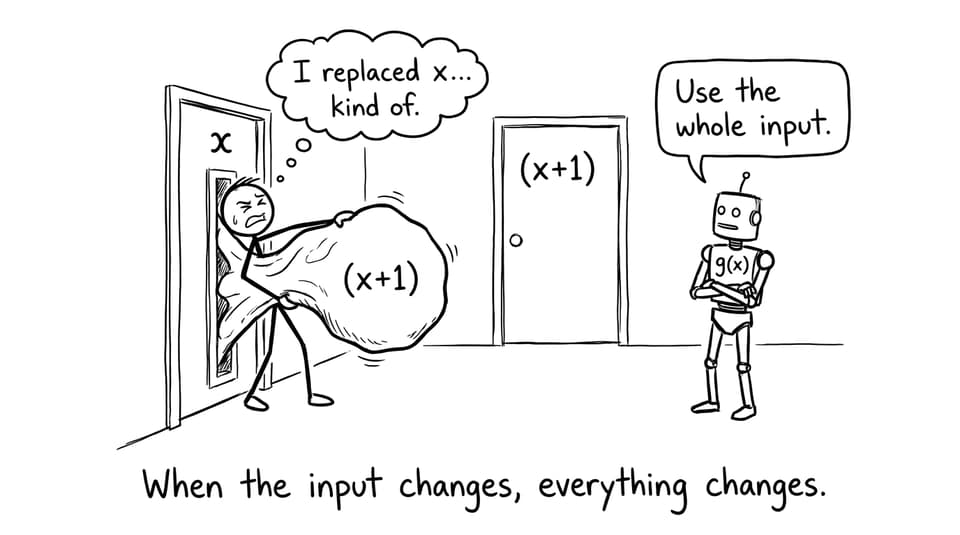
Substitute the entire input (even if it’s messy like x+1 or a+h).
-
Use brackets when substituting.
-
Simplify slowly and line-by-line.
This checklist sounds basic. In IB Math, basic is often what saves marks.
Why IB Math uses inputs like f(x+1) and f(2x)
IB exam writers aren’t trying to be cute. They’re testing whether you understand that a function can accept any valid input, not just a single number.
When the input changes from x to x+1, the whole rule must respond. This shows up constantly in:
-
transformations
-
composites
-
calculus definitions (difference quotient)
-
modelling
If transformations are where your notation confusion spikes, pair this article with: How to Master Functions and Transformations (Graphing Toolkit).
The most common f(x) mistakes (and how to stop making them)
Treating f(x) like a single object
Students often read f(x) as one glued-together symbol. That can be okay visually, but it becomes dangerous when you need to substitute.
A healthier habit in IB Math is to say it out loud (even silently):
- “output of f when the input is x.”
Substituting only part of an expression
If f(x) = x^2 + 3x and you want f(x+1), you must replace every x:
- f(x+1) = (x+1)^2 + 3(x+1)
The brackets are not optional. They’re the difference between a clean 4 marks and a slow-motion collapse.
Confusing f(x) with y
In many graphs, y = f(x), so they match. But IB Math uses f(x) to emphasize the relationship and the rule, not just the output label.
That distinction matters later when you juggle multiple functions (f, g, h), define inverses, or write composite functions.
For extra structured practice, go straight to the RevisionDojo hub: Functions (IB Math AA).
Where function notation quietly becomes important later
Function notation is the language underneath big topics. If it never “clicks,” those topics feel harder than they are:
-
inverse functions and domain restrictions
-
composite functions
-
transformations and graph features
-
differentiation (especially definitions)
-
integration and modelling
If calculus is where the notation pressure really shows, use: Calculus notes (IB Math AA) and drill with Calculus Questionbank (IB Math AA).
How to make f(x) feel normal before the exam
In IB Math, familiarity is earned by repetition with feedback.
A simple loop that works:
-
Read the rule in notes.
-
Do 10 targeted questions.
-
Mark your substitutions line-by-line.
-
Turn your two most common substitution slips into flashcards.
-
Repeat two days later.
RevisionDojo is built for exactly this loop. Use the Functions Questionbank (AA SL 2.2) for exam-style questions, the Study Notes for clean definitions, and Flashcards for the errors you personally repeat. If you get stuck mid-solution, AI Chat can nudge you with the next substitution step without turning the question into a spoiler.
For a broader strategy, these two are helpful:
Conclusion: make function notation boring (that’s the goal)
The real reason IB Math function notation feels confusing is that it looks like multiplication while behaving like a process. Once you internalize “input goes in, output comes out,” f(x) stops being mysterious and starts being a tool you can trust.
If you want that trust before exams, build the habit with RevisionDojo: learn the rule with Study Notes, drill it in the Questionbank, lock it in with Flashcards, sanity-check steps with AI Chat, and level up your timing with Mock Exams and Predicted Papers. Function notation won’t disappear from IB Math -- but the confusion can.