

If you’ve ever stared at your Paper 2 script thinking, “But my calculator says I’m right”, you’re not alone. In IB Math, marks can disappear even when the digits match perfectly. The surprise isn’t that the mathematics is wrong--it’s that the communication is.
This is the quiet rule of IB Math exams: your calculator can compute, but it can’t communicate for you. Examiners award marks for interpretation, appropriate notation, and context. If your final answer looks like a machine transcript, it can signal weak understanding, even when the value is correct.
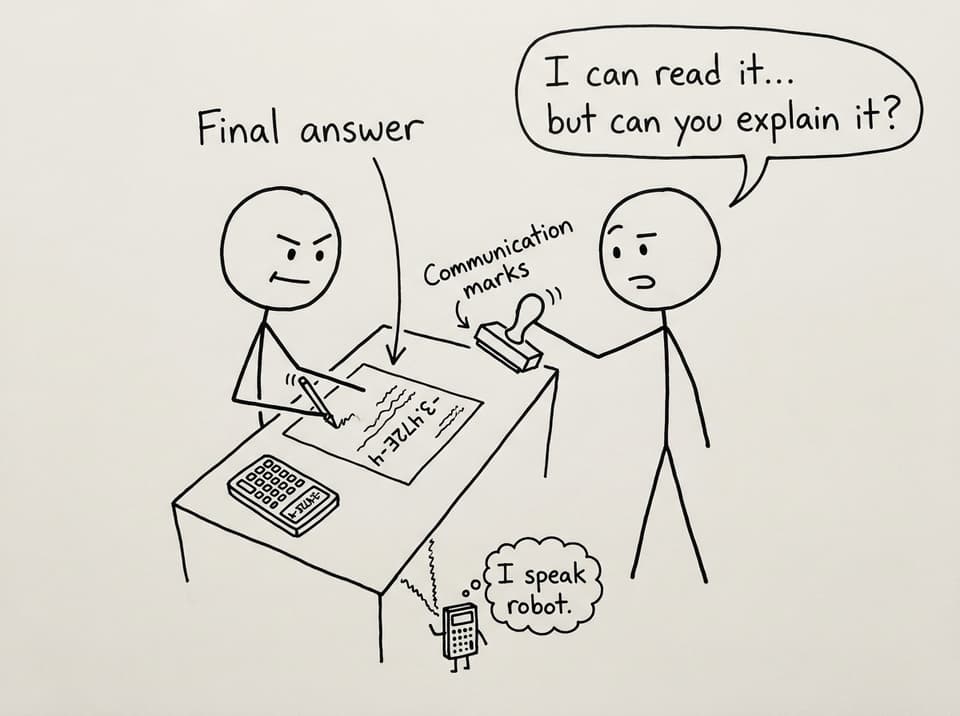
What “calculator notation” means in IB Math
Calculator notation is basically “raw screen output” used as a final answer, such as:
-
E-notation (e.g., (3.2\text{E}-4))
-
Unlabelled scientific notation
-
Long decimals copied digit-for-digit
-
Table values with no explanation of what they represent
These formats are built for speed, not clarity. In IB Math, you’re expected to translate calculator output into standard mathematical language a human reader can understand.
If you want to sharpen the broader skill behind this, the habits in How to Use Mathematical Language and Notation Correctly in the IB Math IA transfer directly into exam responses too.
Why IB Math examiners care (even when the number is right)
In IB Math (especially Applications and Interpretation), the assessment isn’t only “Can you compute?” It’s also:
-
Can you present results clearly?
-
Can you choose sensible rounding?
-
Can you include units and interpret meaning?
-
Can you match notation to the real-world context?
Copying calculator output as a final answer can look like transcription instead of understanding. That’s why students sometimes lose communication marks--or even accuracy marks if rounding and units are part of what defines the “correct” answer.
A quick checklist to avoid losing marks to calculator notation
Before you box a final answer in IB Math, ask:
-
Did I rewrite E-notation into standard or scientific form?
-
Did I round appropriately for the context?
-
Did I include units (if the question implies them)?
-
Did I state what the value represents (in a short phrase or sentence)?
-
Did I label anything that came from a calculator table or regression?
This is also exactly the kind of pattern you can drill using targeted practice in Functions - IB Questionbank or Number and Algebra - IB Questionbank, where you can focus on “final answer quality,” not just getting a numerical value.
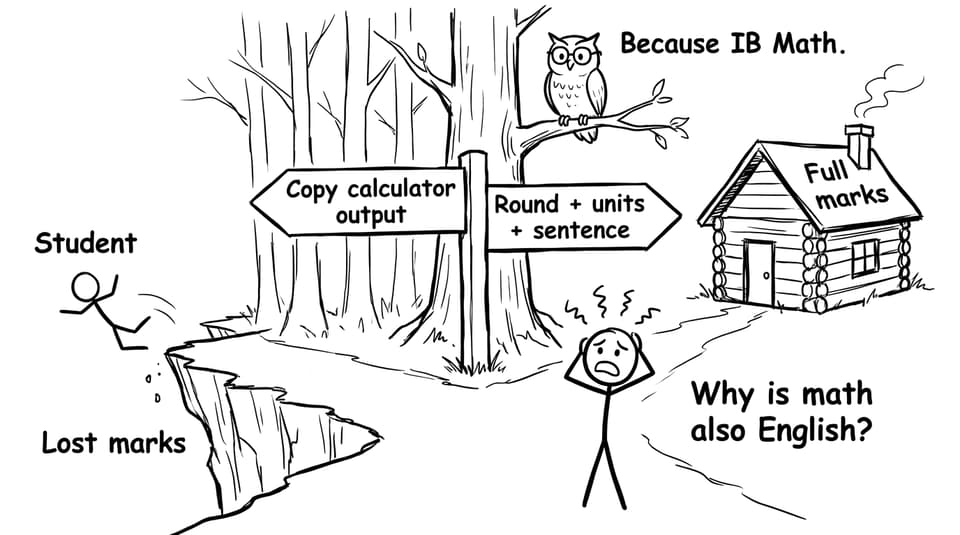
When calculator notation is actually acceptable in IB Math
Calculator notation isn’t “banned.” It’s usually fine when:
-
It appears in intermediate working
-
It’s clearly labelled (so the examiner knows what the number is)
-
You convert it into standard/scientific notation for the final answer
-
You follow it with interpretation (units, context, rounding)
Think of it this way: your calculator can show the messy backstage. Your script should show the clean performance.
This becomes even more important if you’re preparing specifically for calculator papers. See How to Prepare for IB Math Paper 2 (Calculator Allowed) and How to Use Graphing Calculators During IB Math Exams.
Why this hits AI harder than AA
In IB Math AI, many questions live in context: finance, statistics, modelling, regression. Those contexts demand interpretation. So the markscheme often rewards students who write answers like analysts:
-
“The model predicts…”
-
“The probability is…”
-
“The maximum occurs at…”
Raw calculator output doesn’t do that job.
If you’re consolidating AI content, anchor your revision in the core hub: IB Mathematics Applications & Interpretation Resources, and use the topic pages (notes, flashcards, lessons) to practice expressing results clearly.
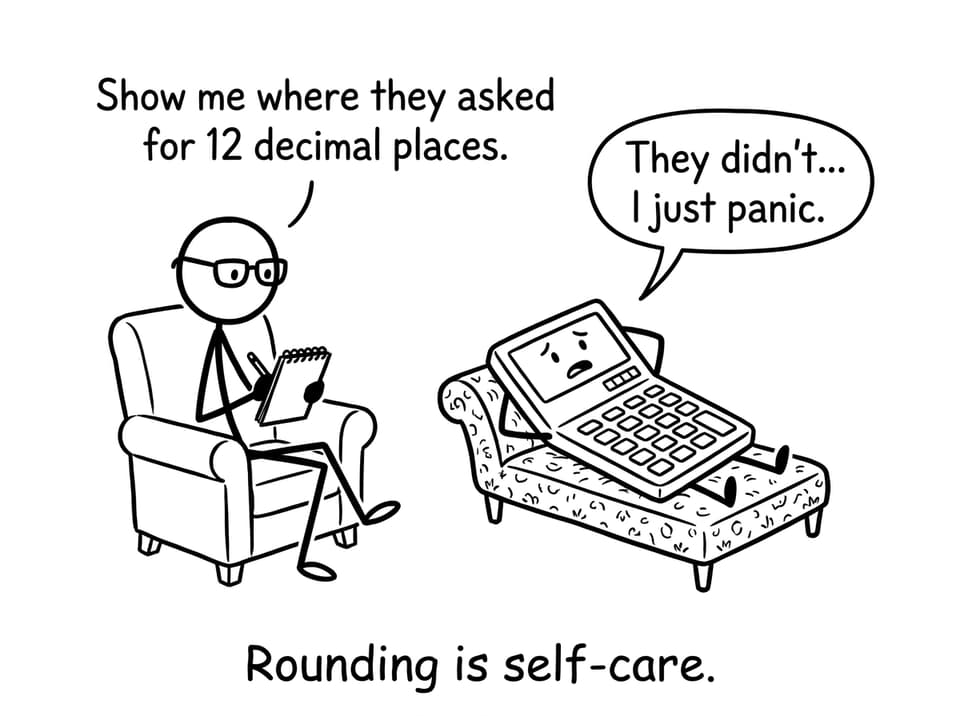
A calmer way to win back those marks
The hidden lesson is simple: IB Math rewards students who act like readers exist. Your calculator is a tool, not a narrator.
If you want a system for this, RevisionDojo is built for it: practice with the Questionbank, tighten explanations with Study Notes, review phrasing with Flashcards, check your logic in AI Chat, and simulate exam pressure with Mock Exams and Predicted Papers. When your final answers start sounding like mathematics (not a calculator screen), the marks usually follow.