

A clean IA can feel almost suspicious.
Not because the math is easy, but because the reader never has to wrestle with it. In the IB, that’s the quiet advantage: you’re not only being assessed on whether your mathematics is correct, but whether your mathematics is readable. When your reasoning is easy to follow, it looks more confident, more intentional, and (often) more accurate.
This guide shows how to communicate mathematical ideas clearly in your IB Math IA, so your examiner spends their energy awarding marks, not decoding your work.
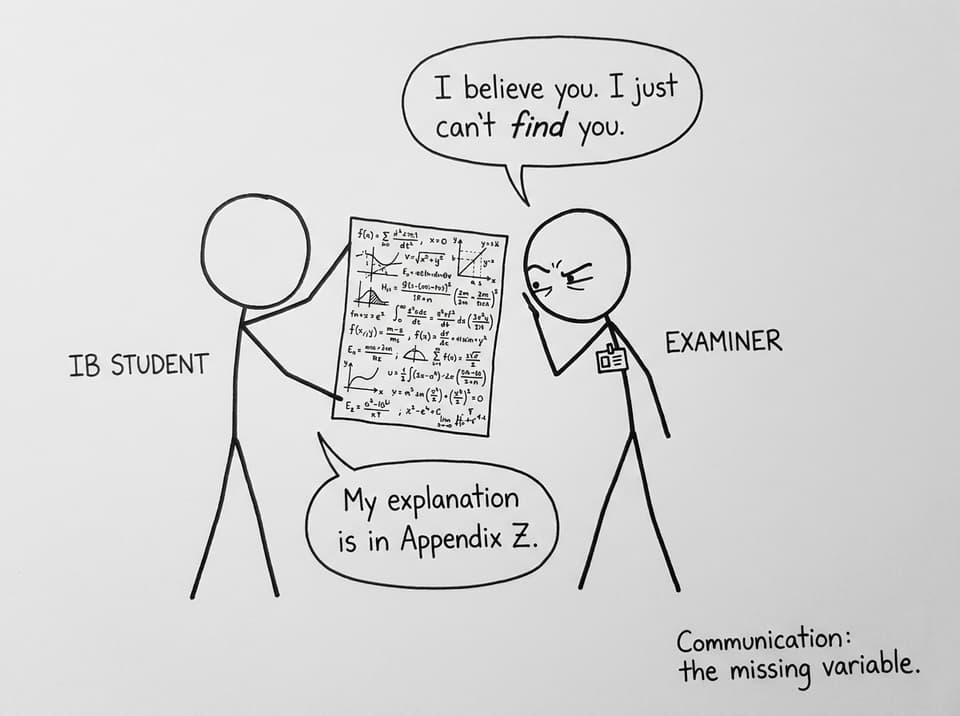
A fast clarity checklist for your IB Math IA
Before you rewrite anything, run this quick check. If you can’t confidently say “yes” to most of these, your IB communication marks are leaking.
-
Every symbol is defined the first time it appears.
-
Each paragraph explains one mathematical idea.
-
Equations are introduced and interpreted in words.
-
Graphs/tables have titles, labels, units, and a written takeaway.
-
The logic has signposts: therefore, because, this implies, however.
If you’re unsure what the examiner expects, start with the rubric breakdown in IB Maths AI IA Grader and the broader guide hub at IB IA Guides.
Write like you’re guiding a tired reader
An IB examiner might read dozens of IAs in a row. That detail matters. Communication isn’t about sounding formal; it’s about reducing reader fatigue.
A simple rule: your IA should read like a guided story, not a stack of calculations.
That’s why strong structure matters. If you haven’t mapped your sections yet, borrow a proven framework from How to Structure Your IB Math IA Logically. When the structure is stable, your communication becomes easier almost automatically.
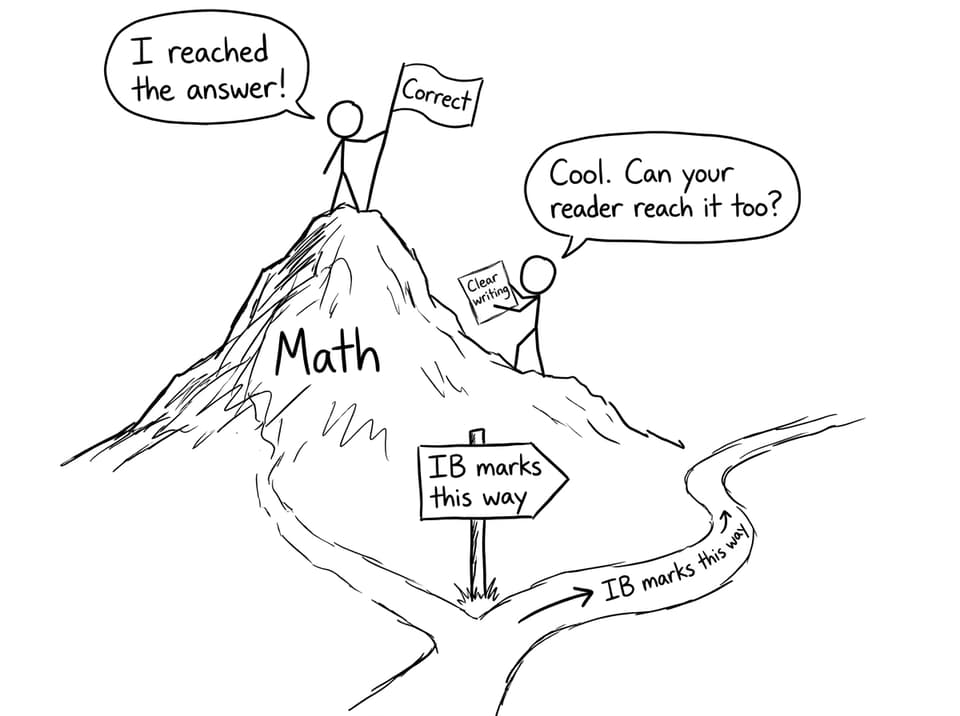
One paragraph, one idea (and one job)
In a high-scoring IB Math IA, paragraphs behave like small proofs:
-
Start with what you are trying to show.
-
Develop the method and calculation.
-
End with what the result means.
Example pattern you can imitate:
“To locate the maximum, I differentiated the area function (A(x) = x(10 - 2x)). Since (A'(x)=10-4x), setting (A'(x)=0) gives (x=2.5). This implies the area is maximized when the cut size is 2.5 units.”
Notice the result doesn’t just appear. It’s escorted.
Define notation early (and keep it consistent)
IB communication breaks when notation becomes a moving target.
Define variables the moment they arrive, not after a full page of algebra:
-
“Let (t) be time (seconds).”
-
“Let (P(t)) be population (thousands of people).”
-
“Let (r) be the growth rate (per year).”
Then protect those definitions. Don’t swap (x) and (t) halfway through. Don’t use (y) as both “output” and “height.” Consistency is a silent form of credibility in IB writing.
If you’re building fluency alongside IA writing, the subject hubs are useful for tightening terminology, especially IB Mathematics Analysis and Approaches Resources.
Embed equations inside sentences
A common IB Math IA problem is “floating equations” -- beautiful expressions with no narrative connection.
Instead, stitch them to meaning:
-
Weak:
(P'(t)=0.03P) -
Strong:
“The rate of change is modeled by (P'(t)=0.03P), which suggests growth proportional to the current population (a hallmark of exponential behavior).”
This is also where RevisionDojo’s AI Chat helps: you can paste a step and ask, “What is the mathematical meaning of this line in one sentence?” Then you rewrite it in your own voice.
Make visuals do work (not decoration)
Graphs and tables should reduce explanation time, not increase it.
For every figure, include:
-
a clear title (“Figure 2: Residual plot for logistic regression”)
-
labeled axes with units
-
a one-sentence takeaway (“The residuals fan out, suggesting non-constant variance.”)
If your IA involves modeling or data, pair your visuals with a short reflection on method choice. The walkthrough in How to Use RevisionDojo to Prepare for IB Math IA Data Analysis shows the expected level of commentary.
Use transitions to show logic, not vibes
Math is already abstract. Don’t make the reader guess why you did the next step.
Keep a small “transition bank” and reuse it:
-
“Therefore, I can simplify…”
-
“This implies the model is appropriate because…”
-
“However, this assumption limits…”
-
“To validate the result, I check…”
That last one is especially IB-friendly: it signals awareness and control.
Explain decisions, not just results
IB examiners reward thinking. Your IA should answer not only “what did I do?” but “why did I do it?”
Examples of decision sentences:
-
“I chose logarithmic regression because the rate of increase slows as (t) grows.”
-
“I used a derivative test because the research question depends on optimization.”
-
“I compared two models to evaluate sensitivity to assumptions.”
Want to calibrate what “good” looks like? Read one strong example in Using IA/EE Exemplars to Improve Your IB Math IA.
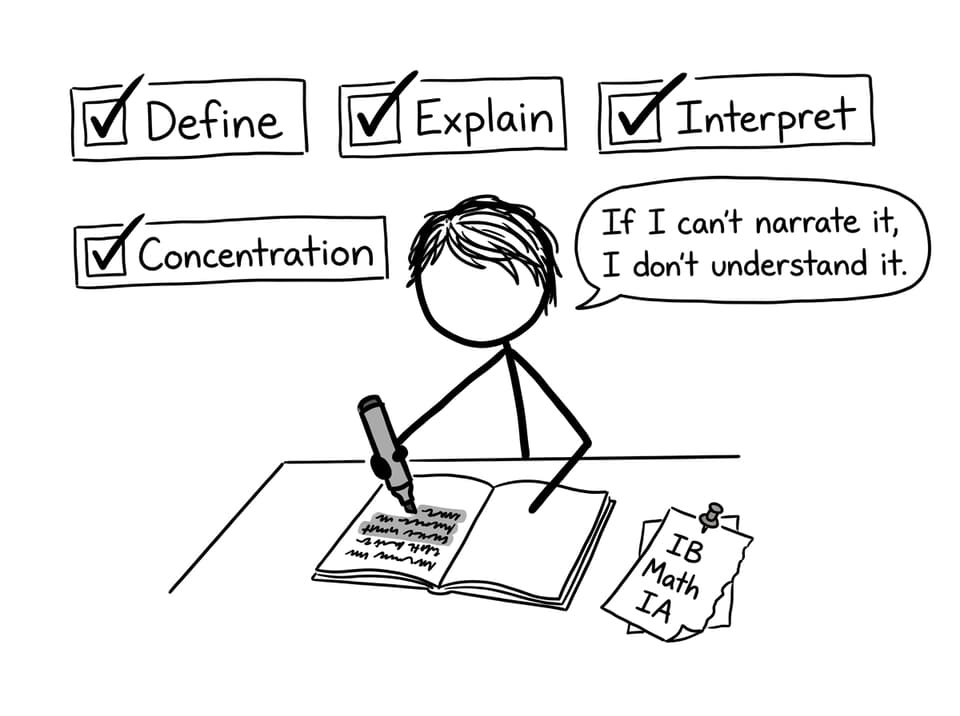
RevisionDojo tools that make IB communication easier
Clear writing is partly skill, partly system. RevisionDojo is built to be that system:
-
Study Notes and Flashcards help you phrase definitions and methods cleanly (see IB Flashcards with Spaced Repetition (SRS) and Flashcards for Internal Assessment (IA)).
-
Questionbank improves your precision: when you practice exam-style questions, you learn what “complete working” sounds like (try How to Use the Questionbank for Targeted Math Revision or the IB Math AA Calculus Questionbank).
-
Grading tools help you self-check rubric alignment before submission.
-
Coursework Library, Mock Exams, and Predicted Papers support exam preparation without blurring coursework boundaries.
-
Tutors can give targeted feedback when you’re too close to your own writing to see the gaps.
Closing: make the examiner’s job easy
In the IB, clear communication is not decoration. It’s part of the mathematics.
When your IB Math IA defines notation early, narrates equations, and uses visuals with purpose, your reasoning becomes easier to trust. And trust is what turns correct work into high marks.
If you want a faster path to that clarity, use RevisionDojo: practice precision in the Questionbank, tighten language with Study Notes and Flashcards, sanity-check against Exemplars, and confirm rubric alignment with the Grading tools. Your math deserves to be understood. In IB, that’s the whole point.