
When IB math gets difficult, it rarely announces itself politely.
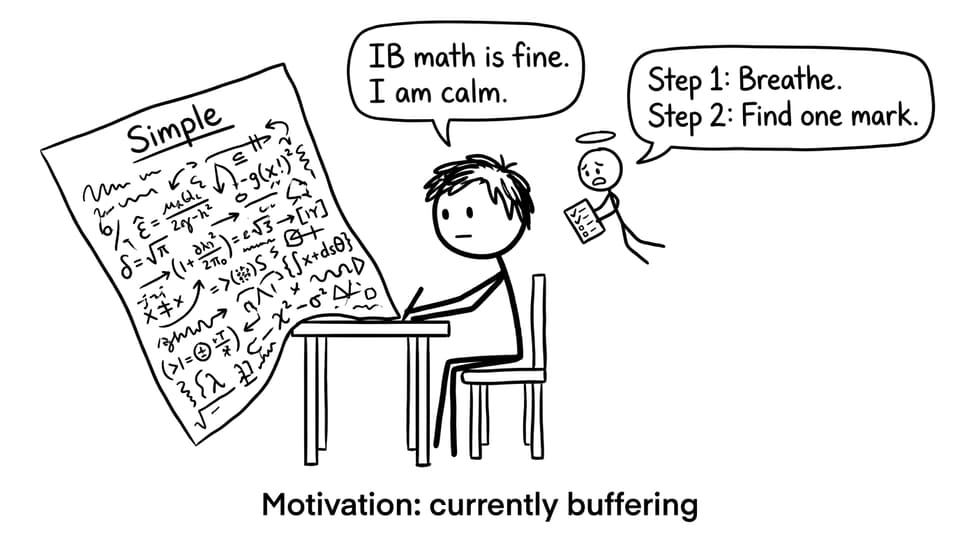
It shows up on a Tuesday night when you planned to “just review derivatives,” and suddenly you are staring at a question that makes you doubt whether you ever understood functions in the first place. Your pencil hovers. Your brain negotiates. You open a new tab, then another.
In the IB, this moment matters more than the easy ones. Not because it proves intelligence, but because it reveals the real skill: staying motivated when progress feels slow. Motivation is not a permanent personality trait. It is an environment you build, a few small choices at a time.
This guide gives you that environment: practical ways to stay motivated when math gets difficult, plus a simple loop you can run inside RevisionDojo using Questionbank, Study Notes, Flashcards, AI Chat, Grading tools, Predicted Papers, Mock Exams, Coursework Library, and Tutors.
Quick motivation checklist for IB Math
Use this when you feel stuck in IB Math and need momentum within 10 minutes.
-
Re-state your “why” in one sentence (write it down).
-
Pick one micro-goal you can finish today (10-25 minutes).
-
Learn one missing piece (Study Notes or a short Lesson).
-
Do a short Questionbank set on that exact piece.
-
Review mistakes immediately and turn the top two into Flashcards.
-
End by choosing tomorrow’s first action (so you don’t rely on willpower).
If you can run that loop, you can stay motivated in the IB even when the topic is brutal.
Why IB motivation disappears when math gets hard
A quiet truth: most “lack of motivation” in IB math is actually uncertainty.
When you do not know what to do next, starting feels expensive. Your brain protects you by avoiding the task. That avoidance creates guilt. The guilt makes the next session feel heavier. Soon you are not fighting calculus or probability, you are fighting the emotional weight of unfinished work.
The cure is specificity: choose a small action that produces feedback. The fastest feedback usually comes from questions, not rereading.
If you want a structured way to build this across subjects, keep the broader IB routine nearby: How to Study for IB Exams: Step-by-Step Guide.
Build a system (because feelings are unreliable)
The most consistent IB students do not have endless motivation. They have a repeatable system that works even on low-energy days.
A good system has three traits:
-
It is small enough to start.
-
It produces measurable feedback.
-
It ends with a clear next step.
RevisionDojo is built around that logic. Start with the platform hub if you want everything in one place: RevisionDojo IB resources.
Then choose your math track:
-
(If you are in AI, you can still use the same motivation loop with AI notes and practice.)
Use micro-goals to rebuild confidence in IB Math
Big goals are inspiring, but they are terrible at getting you to open your notebook.
Instead of “I need a 7,” use micro-goals that you can finish today:
-
“I will get 5 out of 10 on chain rule questions.”
-
“I will fix my method on one optimisation question.”
-
“I will reduce careless algebra mistakes by writing one extra line each time.”
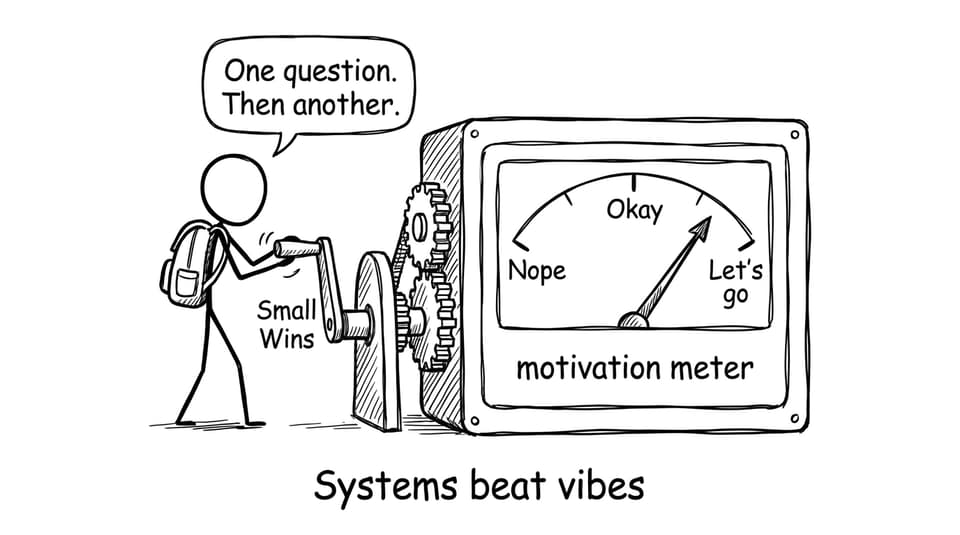
In IB math, confidence returns when your brain sees proof of progress. Micro-goals manufacture that proof.
To make micro-goals practical, use the targeted practice workflow: How to Use the Questionbank for Targeted Math Revision.
Break difficult topics into “one missing sentence”
When math feels hard, it is often because one small sentence is missing.
For example:
-
You “know” differentiation rules, but you cannot decide which rule applies first.
-
You “understand” probability, but you do not know how to translate words into events.
-
You can integrate, but you freeze when you need a substitution choice.
A good IB study session is not “cover calculus.” It is “find the missing sentence.”
A simple method:
-
Identify the exact step where your solution breaks.
-
Learn only that step (use Notes or a short Lesson).
-
Immediately practise 5-15 questions that feature the same step.
RevisionDojo makes this clean: start with Study Notes, then jump into topic practice.
If you are in Math AI and need clearer explanations for applications and modelling, this is particularly useful: How to Use RevisionDojo Notes to Simplify IB Math AI Concepts.
Track effort and feedback (not just grades)
In the IB, grades often improve after habits improve. If you only measure grades, motivation dies in the waiting period.
Instead, track inputs and feedback:
-
Questions attempted (and the topic)
-
Accuracy per topic
-
One recurring mistake pattern
-
One fix you will test again
This turns revision into a science experiment. And science experiments are strangely motivating because they have data.
If you want a deeper understanding-first approach that reduces frustration before you drill questions, use: How to Use RevisionDojo Lessons for Deep Understanding.
Make your environment do the hard work
Motivation is easier when starting is easier.
Try these small environmental changes that work well for IB students:
-
Create a “start ritual” that takes under 60 seconds: open laptop, open Questionbank, set timer.
-
Change location for difficult topics (your brain stops associating the desk with dread).
-
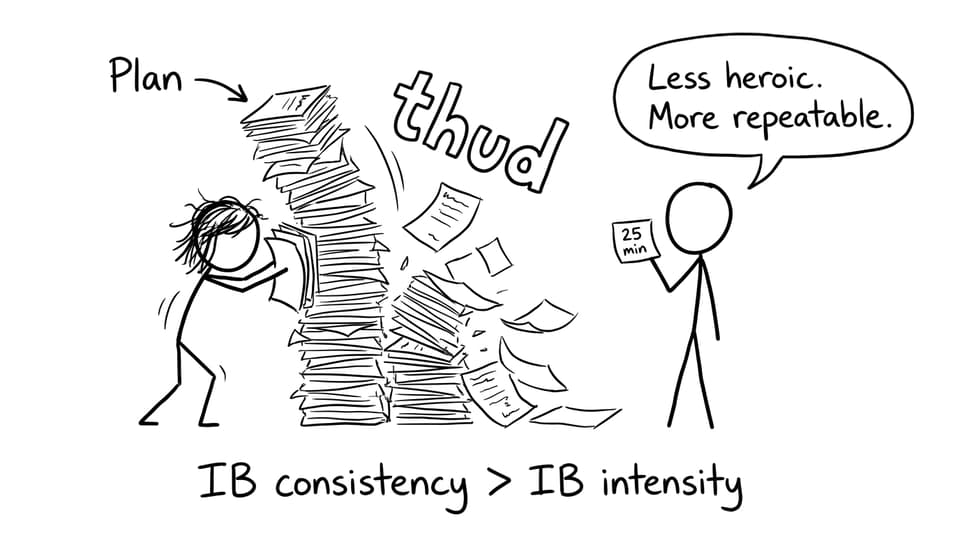
Use time-boxing: 25 minutes on, 5 minutes off.
If you are already tired, do not demand a heroic session. Demand a repeatable one.
Turn RevisionDojo into a motivation engine for IB Math
Here is a simple loop you can run for any IB Math unit, especially when motivation is low.
Learn
Use RevisionDojo Study Notes to re-anchor the concept. If you need a second explanation, ask RevisionDojo AI Chat the exact thing you cannot phrase to a teacher at 11:47 pm.
Drill
Open Questionbank and filter by topic and difficulty. Do a short set. The goal is feedback, not perfection.
Review
Use the Grading tools and markscheme-aligned explanations to find the type of mistake: concept gap, method gap, or careless slip.
Retest
Do another short set on the same mistake pattern within 48 hours. This is how motivation returns: your brain notices it is improving.
Simulate
When you are ready, use Mock Exams and Predicted Papers to practise timing and decision-making under pressure. (This is where many IB students discover that their real problem was pacing, not knowledge.)
For structured mock practice, use: How to Use RevisionDojo to Prepare for IB Math Mock Exams and How to Use RevisionDojo's Mock Exam Builder to Simulate IB Conditions.
If your motivation drops because you feel overwhelmed across subjects, read: How to Study for IB Exams Without Burning Out.
Common motivation traps IB students fall into
A few patterns silently kill IB math motivation:
-
All-or-nothing sessions: “If I can’t do two hours, I won’t start.”
-
Rereading as procrastination: it feels safe, but it does not create feedback.
-
Confusing confusion with inability: confusion is often just an untrained step.
-
Studying without a loop: if you do not review mistakes, practice becomes random.
Avoid these, and math gets lighter even when it stays difficult.
Closing: motivation is built in loops
In the IB, the students who finish strong are rarely the ones who “felt motivated” every day. They are the ones who kept returning to a simple loop: learn a small piece, practise it, review feedback, and retest.
When math gets difficult, do not ask yourself for inspiration. Ask yourself for one honest, measurable step.
If you want that step to be easier, make RevisionDojo your default: Study Notes to rebuild clarity, Flashcards to keep recall automatic, Questionbank to create feedback fast, AI Chat to unblock confusion, Grading tools to correct method, and Mock Exams plus Predicted Papers to make exam pressure familiar. That is how you stay motivated in IB math, not by forcing confidence, but by earning it.


