




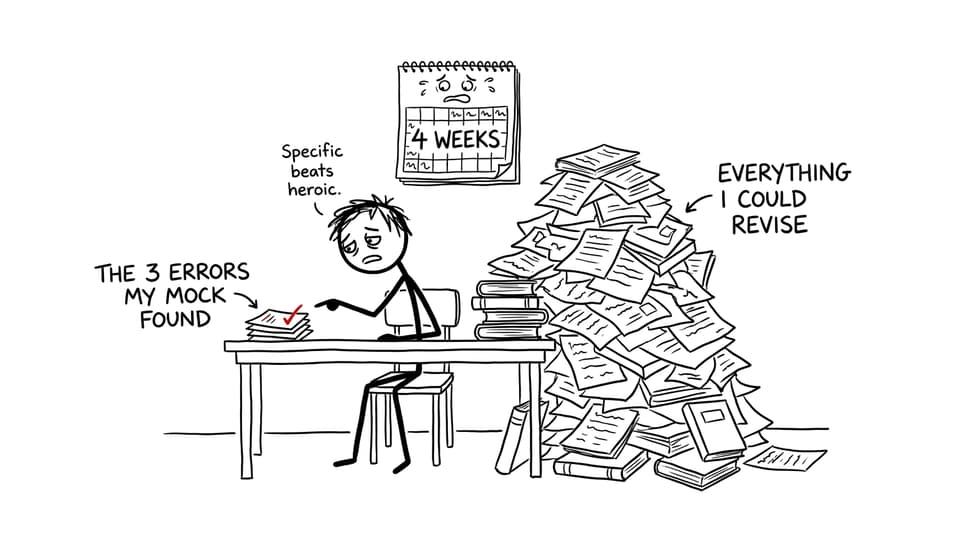
A mock result can feel like a verdict when the November session is close. It is not. It is a map of where marks are currently leaking, provided you look beyond the grade and study each lost mark.
To use mock exam results to guide your last month, classify your mistakes, rank them by potential mark gain, repair only the highest-value weaknesses, and retest them under timed conditions. Your final weeks should be shaped by evidence from your performance, not by the comforting urge to reread everything.
For the November 2026 session, the official examination window runs from 23 October to 13 November. Confirm your personal papers, exam zone, and reporting times with your coordinator, then use the November 2026 exam schedule and study plan to place revision around the sequence you will actually face.
Your post-mock checklist
Before building a timetable, complete this short audit:
- Collect raw marks by paper, section, and question.
- Record where you ran short of time.
- Copy useful teacher or marker comments.
- Classify every meaningful mark loss.
- Identify the three biggest repairable weaknesses in each subject.
- Schedule targeted practice before another full simulation.
- Retest each priority without notes.
- Rehearse difficult combinations from your real November timetable.
The principle is simple: your mock gives you evidence, but improvement comes from what you do with it.
Read the result beneath the grade
A final mock grade compresses many different events into one number. You may have misunderstood one large question, spent too long on an essay, forgotten several definitions, or performed well until fatigue affected the final section. Those problems require different responses.
Review the script question by question. For each lost mark, record the topic, mark value, error type, and corrective action. The following categories work across most IB subjects:
| Error type | What probably happened | Best next action |
|---|---|---|
| Knowledge | A fact, formula, quotation, or process was unavailable | Review the exact concept and retrieve it with Flashcards |
| Understanding | You remembered information but could not explain it | Use Study Notes, then explain the idea without support |
| Application | You knew the topic but could not use it in a new context | Complete targeted Questionbank problems |
| Interpretation | You misread data, stimulus material, or the prompt | Annotate fresh questions and identify the task before answering |
| Communication | Your working, structure, evidence, or evaluation was unclear | Rewrite one response and seek mark-scheme-aligned feedback |
| Timing | You knew enough but rushed or left work unfinished | Practise shorter timed sections with checkpoints |
RevisionDojo’s guide to analysing IB mock exam results explains why the headline score matters less than the patterns underneath it.
Rank weaknesses by marks, not emotion
Students often revise the topic that feels most frightening. A better approach is to prioritize the weakness that is both common and repairable.
Give each issue three simple ratings from 1 to 3:
- Frequency: How often does it recur?
- Mark impact: How many marks does it cost?
- Repairability: Can you improve it meaningfully this month?
Then calculate:
A recurring command-term mistake might deserve attention before an obscure content gap. Likewise, improving essay conclusions across several questions may offer more value than relearning an entire chapter that rarely caused trouble.
Choose no more than three priorities per subject. A list of twenty weaknesses is not a plan. It is an inventory.
Match each weakness to the right revision tool
The error category should determine the activity. This prevents a familiar mistake: responding to every disappointing result by reading more notes.
For a knowledge or understanding gap, use concise IB Study Notes and subject resources, then close the page and retrieve the explanation from memory. Convert fragile formulas, vocabulary, case studies, quotations, or processes into Flashcards.
For application errors, move quickly into the RevisionDojo Questionbank. Filter by the relevant subject, level, paper, and topic. Begin without time pressure until the method is secure, then repeat the skill under a realistic limit.
For unclear written responses, use RevisionDojo’s AI Chat and Grading tools to identify missing reasoning, weak evidence, or command-term mismatches. Ask specific questions such as, “Which part of this response does not answer the command term?” Human feedback still matters. If the same misconception survives several attempts, a RevisionDojo Tutor can help diagnose it directly.
The Coursework Library and coursework grading tools are useful if unfinished internal work is still consuming the fall term. The goal is to contain that workload so it does not quietly take over examination revision.
Build a four-week revision cycle
The last month should move from diagnosis toward realistic performance. It should not become four identical weeks of maximum effort.
Week one: diagnose and repair
Finish your error log and select the highest-priority weaknesses. Spend most sessions on focused rebuilding through Study Notes, Flashcards, and short question sets. After each repair session, answer something without assistance. Recognition is not yet reliable recall.
Week two: prove the fixes
Retest the same skills using fresh questions. Add timed sections for command terms, calculation speed, essay planning, or data interpretation. The RevisionDojo mock exam workflow lets you create focused tests and review performance by question rather than relying only on a total.
If the same error returns, do not simply add more practice. Reconsider the diagnosis. What looked like carelessness may actually be weak method knowledge or a pacing rule that collapses under pressure.
Week three: rehearse complete papers and combinations
Move toward full IB Predicted Papers and Mock Exams under strict conditions. Use only permitted materials, follow the correct duration, and stop when time expires.
Also practise the sequence of your personal timetable. If you have demanding papers close together, train that combination once rather than treating every subject as an isolated event. The guide to the hardest November 2026 exam days can help you identify likely pressure points, but your coordinator-issued timetable remains the version that applies to you.
Week four: consolidate and protect performance
Reduce novelty. Review error rules, formulas, vocabulary, essay frameworks, and a small number of representative questions. Keep some timed work, but avoid filling every day with complete exams.
Sleep, meals, equipment, travel, and start times now become part of preparation. A plan that improves knowledge while exhausting the student is poorly designed.
Measure whether revision is working
A completed session is not proof of improvement. A fresh response is.
Retest a repaired skill after several days without looking at the correction. Track accuracy, time used, and error type. Improvement means the skill survives delay and pressure, not merely that the answer looked familiar during review.
Use a weekly dashboard with four questions:
- Which recurring error disappeared?
- Which error survived targeted practice?
- Where did timing improve or deteriorate?
- What are next week’s three highest-value priorities?
RevisionDojo keeps this loop in one place: Study Notes for clarification, Flashcards for recall, the Questionbank for application, AI Chat and Grading tools for feedback, and Mock Exams or Predicted Papers for proof. For broader setup guidance, see the RevisionDojo IB exam preparation workflow.
Let the mock make the month smaller
The emotional instinct after a weak mock is to make revision bigger. More hours. More chapters. More resources. The useful response is usually the opposite: make the problem smaller and more exact.
Find the marks you repeatedly lose. Write a rule that addresses each pattern. Practise the relevant skill, check the response, and return to it under time. Then rehearse the order and conditions of your November papers.
A mock result cannot predict your final performance with certainty. It can, however, remove much of the guesswork from the month ahead. RevisionDojo is the ultimate IB resource for turning that evidence into a calm, connected cycle of learning, practice, feedback, and realistic rehearsal.