
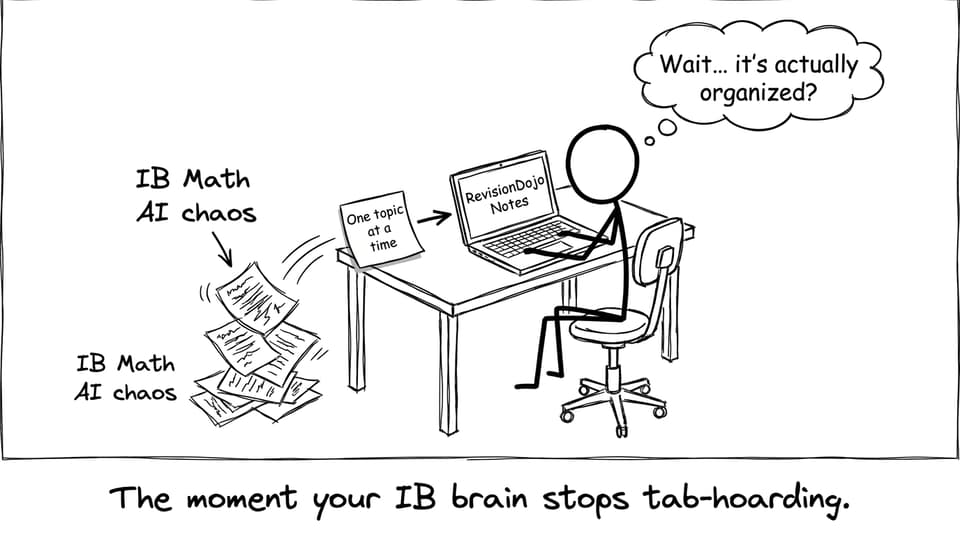
If you’ve ever sat down to revise IB Math AI and felt like you were opening ten tabs in your brain at once, you’re not alone. Math AI is supposed to be “the applied one,” the course that feels closer to real life. But that’s exactly why it can be exhausting: there’s context, data, technology, interpretation, and wording that matters almost as much as the calculation.
The students who do well in IB Math AI aren’t always the ones who “get math instantly.” Often, they’re the ones who make complexity feel smaller. They turn the syllabus into a path. And that’s where RevisionDojo Notes quietly change everything: they help you simplify the story of each topic, so your revision stops feeling like a flood and starts feeling like a sequence.
In this guide, you’ll learn how to use RevisionDojo Notes to simplify IB Math AI concepts, connect them to practice, and build the kind of calm confidence that shows up on exam day.
A quick overview checklist (the 20-minute setup)
Before you revise a single concept, set yourself up to win:
-
Open the main hub for IB Mathematics Applications & Interpretation resources and pick your level (SL/HL).
-
Identify 2 weak areas (for many IB students: functions modeling and statistics interpretation).
-
Choose one note chapter to study first (not three).
-
Plan your loop: Notes first, then Questionbank, then a short Flashcards review.
-
Keep your calculator and tech ready (Math AI is a technology-informed course, not a handwriting contest).
That’s it. Simple on purpose. In IB, a boring system beats an emotional one.
Why RevisionDojo Notes work for IB Math AI
Most resources fail IB students in one of two ways.
They’re either too big (textbook-level detail that hides the examinable point), or too thin (a formula list that tells you nothing about interpretation). RevisionDojo Notes sit in the middle: compact, exam-aligned explanations with worked examples and the kind of structure your brain can actually keep.
When you use RevisionDojo Notes for IB Math AI concepts, you’re not just reading. You’re building a framework:
-
What the concept means in real contexts
-
What the IB expects you to do with it
-
What common mistakes look like
-
How exam-style questions typically frame it
That’s the difference between “I revised” and “I can perform under pressure.”
Use RevisionDojo Notes to simplify IB functions and modeling
Functions is where many IB Math AI students quietly lose marks, not because they can’t plot a curve, but because modeling questions ask for judgment.
Start with a targeted Notes section like Math AI Functions Notes. Your goal isn’t to read everything. It’s to simplify the decision-making.
A simple method: definition, decision, display
As you read Notes, force each subtopic into three lines:
-
Definition: What is this model (linear, exponential, logistic, sinusoidal)?
-
Decision rule: When should I choose it from a scatterplot or context?
-
Display rule: What must I show in working and interpretation for IB marks?
This is how RevisionDojo Notes help: they reduce a topic to choices you can repeat.
Then practice the exact same choice
Right after Notes, move to questions that match your weak point. For example, if you’re shaky on algebra foundations that break modeling later, drill with Number and Algebra Questionbank. If you’re ready for modeling-specific tasks, use a focused subtopic page like SL 2.5 Modelling functions.
In IB, the fastest improvement comes from short cycles: read one concept, answer a few questions, correct the same day.
Use RevisionDojo Notes to simplify IB statistics and probability
Statistics and probability can feel like a foreign language in IB Math AI because the questions often reward interpretation more than computation.
Start in a topic hub like Statistics and Probability (Math AI), then anchor your understanding with definitions. The most underrated revision move is learning the wording the examiners expect you to use.
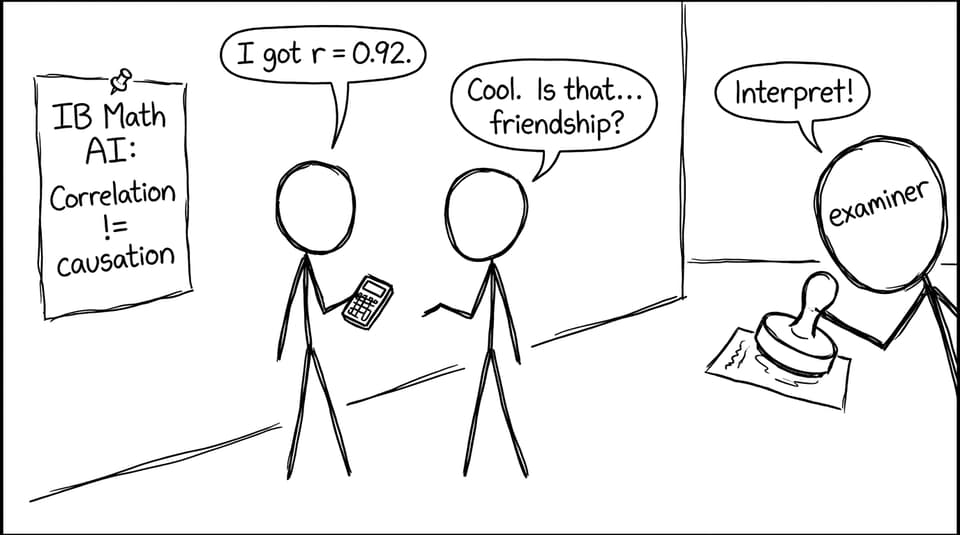
RevisionDojo makes this easier with a dedicated Math AI Key Definitions glossary. When you can confidently explain terms like “residual,” “correlation coefficient,” and “significance level,” your written responses become sharper, and your confidence rises.
Build an “interpretation bank” from Notes
While using RevisionDojo Notes, copy 5 sentence stems into your own sheet. For example:
-
“This suggests a (strong/moderate/weak) (positive/negative) correlation because…”
-
“A limitation of this model is…”
-
“The parameter ___ represents ___ in context…”
Those stems are worth marks in IB Math AI because they turn math into communication.
Pair Notes with a real example note page
To see what examiner-style explanation looks like, study a detailed note such as Expected, observed, hypotheses, chi-squared, gof, t-test (SL 4.11) Notes. Even if you’re not on that subtopic today, it teaches you the tone: precise, contextual, and evidence-based.
Make Notes stick with Flashcards (without making more work)
A quiet truth about IB revision is that forgetting is not a character flaw. It’s a design feature of your brain. The solution is retrieval practice.
Use RevisionDojo Notes as the source of what matters, then let Flashcards handle the repetition.
A practical approach:
-
After each Notes session, turn 3 lines into Flashcards: one definition, one common mistake, one interpretation sentence.
-
Review a small deck daily.
-
Keep cards short enough that you can answer them in under 15 seconds.
If you want a full system for this, follow How to Use Flashcards to Learn IB Math Definitions. It’s built for the reality of IB life: deadlines, CAS, and a brain that gets tired.
Add AI Chat and Grading tools when you’re stuck, not when you’re bored
RevisionDojo Notes simplify the first layer of learning. But sometimes you still hit a wall: a step that doesn’t make sense, a graph you can’t interpret, a regression output that feels like it’s speaking in code.
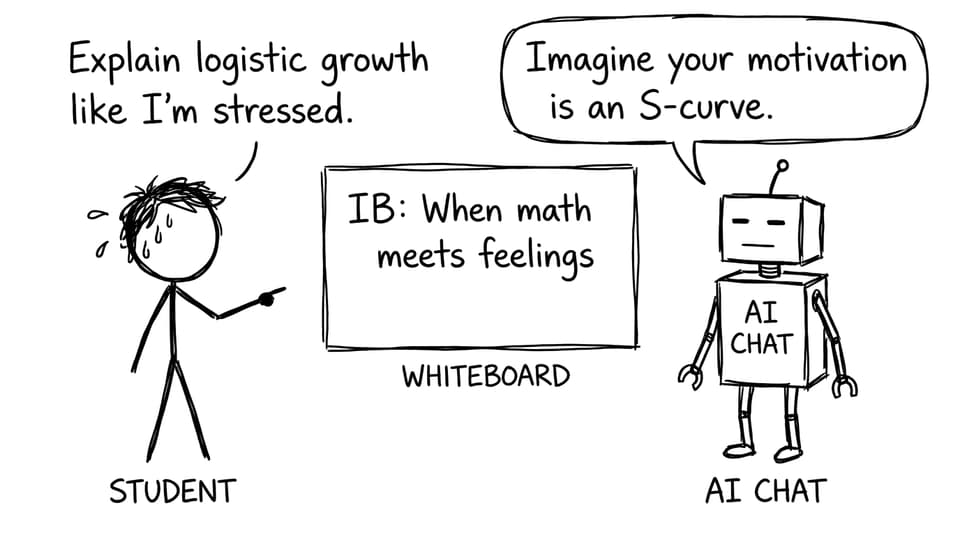
That’s the right moment to use AI Chat. Not to replace learning, but to compress confusion into clarity. Ask one precise question: “Why does changing the base in an exponential model affect long-term growth?” or “How do I justify my choice of model in IB language?”
Then use Grading tools to check whether your explanation would earn marks, especially in interpretation-heavy questions.
This is also where RevisionDojo’s Tutors can be a multiplier. Notes give you structure; a tutor helps you correct patterns quickly.
Use Notes to support your IB Math AI IA (without overcomplicating it)
Your Math AI Internal Assessment isn’t a separate universe. It’s built from the same concepts you revise.
RevisionDojo Notes help in two ways:
-
They give you clean explanations you can mirror in your own writing (clear notation, logical steps, correct language).
-
They help you choose and justify models in context, which is what a good IA needs.
If you want a criteria-focused roadmap, use the IB Math AI IA Guide alongside your Notes. And if you want deeper strategy for scoring high, this guidebook for scoring 7 in the Mathematics: Applications and Interpretation IA adds structure without adding noise.
A 7-day RevisionDojo Notes plan for IB Math AI
Here’s a realistic plan you can repeat.
Day 1-3: Learn and simplify
-
25 minutes: one Notes chapter
-
20 minutes: matching Questionbank set
-
5 minutes: Flashcards
Day 4-6: Strengthen and time
-
15 minutes: Notes skim + your 3-line summaries
-
30 minutes: timed questions
-
10 minutes: correct and write one “error rule”
Day 7: Simulate
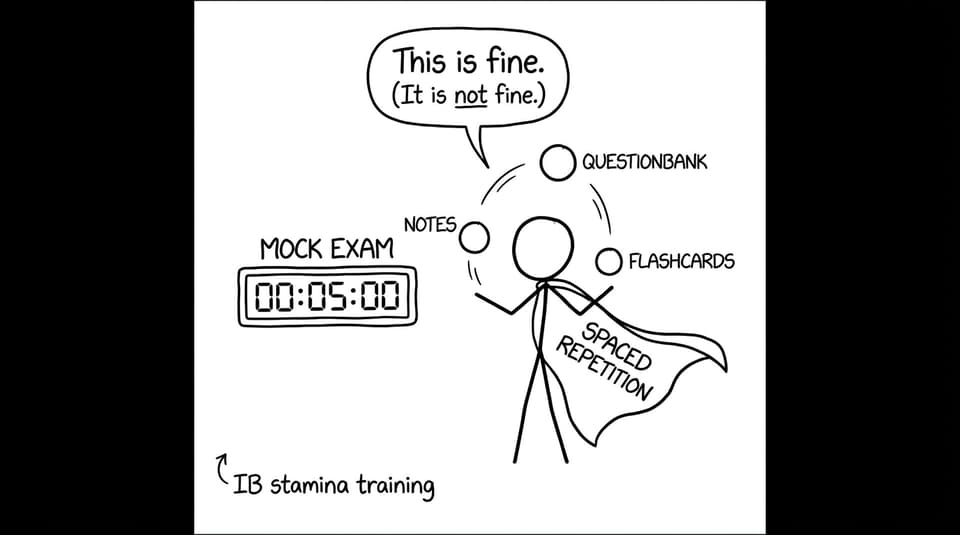
Do a longer timed session with Mock Exams or Predicted Papers to train pacing and stress control. If you’ve never trained timing properly, read How Mock Exams Can Improve Your IB Scores by 2 Grade Points. IB performance improves when your nerves have seen the format before.
Conclusion: Make IB Math AI smaller, one Notes page at a time
The hardest part of IB Math AI isn’t the math itself. It’s the feeling that every topic connects to ten others, and you’re supposed to hold it all at once.
You don’t.
Use RevisionDojo Notes to simplify IB Math AI concepts into small decisions you can repeat. Pair each note with Questionbank practice, lock in the language with Flashcards and Key Definitions, and train your timing with Mock Exams and Predicted Papers. If you need a quick explanation or feedback, lean on AI Chat, Grading tools, and Tutors.
Open one Notes chapter today, and run one complete loop. In the IB, progress is usually quiet at first. Then it becomes obvious.