
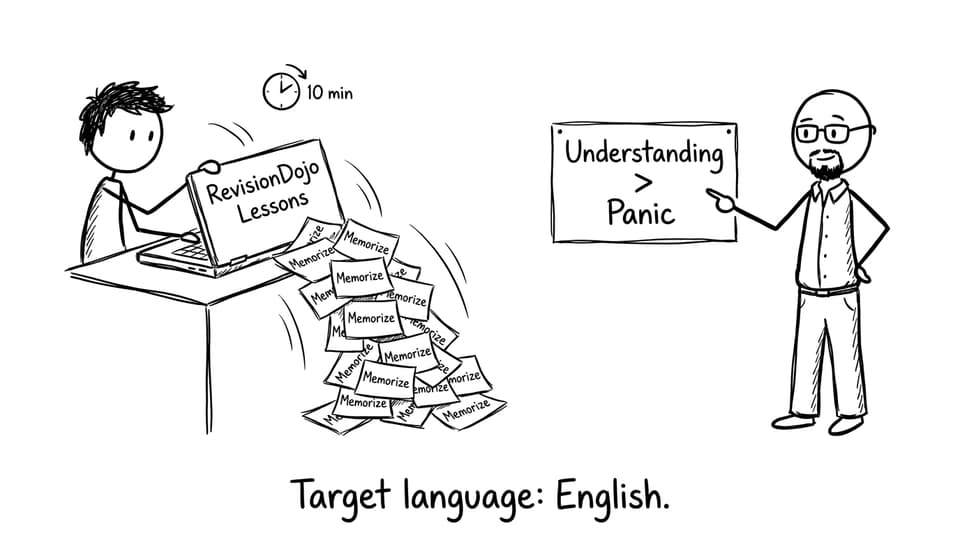
You can usually tell when studying has quietly turned into superstition.
You rewrite notes you will never reread. You highlight paragraphs like you are painting a fence. You memorize a method, feel briefly safe, then panic when an IB question changes one detail and your brain goes blank.
That moment is not a character flaw. It is a signal.
In the IB, marks often come from reasoning and transfer, showing you understand a concept well enough to use it in a new situation. That is exactly what RevisionDojo Lessons are designed to train: not more exposure, but more understanding per minute.
This guide shows how to use RevisionDojo Lessons for deep understanding, then lock it in with the rest of the RevisionDojo loop: Study Notes, Questionbank, Flashcards, AI Chat, Grading tools, Predicted Papers, Mock Exams, Coursework Library, and Tutors.
The 10-minute IB understanding checklist
When you sit down to study, run this quick workflow. It is simple enough to repeat, and repetition is what makes it powerful for IB revision.
-
Choose one micro-topic you can name in a sentence.
-
Do one RevisionDojo Lesson on that micro-topic.
-
Answer the built-in checks (no skipping).
-
Patch your explanation using linked Study Notes.
-
Do 8-15 targeted questions in the Questionbank.
-
Convert your biggest mistake into 3-5 Flashcards.
-
Ask Jojo AI Chat one precise “why” question.
If you want the bigger ecosystem view, see the platform overview on the RevisionDojo homepage.
Why IB understanding beats memorization (even when you feel rushed)
Memorization feels fast because it reduces uncertainty. In the short term, it is comforting: you can repeat a procedure and get the “right” answer in familiar practice.
But the IB rarely rewards familiarity alone. Questions are designed to test whether you can recognize the underlying idea when the surface changes: different numbers, a new context, a multi-step prompt, a command term that quietly shifts what “good” looks like.
Deep understanding is what survives those changes. It is the difference between “I remember the steps” and “I see why these steps work, so I can rebuild them under pressure.”
That is why RevisionDojo Lessons being short matters. They do not ask you to spend hours passively consuming content. They ask you to make a concept click, then prove it immediately.
Use RevisionDojo Lessons like a microscope, not a movie
Many students treat lessons like a Netflix episode: start, watch, finish, move on. For IB prep, that is too passive.
Instead, treat each RevisionDojo Lesson as a microscope that zooms in on one concept until you can explain it cleanly.
Pick the smallest unit that still feels real
Aim for a unit that answers: “What would I get wrong on a test?” not “What chapter am I on?”
Small targets reduce the most expensive problem in IB revision: vague effort. When a target is vague, you cannot tell if you are improving.
If you study a bite-sized lesson and then practice right away, you get feedback while the concept is still warm.
Make the lesson active: pause, predict, and paraphrase
Deep understanding is built in moments where you predict what happens next.
During your IB RevisionDojo Lesson:
-
Pause before a key step and predict the next line.
-
If there is a graph, diagram, or model, describe it out loud in plain language.
-
Write a one-sentence paraphrase: “This works because…”
That last part is the whole game. When you can finish “because” without copying a phrase you memorized, you are moving toward exam-ready understanding.
Link Lessons to Study Notes for clean, exam-shaped explanations
Lessons are where concepts become intuitive. Notes are where concepts become precise.
After a lesson, open the linked Study Notes and scan only for what supports your explanation: definitions, assumptions, common traps, and the wording that earns marks.
Use RevisionDojo’s notes feature here: Study Notes. For a broader strategy, the blog post How to Use RevisionDojo Notes to Boost Long-Term is a useful companion.
In the IB, clarity is not “nice.” It is graded.
Turn understanding into marks with the Questionbank loop
Understanding is a starting point. The exam is a performance.
Once you finish a RevisionDojo Lesson, go directly to practice using the Questionbank: Questionbank feature page.
Here is the mindset shift that helps most IB students: do not practice to prove you are good. Practice to discover what you misunderstand.
A good loop looks like this:
-
Do a short set in the Questionbank (8-15 questions).
-
Check feedback immediately.
-
Tag the questions you missed.
-
Return to the specific minute (or paragraph) in the lesson that fixes the misunderstanding.
If you want a targeted approach, this guide is strong: How to Use the Questionbank for Targeted Math Revision.
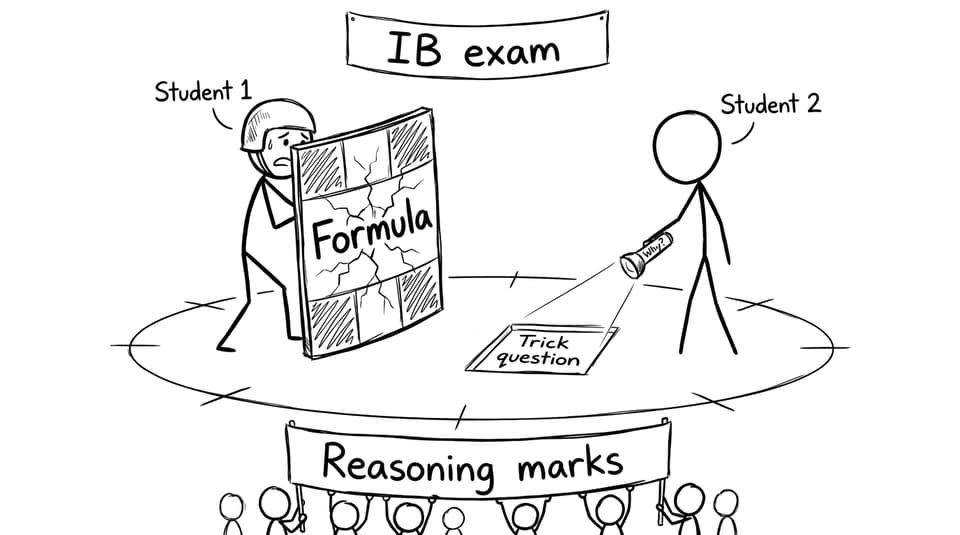
Use Flashcards to remember the “why” (not just the formula)
Students often build flashcards that only ask for the final answer. That creates the illusion of mastery while skipping the reasoning.
In the IB, flashcards work best when they test one of these:
-
A definition plus how it shows up in questions.
-
A method plus when it fails.
-
A formula plus what each symbol means.
RevisionDojo makes that daily habit light: IB Flashcards with Spaced Repetition (SRS) and the feature overview Flashcards.
For a practical routine, see How to Use RevisionDojo Flashcards for Formula Mastery.
Even 7 minutes a day compounds fast in an IB term.
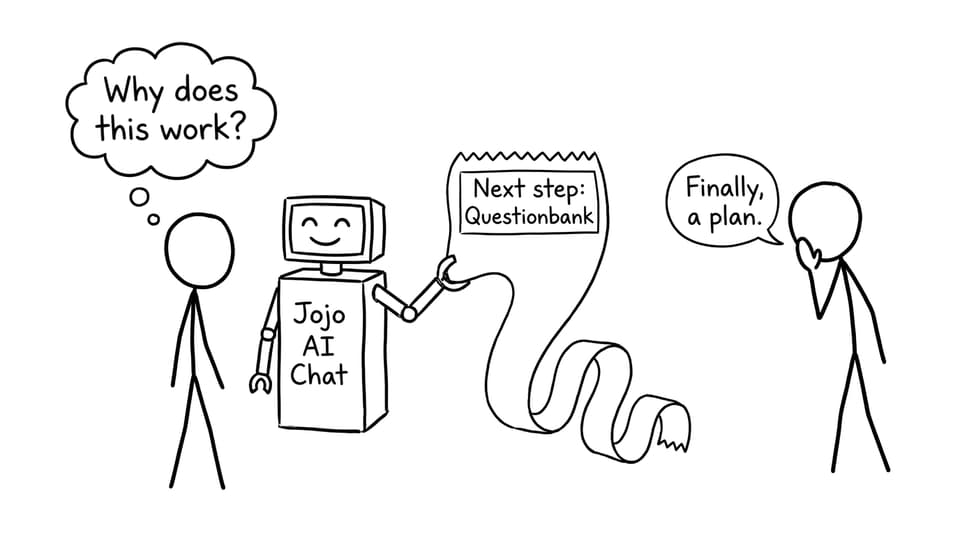
Ask Jojo AI Chat one question that saves you an hour
The best time to ask for help is not after you have spent an hour stuck. It is at minute three.
Use Jojo AI Chat like a calm tutor who keeps the learning moving:
-
Ask: “Why does this method work in this case?”
-
Ask: “What assumption am I using without noticing?”
-
Ask: “Give me a second example that changes the surface but keeps the same idea.”
Then go back to practice immediately. The IB rewards students who can correct themselves quickly.
Pressure-test your understanding with Mock Exams and Predicted Papers
Lessons build clarity. Practice builds accuracy. But IB exams also test stamina, timing, and composure.
That is where timed work matters. Add one weekly session where you simulate exam conditions using Mock Exams and Predicted Papers inside RevisionDojo.
If you are unsure how to think about predicted sets, read: IB Predicted vs Specimen Papers: What They Mean.
The goal is not to “predict the future.” The goal is to make exam structure familiar enough that your brain can spend energy on reasoning.
Don’t let coursework steal your exam season
Most IB students are balancing exams with coursework pressure. The trap is letting coursework anxiety consume all your best study hours.
RevisionDojo’s Grading tools and Coursework Library are there for a reason: shorten the feedback loop so you are not guessing what to improve. When you can get rubric-aware feedback quickly, you make higher-impact edits and return to exam training.
If you want a calm reality check for late-stage planning, this helps: IB: The Last 2 Weeks Before Exams (What Matters).
Closing: make IB understanding your default, not your lucky day
In the IB, confidence is usually just evidence you can trust. Evidence comes from a loop you repeat: learn one concept deeply, practice it until it holds, and revisit it on schedule.
That is what RevisionDojo Lessons are for. Pair them with Study Notes, the Questionbank, and daily Flashcards. Use AI Chat to get unstuck fast. Then pressure-test with Mock Exams and Predicted Papers, and keep coursework under control with Grading tools, the Coursework Library, and Tutors when you need a human reset.
If you want the wider system in one place, start here: RevisionDojo App: The Smarter Way to Prep for IB Exams. Then open a lesson today and run the loop once. Your future self will recognize the feeling: not hype, just calm proof.

