
The night before your deadline has a special talent: it makes every paragraph feel brilliant.
Then you reread it in the morning and realize you built a beautiful story that doesn’t actually investigate anything.
That tension sits at the heart of IB History IAs, especially in the new course (first assessment 2028), where expectations are clearer and more skills-focused. Most low-scoring work isn’t lazy. It’s simply aimed at the wrong target. This guide walks through the most common IB History IA mistakes and shows how to fix them early, while you still have room to steer.
Quick checklist: what to catch before it costs marks
-
Is your research question narrow enough to answer in 2,200 words?
-
Does every paragraph connect back to the research question?
-
Are you investigating (argument + evidence), not narrating (timeline + facts)?
-
Do you analyze and evaluate sources rather than quote them?
-
Have you matched your draft to the rubric criteria?
-
Did you leave time for feedback, editing, and tightening?
If you need a reference point, keep the full IA roadmap open while you write: How to Write an Outstanding IB History IA.
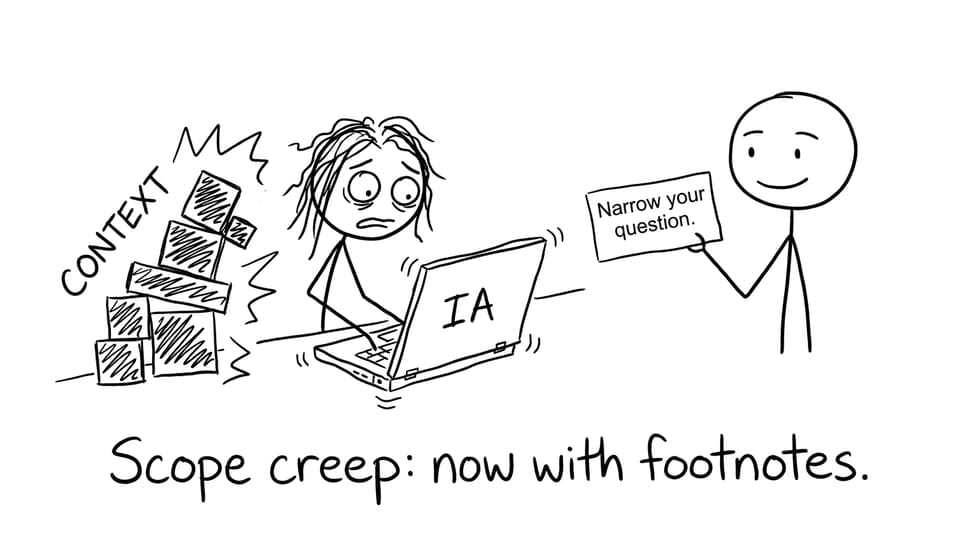
Mistake: choosing a question that’s too broad
A broad question turns your IA into a mini-textbook chapter. You end up summarizing events because there’s no other way to cover the territory.
In IB History, a strong question is narrow, debatable, and researchable. It forces you to make choices: which evidence matters, which interpretations clash, and what conclusion your sources actually support.
Fix: shrink the scope using one lever at a time:
-
Reduce the time frame
-
Limit the geography
-
Focus on one actor, policy, or turning point
-
Add an analytical command term (evaluate, assess, to what extent)
If you want examples of what “focused” really looks like, use: 10 Expert Tips to Choose a Focused and Clear History IA Research Question.
Mistake: writing a narrative instead of an investigation
A narrative explains what happened. An investigation argues why and how we know.
Under the new course framing, descriptive writing is easier to spot because it reads like a timeline: “first… then… after that…” The examiner isn’t allergic to context, but they are grading your historical thinking.
Fix: use a simple rule for every paragraph: claim, evidence, analysis, link back to the question. If you can’t find the claim, the paragraph is usually just storytelling.
For a practical model of analytical writing in IB History, keep this nearby while drafting Section B: 10 Proven Tips to Write a Strong IB History IA Analysis.
Mistake: treating sources like decoration
Many students “use” sources by quoting them, citing them, and moving on. In IB History, that’s like bringing witnesses to court and never asking them questions.
The IA expects you to handle evidence with intent:
-
What is the source saying?
-
Why should we trust it (or not)?
-
What does it prove about your specific question?
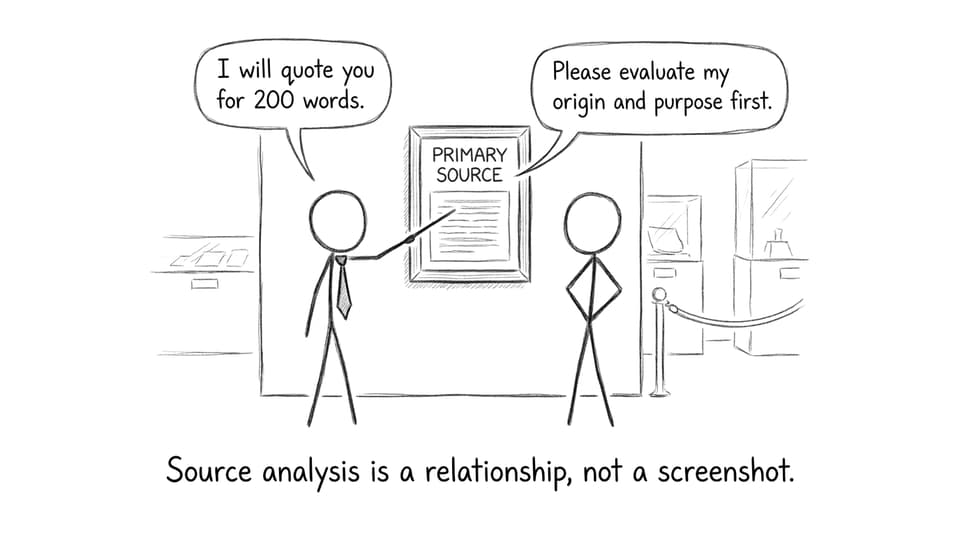
Fix: build “OPVL moments” into your writing rather than isolating them. And make sure your two key sources are evaluated in depth, not just praised or dismissed.
Want to see what good looks like? Review annotated models here: IB History IA Examples.
Mistake: vague evaluation that sounds confident
The fastest way to lose marks is to write evaluation that is technically present but intellectually empty:
-
“This source is biased.”
-
“This historian is unreliable.”
-
“This shows the policy was effective.”
In IB History, evaluation must be reasoned and supported. “Biased” is not an argument. It’s a starting point.
Fix: upgrade every evaluation statement by adding:
-
because (cause)
-
therefore (impact on usefulness)
-
however (limits + alternative interpretations)
If you’re unsure whether your evaluation is actually earning marks, run it through RevisionDojo’s rubric tool: IB History IA Grader.
Mistake: drifting away from your research question
A common pattern in IB History IAs: a strong opening, a decent set of sources, then a gradual slide into whatever the sources talk about most.
This drift is subtle. It happens when interesting context starts to feel like “proof,” or when you add a paragraph because it’s fascinating, not because it answers the investigation.
Fix: add a one-sentence “so what?” line at the end of each section: How does this directly answer the research question? If you can’t do it, cut or reframe.
Mistake: stuffing the IA with detail to look smart
More facts can actually lower clarity. Long quotations, repeated background, and extra mini-topics crowd out analysis.
In the new assessment mindset, IB History rewards selectivity: choose the evidence that does the most work per word.
Fix: aim for short quotes, paraphrase with precision, and reserve word count for analysis and evaluation. If you’re unsure what counts in your word total, check: Do References Count in the IA Word Count?.
Mistake: ignoring the rubric until the end
The rubric isn’t a formality. It’s the scoring system.
When students skip it, they often create:
-
an overbuilt investigation section with weak source evaluation
-
a reflection that’s personal but not about the historian’s methods
-
an imbalanced draft that can’t reach the top bands
Fix: do two “rubric passes” while writing: once after a rough draft, and again after editing. RevisionDojo’s IB Internal Assessment Guides make this much easier across subjects, not just IB History.
Mistake: starting too late (the silent multiplier)
Time pressure doesn’t just make you stressed. It forces you into the exact habits that lose marks: broad questions, descriptive paragraphs, shallow evaluation, and messy structure.
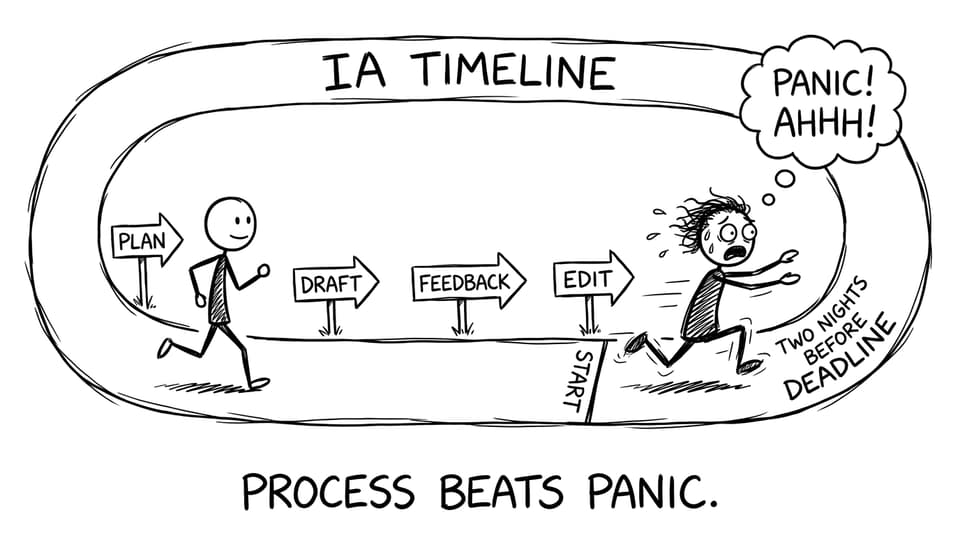
Fix: build a simple process schedule:
-
Week 1: question + initial sources
-
Week 2: outline + Section A planning
-
Week 3: draft Section B
-
Week 4: draft Section C + edit for focus
-
Week 5: feedback + final polish
How RevisionDojo helps you avoid these IB History traps
The best IAs feel calm because they’re built with feedback loops.
RevisionDojo is designed for that: use Study Notes to tighten context without bloating your word count, AI Chat to pressure-test your research question, and the Grading tools to spot exactly where your draft drops a criterion. When exam season overlaps, the Questionbank, Flashcards, Mock Exams, and Predicted Papers help you keep Paper skills sharp while the IA moves forward. And if you want human guidance, RevisionDojo Tutors can help you rebuild a shaky draft into a focused investigation.
Explore the full hub here: IB History Resources and browse targeted strategy articles via IB History Posts.
Closing: make IB History feel smaller, not heavier
Most IB History IA mistakes come from one instinct: trying to cover everything. The new course rewards the opposite. Choose less, argue more.
If you want your next draft to feel clearer and score higher, build around a focused question, evaluate sources with precision, and check your work against the rubric early. Then use RevisionDojo to keep the process steady: the Grading tools to diagnose weaknesses, Study Notes and Flashcards to stay sharp, and targeted support across the Questionbank, AI Chat, Mock Exams, and Tutors when you need momentum.