
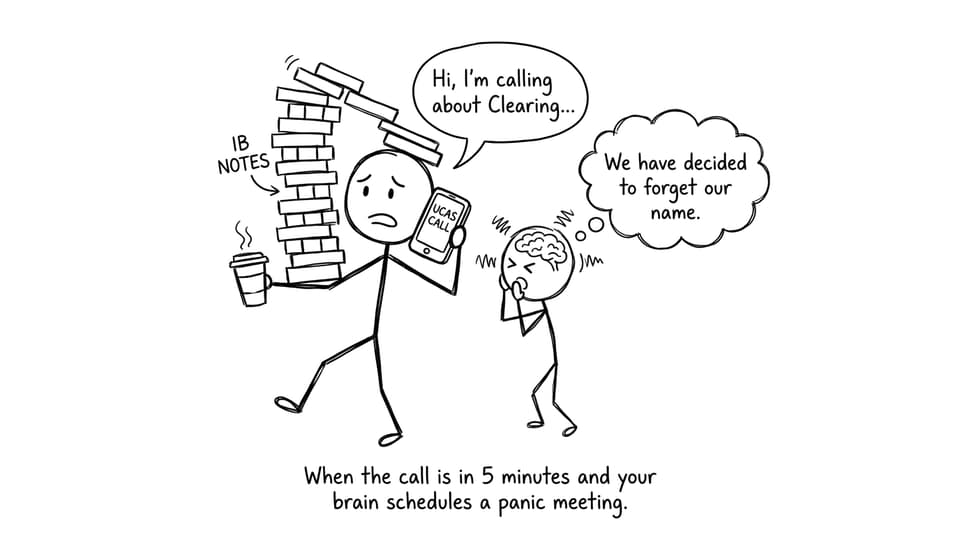
Clearing calls have a special kind of pressure: they arrive when you’re already tired, results are fresh, and your brain is still thinking in IB markschemes. But a UCAS call is not a trapdoor moment. It’s closer to a short, practical conversation where preparation does the heavy lifting.
If you’re an IB student heading into exams (or just coming out the other side), the goal is simple: make your UCAS Clearing call feel like a routine you’ve rehearsed, not a performance you’re improvising.
UCAS Clearing calls: your 60-second plan
Keep this checklist beside you before any UCAS call:
-
UCAS ID + Clearing number visible (UCAS Hub)
-
IB results written clearly (total points + HL/SL breakdown)
-
Course name, UCAS code, and key entry requirements
-
A 20-second opener + 2 proof points (why you, why this course)
-
3 questions you genuinely want answered
-
Notes template: who you spoke to, what they said, next step, deadline
For the wider process, keep UCAS Clearing 2025: Secure Your Ideal University Place Today open in a tab so you can cross-check the steps quickly.
What to have ready before you dial UCAS Clearing numbers
Admissions teams move fast in UCAS Clearing. Help them help you by making your info easy to scan and say.
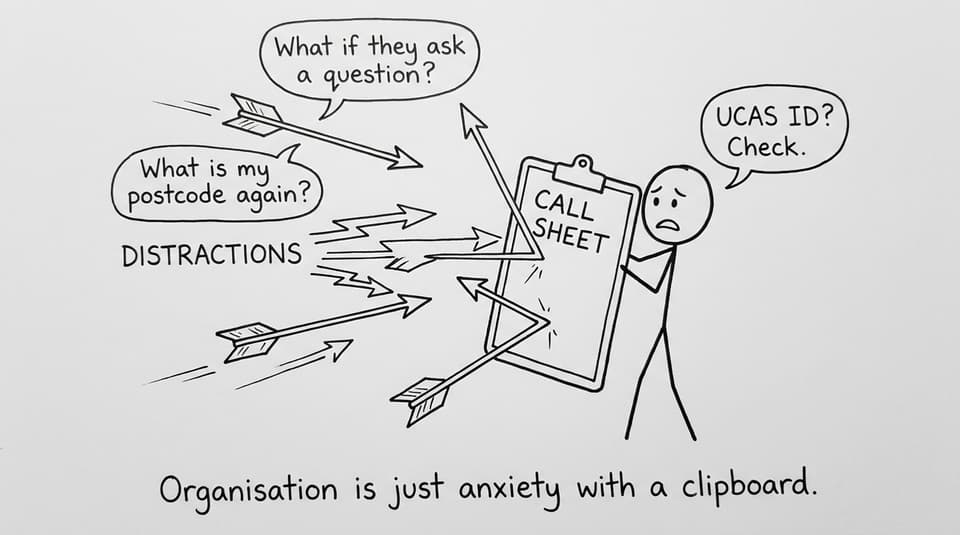
Start with a one-page “call sheet” (paper beats frantic tab-switching). Use the structure from UCAS Clearing Checklist 2025: What to Prepare Before You Call and add one IB-specific line: your strongest subject evidence (for example, “HL Biology: IA on enzymes; EE on sleep and memory”).
If you might need to switch routes (Extra vs Clearing vs other options), clarity reduces panic. This guide helps: UCAS Adjustment vs Clearing 2025: Which Is Right for You.
What to say on a UCAS Clearing call (a simple script that works)
Think of your UCAS Clearing call like an IB oral: short answers, specific evidence, calm delivery.
Use this structure:
-
Line 1 (identity): “Hi, my name is ____. My UCAS ID is ____, and I’m calling about the ____ course.”
-
Line 2 (fit): “I’m interested because ____ (module/feature/placement).”
-
Line 3 (proof): “My IB background supports this, for example ____ (EE/IA/topic strength).”
-
Line 4 (question): “Could I check if my grades meet your requirements, and what the next step is?”
If they ask why you’re changing direction, stay factual and forward-looking. You’re not defending yourself; you’re explaining your fit.
And if a university asks for a personal statement quickly, don’t start from zero. Use a fast method like Writing a Personal Statement in a Hurry (Clearing Guide) or the more detailed Personal Statement in a Hurry: UCAS Clearing 2025 Fast Writing Guide.
Staying calm: borrow your IB exam routine for UCAS
Most students try to “be confident” by force. A better approach is to be prepared enough that confidence shows up on its own.
Steal the same tools you use for IB papers:
-
Breathe first, then speak (slow exhale). The technique is the same one recommended in How to Stay Calm During IB Exams.
-
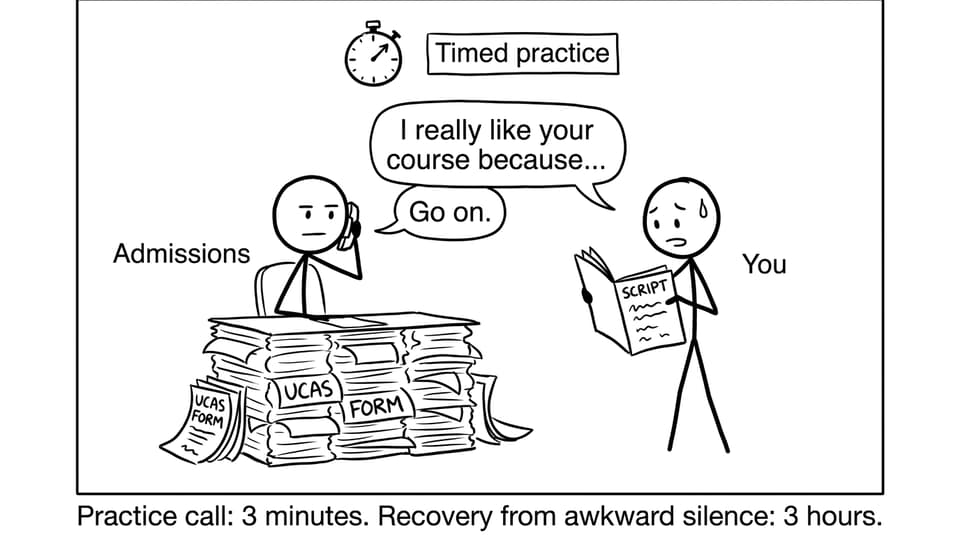
Use a timer for practice calls. Two rehearsals makes the real UCAS Clearing call feel familiar.
-
Keep your answers markscheme-simple: one claim, one example, one link back.
If you’re prone to spiralling, build a reset routine from Exam Stress Management Tips for IB Candidates before you dial.
Mistakes that quietly cost offers in UCAS Clearing
A few patterns show up again and again in UCAS calls:
-
Sounding vague: “I like your university” is weaker than naming one module, pathway, or placement.
-
Not taking notes: you’ll forget deadlines and conditions when you call multiple places.
-
Over-talking: if your answer is longer than the question, tighten it.
For more advanced tactics (when you’re close to requirements or discussing flexibility), see How to Negotiate Offers During UCAS Clearing Calls.
A final note for IB students using UCAS Clearing
It’s easy to treat UCAS Clearing like a judgment. It’s not. It’s a logistics system that rewards students who show up prepared.
If you want that preparation to feel steadier, build it the way you build IB confidence: small rehearsals, clear structure, and feedback. RevisionDojo helps with exactly that mindset. Use Study Notes and Flashcards to keep exam confidence stable, drill pressure-proof thinking with the Questionbank, and run timed Mock Exams to make high-stakes moments feel normal. When you’re juggling applications too, AI Chat and Grading tools can reduce decision fatigue, while Predicted Papers keep revision focused, and Tutors offer a calm second voice when you need it.
When the UCAS phone line connects, you want one feeling: “I’ve done this before.” Not because life is predictable, but because you prepared like it is.