
When the invigilator says, "You may begin," it can feel like time folds in on itself.
In that first moment of an IB exam, your brain doesn't ask, "What's the command term here?" It asks, "What if I mess this up?" A racing heart shows up like an uninvited guest. Your hands feel unfamiliar. Suddenly you're staring at the paper as if it's written in a language you once knew.
But calm isn't luck. It's a skill.
In IB, the students who look "naturally relaxed" usually aren't relaxed at all. They've simply trained a routine that makes panic less sticky. They've rehearsed what to do when they blank. They've built systems that keep the mind from spiraling.
This guide is about building that system so you can stay calm during IB exams, even when the pressure is real.
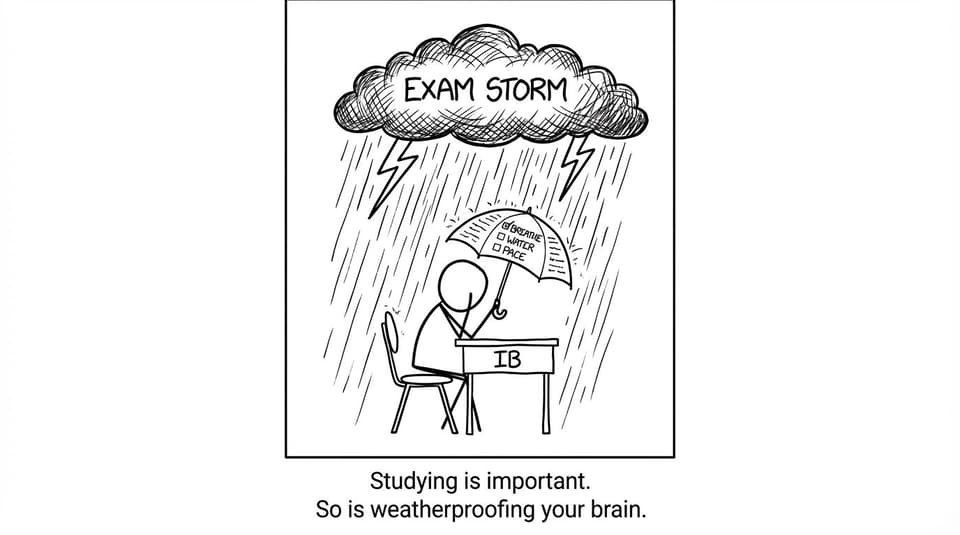
The IB calm checklist (save this)
Use this quick checklist as your "default settings" for any IB paper:
- The night before: pack, sleep, light review only.
- The first 60 seconds: breathe slowly, scan the paper, choose your start.
- If you panic: box breathing + write anything true about the topic.
- If you're stuck: skip, bank marks elsewhere, return with fresh eyes.
- Between papers: no post-mortems, short walk, reset script.
To build calm faster, combine this with realistic practice using RevisionDojo Questionbank and timed exam simulation in RevisionDojo's mock tools (more on that below).
Why IB exams feel so intense (and why that matters)
IB exams don't just test knowledge. They test state.
A student can know the syllabus and still underperform because stress hijacks attention. In an IB exam, attention is your most valuable currency. When anxiety grows, attention narrows and jumps. You misread command terms. You rush. You second-guess obvious steps. You lose time not to difficulty, but to noise.
The point isn't to "eliminate stress." That's not realistic in IB.
The point is to keep stress below the level where it disrupts working memory. Calm is not an emotion. It's a performance range.
If you want a deeper companion read, see Strategies for Dealing with IB Exam Anxiety and treat it like the "theory" behind this practical guide.
Train calm before the IB exam day: the exposure principle
Most IB exam panic is not caused by the exam itself.
It's caused by meeting a familiar topic in an unfamiliar condition: silence, time pressure, consequence, fatigue.
That's why calm is best trained through exposure: repeated practice in conditions that resemble the real thing.
Build calm with timed practice (without burning out)
You don't need to do full papers every day. You need frequency and realism.
Try this weekly structure:
- 2x per week: 25-45 minutes of timed sections.
- 1x per week: a longer sitting to build stamina.
- After each timed attempt: short review and one clear "next step."
On RevisionDojo, you can do this using the Questionbank for targeted drills and then step up the intensity with timed mock workflows described in How to Run Timed IB Mock Exams in RevisionDojo.
The key IB benefit: you stop treating time pressure as a surprise. It becomes familiar.
The 60-second IB start routine (the calmest students do this)
The first minute of an IB exam is where many students lose the next twenty.
A strong start routine is simple, repeatable, and almost boring. That's the point. You don't want creativity. You want stability.
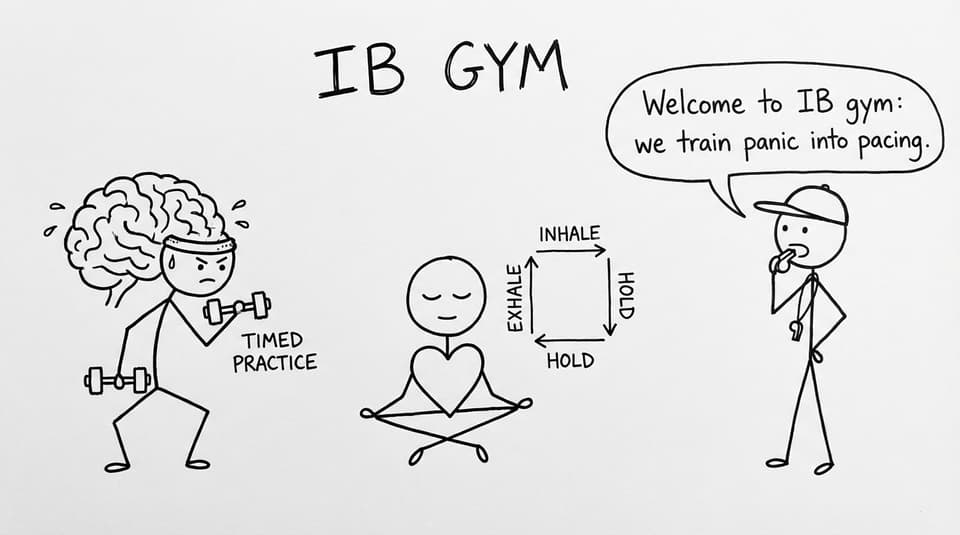
A practical 60-second script
- Exhale slowly (your body needs a signal that you're not in danger).
- Box breathing once: 4 in, 4 hold, 4 out, 4 hold.
- Scan the paper: identify the "bankable marks" questions.
- Choose your start: begin with something you can do.
This works because it interrupts the spiral. You move from vague fear to concrete action.
If you want more breathing options, keep Meditation and Breathing Techniques for Exam Stress bookmarked and practice one method daily during exam season.
What to do when you blank in an IB exam
Blanking is common in IB. It's also reversible.
When you blank, the worst move is to stare and negotiate with yourself. Your brain interprets that as confirmation that something is wrong.
Instead, use a "restart protocol."
The IB restart protocol
- Breathe: one slow exhale, then inhale.
- Write keywords: even messy ones. Definitions. Diagrams. A formula. A date. A case study.
- Convert to structure: turn keywords into a plan or a short chain of logic.
The surprising part: writing anything true often unlocks more memory. Momentum is calming.
RevisionDojo's Jojo AI Chat is especially useful before exam day for rehearsing this. You can ask it to generate a few "blanking scenarios" and practice recovering: outline-first answers, command term decoding, and quick planning under time.
Calm pacing: the IB time strategy that prevents panic
Many students feel anxious because they don't trust time.
They can't tell if they're on track, so every minute feels suspicious.
Use "time boxes," not vibes
Before you start writing, decide:
- Marks per minute (roughly): many IB papers reward steady, not perfect, writing.
- Checkpoints: "By 30 minutes, I'm done with Section A."
- The skip rule: if a question is draining time, park it.
This is why timed practice matters. If you train pacing with real questions, you stop inventing pressure.
For more on focus under time, pair this with How to Stay Calm During a Timed Exam.
Between IB exam papers: the mental reset that protects your next grade
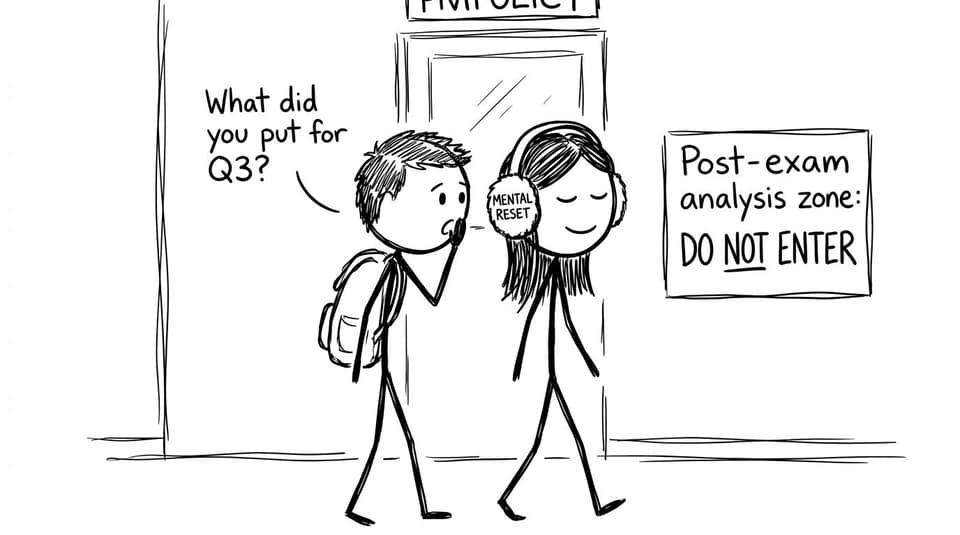
One of the quiet killers in IB is emotional carryover.
You finish a paper and immediately start replaying. You hear what others wrote. You spot a possible mistake. The next exam hasn't started yet, but your nervous system is already spending its budget.
A reset is not denial. It's strategy.
A simple reset routine (5-10 minutes)
- Walk outside (even a corridor lap counts).
- Drink water.
- Put your phone away.
- Repeat a short script: "That exam is complete. My job is the next one."
This is expanded beautifully in How to Mentally Reset Between IB Exam Papers. Read it once, then actually practice it during mocks.
Calm comes from preparation you can feel
There's a specific kind of calm that only comes from evidence.
Not motivation. Not last-minute reassurance. Evidence.
In IB, evidence looks like:
- You've done enough exam-style questions to know what patterns repeat.
- You've seen your weak topics and closed the gap.
- You've sat enough timed papers that your body recognizes the setting.
This is where RevisionDojo becomes more than "resources." It becomes feedback.
Build the calm loop with RevisionDojo
- Use Study Notes to remove confusion fast (especially when stress makes concepts feel slippery). Start at RevisionDojo.
- Drill weak areas with Questionbank and tag questions for review.
- Lock in recall using Flashcards with spaced repetition.
- Ask Jojo AI Chat to explain concepts in simpler language, generate mini-quizzes, or role-play examiner feedback via RevisionDojo IB Resources.
- Run Mock Exams and timed simulations using the platform's exam workflows, plus guidance from How to Use RevisionDojo's Mock Exam Builder.
- For coursework stress that bleeds into exam season, use the Grading tools and Coursework Library to reduce uncertainty and decision fatigue (available through RevisionDojo's IB ecosystem at RevisionDojo IB Resources).
Calm grows when your plan keeps producing proof.
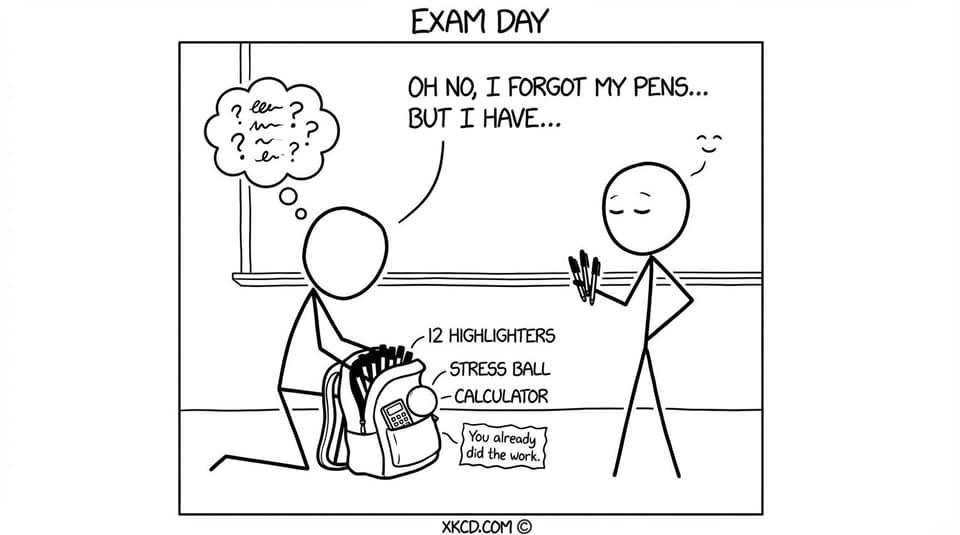
Common mistakes that make IB exam anxiety worse
Treating panic like a character flaw
In IB, panic is usually a signal: you're under-rehearsed for the condition, not incapable. Shame adds a second problem.
Trying to "study calmness" instead of practicing it
Reading tips helps, but calm is mostly procedural. If you don't rehearse breathing, pacing, and resets in timed conditions, your brain won't retrieve them.
Post-exam discussion
It feels comforting, but it spikes uncertainty. You can't change what you wrote, but you can damage your next paper.
Overpacking your brain the night before
Light review is fine. Heavy new learning increases cognitive noise. Sleep consolidates memory, and IB rewards what you can retrieve under pressure.
Closing: Calm is a decision you rehearse
IB exams can feel like a spotlight.
But the spotlight isn't the problem. The problem is walking into it without a script.
If you take one thing from this: calm is not something you wait for. It's something you rehearse in small, repeatable actions until your brain trusts them.
Start today: pick one breathing technique, one pacing checkpoint, and one reset routine. Then train it with real exam-style practice.
When you're ready to make calm practical, build your routine inside RevisionDojo: use Study Notes to reduce uncertainty, Flashcards to strengthen recall, Questionbank to create familiarity, Jojo AI Chat for instant clarity, and timed Mock Exams plus Predicted Papers to rehearse the real pressure of IB.
The goal isn't to feel nothing.
It's to stay steady enough to show what you know in IB, when it matters.