If you have ever watched two students get the same regression line and walk away with very different IA marks, the difference is rarely the algebra. It is the interpretation.
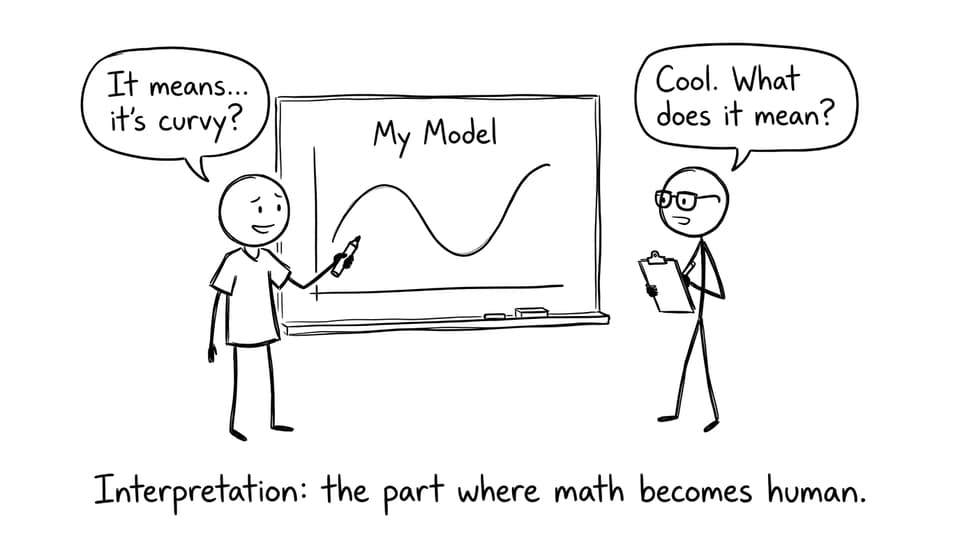
In an IB Math IA, building a model proves you can do mathematics. Interpreting a model proves you understand it. That is what examiners reward when they read your results and ask the silent question: So what?
A fast IB checklist for model interpretation
Use this checklist each time you finish a model in your IB Math IA:
-
Restate the aim of the model in one sentence.
-
Describe the mathematical behavior (shape, key features, end behavior).
-
Translate parameters into real meaning with units.
-
Identify important features (turning points, asymptotes, intercepts, inflection points).
-
Test fit against data and discuss error.
-
Evaluate assumptions and limitations honestly.
-
Do a small sensitivity check (change a parameter and interpret what happens).
-
End with one insight sentence that answers your research question.
If you need a rubric-aligned roadmap for where interpretation belongs, the IB Math AI Internal Assessment: Step-by-Step Guide and How to Structure the IB Math IA for Maximum Clarity make the expectations feel much less vague.
Why interpretation matters in the IB Math IA rubric
In IB terms, interpretation strengthens two places examiners care about:
-
Use of Mathematics: you are not just applying methods, you are using them appropriately and communicating what the results show.
-
Reflection: you evaluate the model, not worship it.
A good way to calibrate your writing is to compare it to high-scoring samples. Using IA/EE Exemplars to Improve Your IB Math IA helps you notice what top students do after the calculations are finished.
Restate your model’s purpose (the examiner’s anchor)
Start your interpretation by reminding the reader what the model was designed to do.
Not: “A logistic model was used.”
Better: “This logistic model is used to estimate how the population grows over time and whether it approaches a stable carrying capacity.”
That one sentence is an IB signal flare: it tells the examiner what they should look for in your discussion.
Describe the mathematical behavior before the real-world story
Many IB students jump straight into context, then end up writing vague claims like “the graph goes up quickly.” Instead, earn clarity by naming behavior precisely.
Depending on your model, you might comment on:
-
Growth/decay rate (exponential, logarithmic)
-
Concavity and changes in concavity (inflection points)
-
Asymptotes (horizontal/vertical) and what “approaches” means
-
Period, amplitude, phase shift (trigonometric)
-
Domain restrictions and piecewise behavior
Then you translate it into meaning. But first, show you can read the math.
Translate parameters into meaning (and always include units)
Parameters are where interpretation becomes distinctly IB. They are also where many IAs quietly lose marks.
Write each parameter as a sentence with meaning.
Example frames you can reuse:
-
“In this model, k represents __. Because its unit is __, it can be interpreted as __ per __.”
-
“The constant c shifts the output by __, suggesting a baseline of __ when the input is zero.”
-
“The coefficient a controls curvature; a larger |a| would imply __ happening more sharply.”
If you are unsure how deep your reflection should go, How to Use Reflection Sentences to Earn Marks in IB Math IA Criterion E is a quick way to learn the tone examiners actually reward.
Highlight key features and tell the reader why they matter
Key features are the “story beats” of your model. In an IB Math IA, do not just compute them. Interpret them.
Common features to interpret:
-
Intercepts: what happens at time zero or input zero? Is it realistic?
-
Turning point / vertex: what is being maximized or minimized?
-
Inflection point: when does growth stop accelerating and start slowing?
-
Asymptote: what limit does the situation approach, and is that plausible?
A simple rule: every feature needs two halves.
-
Mathematical statement: “The maximum occurs at x = 4.2.”
-
Context statement: “This suggests peak efficiency after about 4.2 hours of __.”
Compare predictions to observations (fit is not a vibe)
Interpretation gets stronger when you compare your model to data or accepted theory.
In practice, that can mean:
-
residual plots
-
percentage error at a few test points
-
R² (with a sentence explaining what it does and does not prove)
-
comparing two models (linear vs exponential) and justifying your choice
If your IA uses real datasets, How to Use RevisionDojo to Prepare for IB Math IA Data Analysis is a useful companion because it focuses on the exact bridge between graphs and written interpretation.
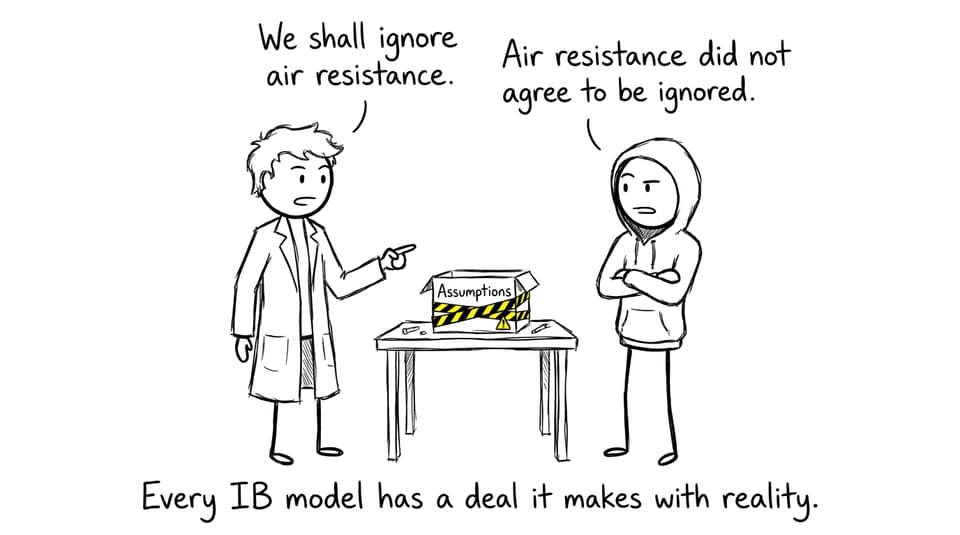
Reflect on assumptions and limitations like a scientist, not an apologist
In IB, limitations are not confessions. They are evidence you understand what models leave out.
Write limitations in a structured way:
-
Assumption: what you assumed (constant conditions, independence, no friction, etc.).
-
Effect: how that assumption might bias results (overestimate, underestimate, distort shape).
-
Fix: a realistic improvement (more data, a different model, narrower domain).
For deeper rubric-aligned guidance, How to Demonstrate Critical Thinking in the IB Math IA and How to Write an IB Math IA Evaluation That Impresses Examiners show what reflection looks like when it is more than generic disclaimers.
Add a small parameter sensitivity check (big marks for small effort)
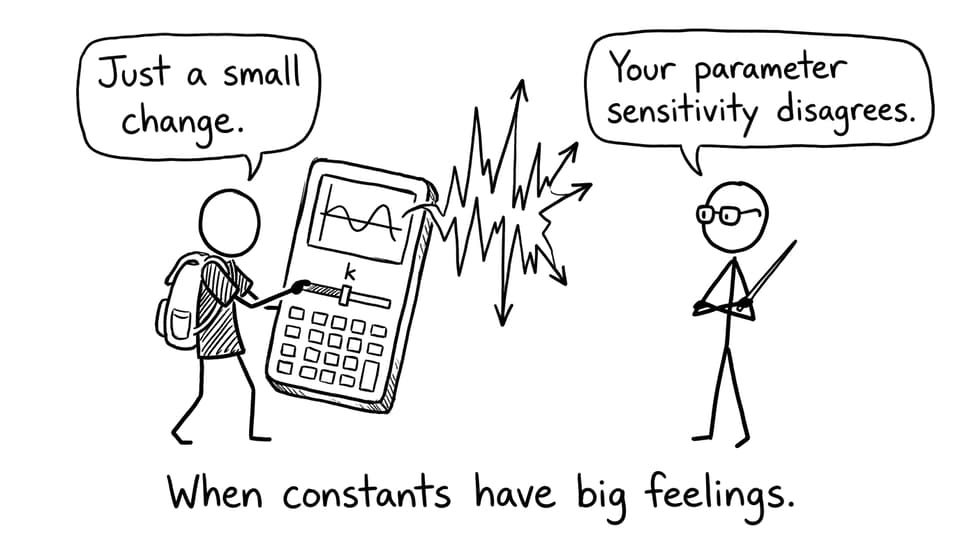
A sensitivity check is one of the most efficient ways to show real IB understanding.
Pick one meaningful parameter and change it slightly (for example, +5% and -5%). Then interpret what changes:
-
Does the model become unstable?
-
Does the predicted maximum shift?
-
Does the asymptote move in a way that changes the story?
Even a short paragraph here can separate “I ran regression” from “I understand the model.”
Where RevisionDojo fits into an IB student’s workflow
Interpretation is easier when you have structure. RevisionDojo is designed for that.
-
Use the Study Notes and Flashcards to refresh the exact behavior language (asymptotes, concavity, residuals).
-
Use AI Chat to test whether your interpretation sentences are precise, then rewrite them in your own voice.
-
Use the Grading tools to self-check your rubric alignment early, not the night before.
-
Use the Coursework Library and Mock Exams to keep IA work connected to exam skills, especially model reading.
-
Use the Questionbank and Predicted Papers to strengthen the same interpretation habits you need for unfamiliar contexts.
-
If you are stuck choosing an approach, Tutors can help you decide what is reasonable for your level without overcomplicating it.
For official-style guidance hubs, bookmark IB Internal Assessment Guides and the course pages for IB Mathematics Applications & Interpretation (AI) IA Guide and IB Mathematics Analysis and Approaches (AA) IA Guide.
Closing: make your IB math speak
The quiet truth of the IB Math IA is that models are easy to admire and hard to understand. Interpretation is the moment you stop describing a curve and start explaining a world.
If you want your writing to sound like a top student, use RevisionDojo to tighten the loop: build with the Study Notes, test yourself with the Questionbank, sharpen explanations with AI Chat, and rubric-check your draft with the Grading tools. Then return to your model one last time and ask the question your examiner cannot stop asking: What does it mean?

