
A surprising thing happens when an examiner reaches the last pages of your Math IA. They already know whether you can do the mathematics. What they still don’t know is whether you can think about the mathematics.
That’s why the IB Math IA evaluation matters so much. It’s the final section, but it’s also the moment you prove you understand what your model can do, what it can’t do, and what you would change if you had one more week and a cleaner dataset. In IB terms, that’s the difference between sounding like a student who followed steps and sounding like a young researcher.
The IB Math IA evaluation checklist (use this before you write)
If you want your evaluation to read like it belongs in a top-band IB exploration, check that it does five things:
-
Re-states the aim in one clean sentence (so the reader remembers the target).
-
Judges success using evidence (numbers, residuals, error bounds, or comparison to known values).
-
Names 2-4 limitations that actually affected results.
-
Explains the impact of each limitation (what changed because of it).
-
Proposes realistic improvements, linked directly to those limitations.
To calibrate your tone and structure, it also helps to scan a high-scoring model. The quickest route is using IB Coursework Examples: IA, EE and TOK Exemplars to see what examiner-friendly evaluation sounds like in real student writing.
What IB examiners are really looking for in an evaluation
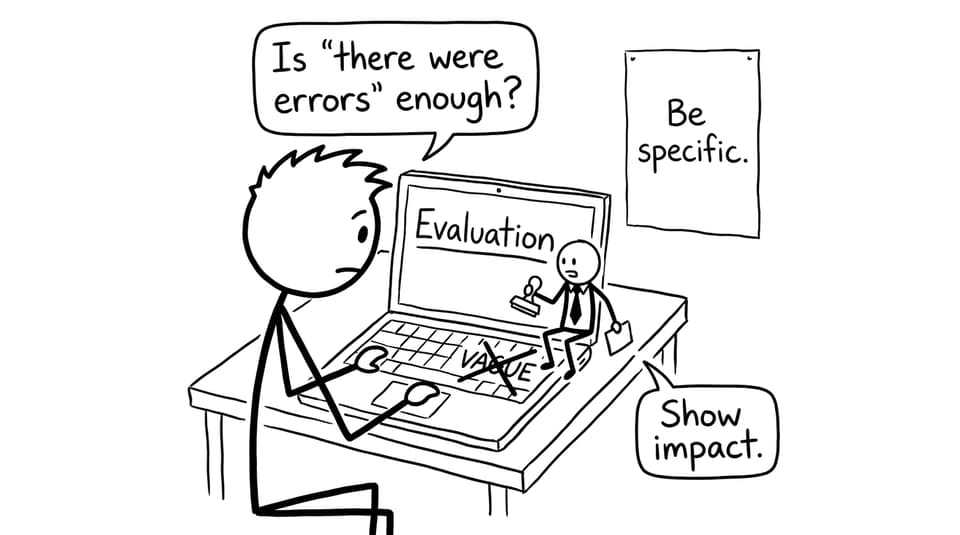
Most IB students treat evaluation like an apology. “There were errors.” “It could be improved.” “More trials would help.”
Examiners read that as: I know an evaluation should exist, but I don’t know what it’s for.
A strong IB Math IA evaluation is not about being negative. It’s about being precise. Your job is to show you can:
-
Separate method strength from method weakness.
-
Connect weakness to consequences.
-
Suggest improvements that would meaningfully change reliability or validity.
If you want the broader rubric context, revisit How to Write a Top-Scoring Math IA (2025 Guide) and 2.1 Unpacking the IB Math IA Assessment Criteria. Those pages help you see how evaluation language feeds into reflection and mathematical communication.
Build your evaluation in three moves: claim, impact, improvement
Here’s the simplest structure that still sounds mature in IB writing:
Claim: state the limitation without drama
Don’t generalize. Point to the exact place your investigation becomes fragile.
Examples of focused limitation claims:
-
“The regression model was trained on only 12 data points, which increases sensitivity to outliers.”
-
“Assuming constant acceleration simplified the derivation but ignored air resistance, which becomes significant at higher speeds.”
Impact: explain what that limitation did to your results
This is where marks are won. You’re showing mathematical awareness.
Examples of impact language:
-
“This likely inflated the coefficient estimate, shifting the turning point and therefore changing the predicted optimum value.”
-
“Residuals increased systematically for larger x-values, suggesting the model underestimates growth in that region.”
Improvement: propose a fix that is realistic and mathematical
The improvement should match the limitation. Not a vague “do better.”
Examples:
-
“Collecting data across a wider domain would reduce extrapolation and allow a second model to be compared using SSE or RMSE.”
-
“A piecewise model (or adding a drag term) would better reflect changing conditions, then parameters could be estimated via non-linear regression.”
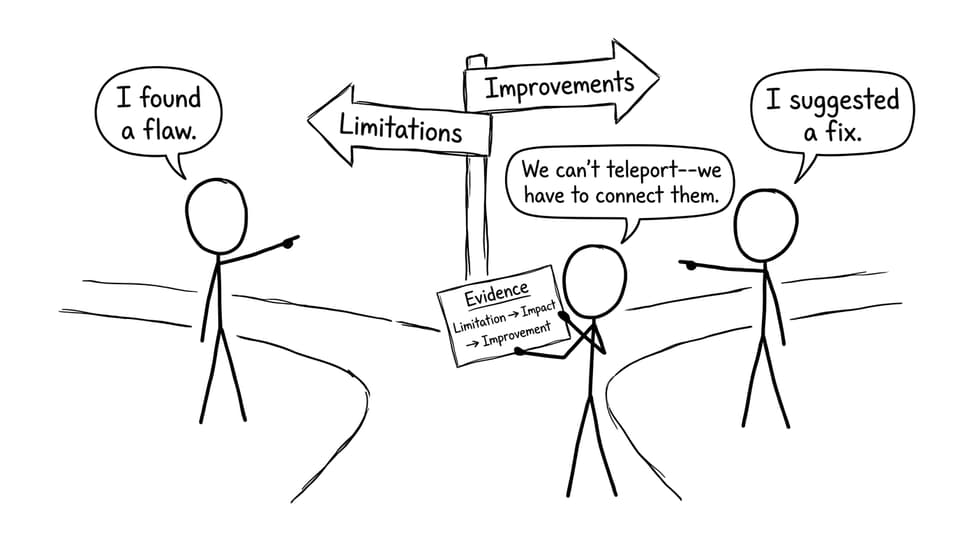
If your evaluation currently feels scattered, it usually means your IA’s logic is scattered too. Use How to Structure Your IB Math IA Logically as a quick reset before polishing the final section.
What to write (and what to avoid) in an IB Math IA evaluation
A calm rule: your evaluation should sound like someone checking a bridge, not someone reviewing a movie.
Include strengths, but make them specific
Strengths are not compliments. They are technical reasons your approach is credible.
-
Good: “Using residual plots helped confirm the model fit was reasonable within the chosen domain.”
-
Weak: “The model worked well.”
Use assumptions like levers, not decorations
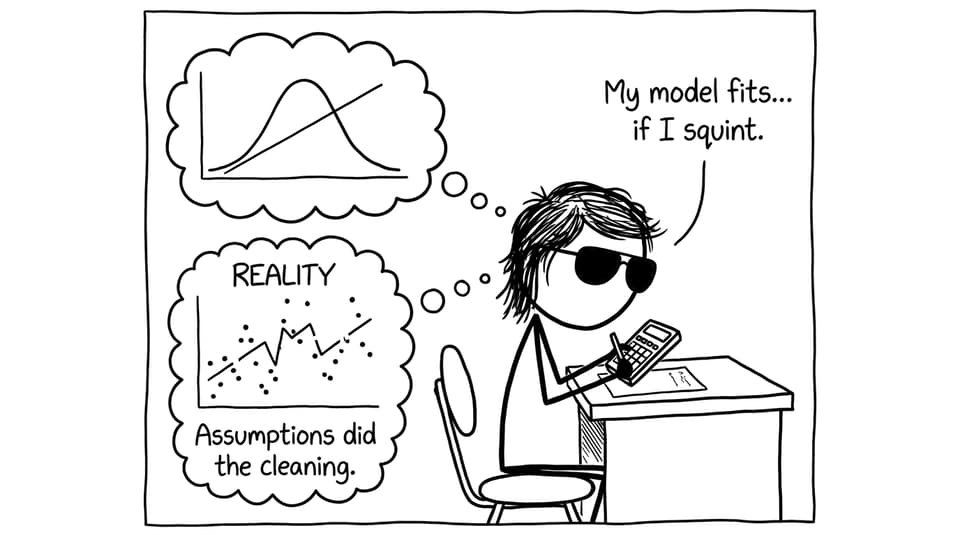
In IB math, assumptions are never just “stated.” They must be used.
Write: what you assumed, why you assumed it, and what changes if the assumption fails.
To tighten this skill, compare your work against How to Evaluate Mathematical Accuracy in the IB Math IA and How to Master Reflections and Evaluations in the IB Math IA.
Avoid the three most common “empty” evaluation lines
These phrases almost never earn marks unless you attach evidence:
-
“Human error may have occurred.” (Where, and how did it shift outcomes?)
-
“The sample size was small.” (So what changed because of that?)
-
“More trials would improve accuracy.” (How many more, and what metric improves?)
How RevisionDojo helps you write a sharper IB evaluation (without fluff)
When you’re tired, you don’t need motivation. You need a system.
RevisionDojo works well for IB students because the pieces connect:
-
Use IB IA Guides to mirror the rubric language while staying readable.
-
Check your tone and realism using How to Write Evaluation That Actually Earns IA Marks.
-
If you’re also studying alongside your IA, keep your skills sharp with IB Mathematics Applications & Interpretation Resources or targeted practice from the Questionbank feature page.
Under the hood, the RevisionDojo ecosystem supports the exact habits that improve evaluation writing: a Coursework Library for examples, Study Notes and Flashcards for clean definitions, AI Chat for drafting better “impact” sentences, Grading tools for rubric alignment, and Tutors when you need human feedback on whether your reflection is convincing.
Closing: the evaluation is your IB “signal” line
In an IB Math IA, the evaluation is not a summary. It’s your signal to the examiner that you can step back, critique your own work, and still defend why it matters.
Write it like a person who ran an investigation, noticed what bent the results, and knows what to change next. Then use RevisionDojo to tighten the loop: pull structure from the IA Guides, compare against Exemplars, and sharpen your mathematics with the Questionbank, Study Notes, Flashcards, AI Chat, Grading tools, Predicted Papers, Mock Exams, Coursework Library, and Tutors. Finish your IB evaluation with evidence, not apologies, and make the last page your strongest page.