


The moment your IB Math IA stops being “correct” and starts being impressive
At some point in every IB Math IA, there’s a quiet fork in the road.
On one path, you do the maths neatly, show the graphs, land on an answer, and hope the examiner notices your effort.
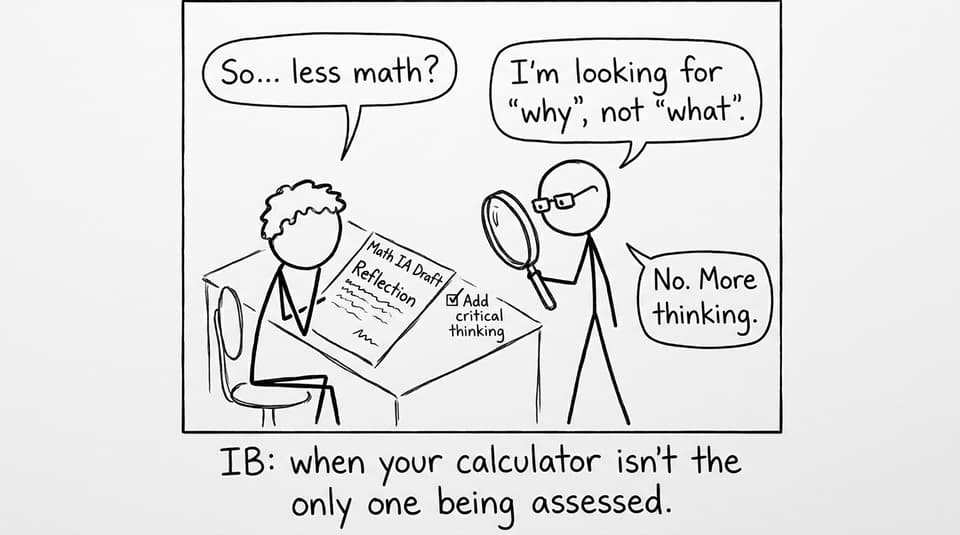
On the other path, you do the same maths, but you keep asking a harder question: Should I trust this? That question, and the way you answer it, is what examiners recognize as critical thinking.
Critical thinking in an IB Math IA isn’t a personality trait. It’s visible on the page. It shows up when you justify a method, test assumptions, interpret results, and admit limitations without panicking. Most importantly, it shows that you understand your mathematics as a tool with conditions, not a magic spell.
Critical thinking checklist (use this before you submit)
If you want a fast way to pressure-test your draft, check whether you have:
-
A clear “why” behind every major mathematical choice (model, formula, test, transformation)
-
At least one moment where you compare or acknowledge an alternative method
-
A balanced evaluation (what worked, what didn’t, and how you know)
-
Specific reflection sentences placed throughout, not only at the end
-
Realistic improvements that connect to your limitations
If you need a structure that aligns with what examiners look for, borrow a proven framework from How to Structure Your IB Math IA Logically and then layer your critical thinking into each section.
What critical thinking looks like in an IB Math IA (and what it isn’t)
Critical thinking is not filling half a page with “I found this interesting.” In the IB, reflection is strongest when it stays mathematical.
Think of it like commentary during a football match. The game is still the game (your calculations), but the commentary explains decisions, trade-offs, and what the numbers mean.
A strong starting point is to study how reflection is assessed across the process in How to Include Reflection Throughout Your IA. It reinforces one key idea: you earn the most credit when reflection is woven in, not bolted on.
Ask “why this math?” before you ask “what next?”
The quickest way to sound like a critical thinker is to narrate your reasoning.
Instead of writing:
- “I used an exponential model.”
Try:
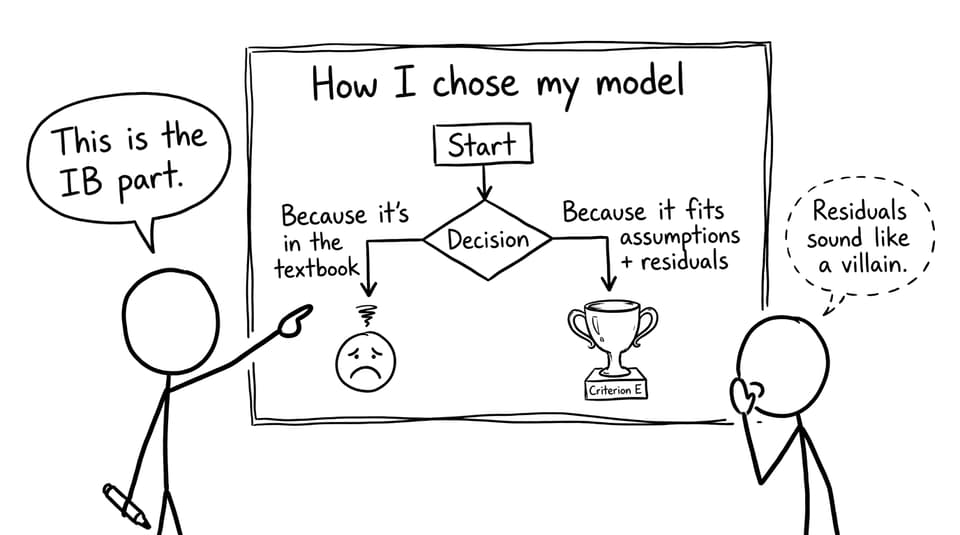
- “I tested linear and exponential fits. The exponential model reduced patterned residuals and matched the constant percentage-change assumption in the context, so it was more appropriate for this IB investigation.”
This kind of sentence does two things: it shows understanding of the context and signals that your choice wasn’t automatic.
If you’re still shaping the direction of your exploration, use a guide that keeps the full assessment in mind, like How to Write a Top-Scoring Math IA (2025 Guide). Good critical thinking often begins with a research question that naturally invites evaluation.
Justify every mathematical decision (yes, even the “obvious” ones)
In an IB Math IA, the examiner can’t read your mind. If your draft skips reasoning, your work can look like a sequence of moves rather than an investigation.
Three high-impact places to justify decisions:
Choosing a model or method
Explain why it fits the situation and what it assumes. If you’re doing regression, mention why that functional form makes sense.
Choosing a range or sample
If you limit data to a certain interval, explain why. If you remove an outlier, justify it mathematically (and ideally show what happens if you keep it).
Choosing a metric for “goodness”
R² alone is rarely enough. Mention residual plots, error measures, or reasonableness in context.
When you’re revising for exams alongside your IA, RevisionDojo’s subject hubs help you keep techniques sharp. For example, AA students can drill the relevant modelling tools via IB Mathematics Analysis and Approaches Resources and targeted practice like the AA Calculus Questionbank.
Evaluate strengths and weaknesses like a scientist, not a salesperson
A common fear in the IB is that admitting limitations will “lose marks.” In reality, thoughtful limitations often earn marks because they show awareness.
Write evaluation in a balanced way:
-
Strength: what evidence shows your method worked?
-
Weakness: where does it break down?
-
Reason: what assumption or data issue causes that weakness?
If you want a clean template for an evaluation paragraph that sounds mature, model yours after the steps in How to Write an IB Math IA Evaluation That Impresses Examiners.
Interrogate assumptions and data reliability (this is where top marks live)
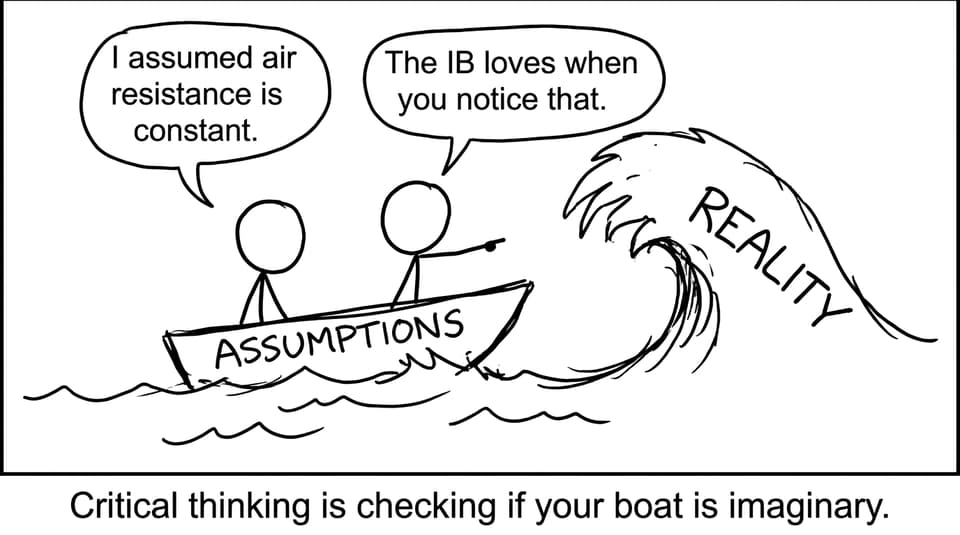
Assumptions are the hidden engines of your IA. If you don’t mention them, it looks like you didn’t notice they exist.
Examples of assumption-based reflection that reads as critical thinking:
-
“Assuming constant air resistance simplified the differential equation, but this reduces validity at higher speeds. This may explain the growing error for later time values.”
-
“The model assumes independence between trials. In practice, fatigue could introduce dependence, which would bias the probability estimates.”
To practice the writing of these moments, use short, repeatable reflection sentences. A practical guide is How to Use Reflection Sentences to Earn Marks in IB Math IA Criterion E. Those small inserts can transform an IA’s tone.
Compare alternatives without rewriting your whole IA
You don’t need to run three full methods to show critical thinking in an IB Math IA. You only need to show that you considered alternatives and can explain trade-offs.
Simple ways to do this:
-
Briefly test a second model on a subset of data
-
Explain why another approach would be appropriate but too complex for your scope
-
Mention what extra data would be required for an alternative method
This also pairs well with personal engagement. When your choices look intentional, your IA feels more like yours. If that’s a weak area in your draft, Writing the Personal Engagement Section Effectively can help you sound like an investigator rather than a summarizer.
Propose realistic improvements (and link them to your limitations)
Improvements shouldn’t be fantasy upgrades. “Use more data” is fine, but better is: which data, why, and what would change?
Strong improvement statements have three parts:
-
what you would change
-
why it matters mathematically
-
what effect you predict on results
Example:
- “Collecting measurements at smaller intervals near the turning point would reduce interpolation error and improve the derivative estimate, which currently depends on sparse data.”
If you’re unsure what strong reflection sounds like across subjects, skim real examples in High-Scoring IA Reflections: Examples and Lessons. It trains your ear for specificity.
Bringing it all together (and using RevisionDojo to sharpen it)
A strong IB Math IA doesn’t try to look perfect. It tries to look awake.
When you justify methods, check assumptions, interpret results, and propose grounded improvements, you show the examiner what they’re actually grading: your mathematical thinking.
If you want to build that voice faster, RevisionDojo is designed for it. Use the Coursework Library and IA Guides to model strong structure, the Study Notes and Flashcards to keep key techniques fluent, and the Questionbank plus Mock Exams to stay exam-ready while you write. When you’re stuck, AI Chat can help you generate better reflection prompts, and the Grading tools can help you spot where your explanation is thin.
Start with the core hub, International Baccalaureate (IB) Resources, and then revisit your draft asking one final question: “Did I show my maths, or did I show my thinking?” In the IB, that difference is the whole game.