
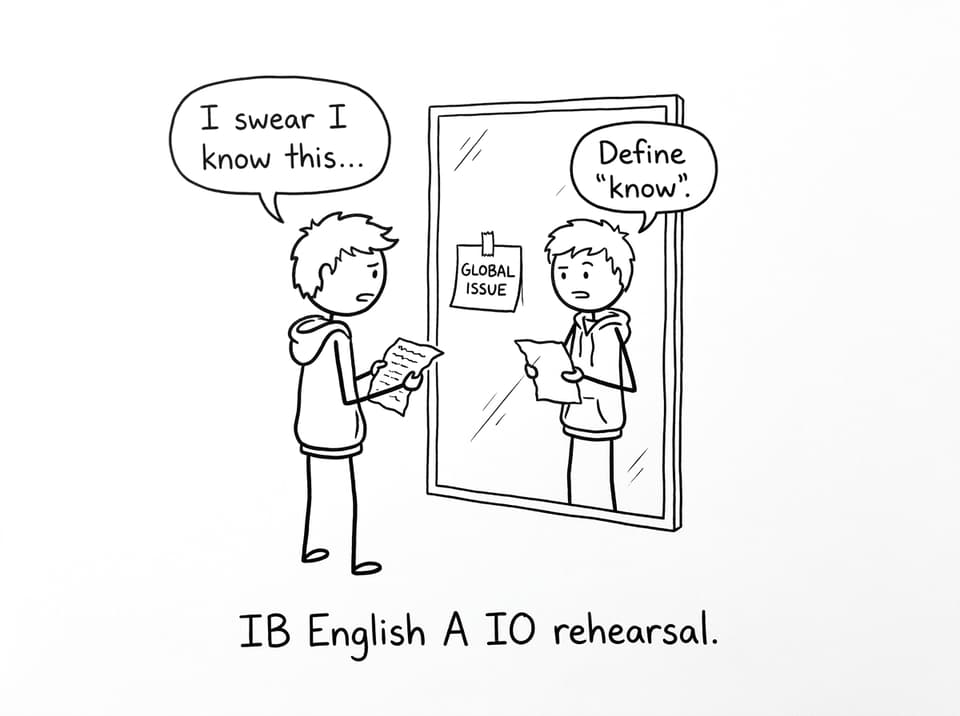
The scariest part of the IB English A Individual Oral isn’t the speaking. It’s the moment you realise you have ten minutes to prove you understand two texts, a global issue, and your own argument, without hiding behind paragraphs.
If you want high marks in the IB Individual Oral, the goal is simple: make your thinking audible. Not longer. Not louder. Just clearer.
What high marks in the IB Individual Oral actually look like
Before you write another script, anchor your prep to what the IB rewards:
-
A focused global issue that is genuinely present in both texts
-
Specific references (not plot summary) and confident interpretation
-
Technique-led analysis: how meaning is made, not just what it means
-
A structure you can deliver under time pressure
-
Calm, precise language in the discussion
If you need a quick refresher on what the assessment is and how it works, start with What is an IB Individual Oral (IO)? and then skim the criteria breakdown in Understanding the Assessment of Your IB Individual Oral (IO).
Choose a global issue that does the heavy lifting (IB marks love precision)
In the IB, vague issues create vague analysis. “Power” is a theme. “How institutions normalise surveillance to control citizens” is an arguable global issue.
A practical test: can you finish this sentence in one breath?
“This oral explores how [global issue] is represented through [authorial choices] in both texts.”
If you’re stuck, use the IB’s thematic lens to narrow quickly. Understanding the Fields of Inquiry in IB English A is a fast way to turn “interesting topic” into a defensible global issue.
For inspiration, browse high-quality examples in IB Language A: Individual Oral Examples and note how the best global issues are specific, debatable, and easy to track.
Build a structure you can repeat under pressure
The best IB English A Individual Oral structures feel almost boring, because boring is reliable.
A simple, high-mark IO flow
-
Opening (about 1 minute): define the global issue, introduce both texts, state your line of argument
-
Text 1 (about 4 minutes): 2-3 key moments + techniques + mini-conclusion linking back to the global issue
-
Text 2 (about 4 minutes): same approach, with comparisons woven in
-
Close (about 1 minute): what your comparison reveals about the global issue
To deepen this, cross-check your plan with Comprehensive Guide to the IB Individual Oral (IO) and How to Approach the IB English Individual Oral (IO).
Analyse like the examiner is allergic to summary
A useful IB rule: every time you describe what happens, follow immediately with why it matters.
Instead of: “The narrator describes the street.”
Try: “The bleak imagery compresses the setting into a feeling of inevitability, which reframes the global issue as systemic rather than personal.”
If you want extra practice turning quotes into analysis, RevisionDojo’s Study Notes and Flashcards help you drill technique vocabulary so you can retrieve it quickly under pressure.
Practise the spoken version (not the written version)
Your IO isn’t a mini-essay. It’s spoken reasoning.
Do three rounds of practice:
-
Messy run: speak from bullet points, find your real argument
-
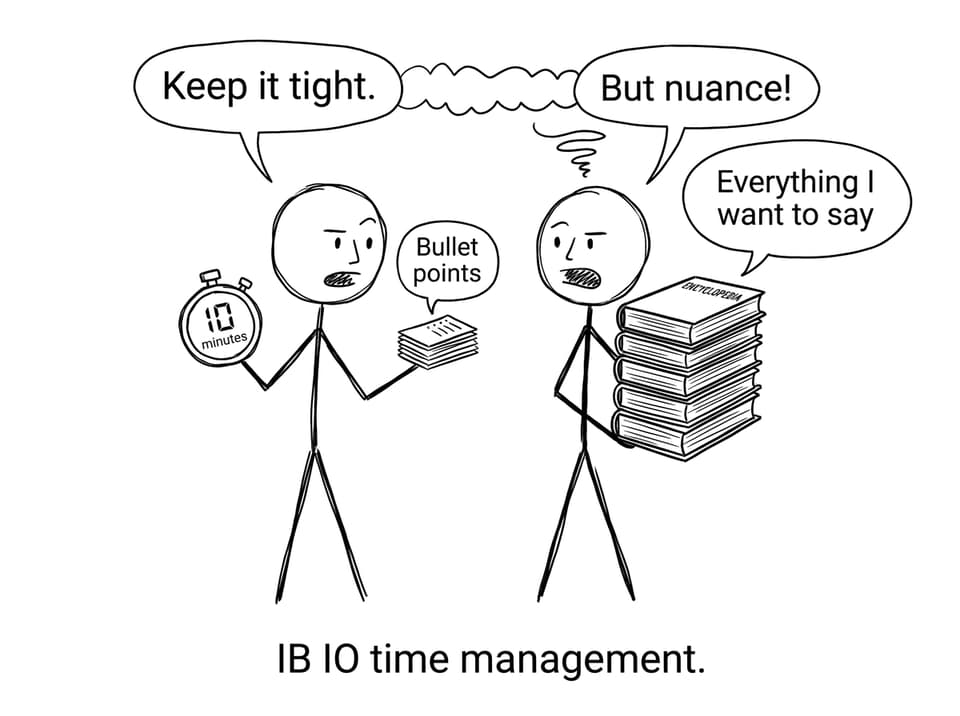
Timing run: hit 10 minutes without rushing (cut concepts, not clarity)
-
Rubric run: record, review, and adjust based on criteria
A simple schedule that works for busy IB weeks is outlined in IB Oral Practice Schedule: Regular Speaking Skill Development.
For feedback that doesn’t depend on someone being free at 9pm, use RevisionDojo’s AI Chat to test your line of argument, then record and score yourself with the IB Language A: Individual Oral Grader. Pair that with Language A Individual Oral: How to Score Higher with AI to turn each rehearsal into a measurable improvement loop.
A final IB reminder (and your next step)
High marks in the IB English A Individual Oral come from one quiet skill: saying less, but proving more. A sharp global issue. Two texts. A handful of techniques. And a voice that sounds like it believes its own argument.
When you’re ready to practise like it’s real, build your routine with RevisionDojo: use the Questionbank for skill checks, Flashcards for terminology, AI Chat for argument testing, and the Grading tools to rehearse and improve your IB Individual Oral until it feels inevitable.