
A rule can tell you what to do. An example can show you what that rule looks like in life. This distinction helps explain the relationship between hadith and Sunnah, two closely connected sources of Islamic teaching.
For IB World Religions SL students, the essential difference is simple: the Sunnah is the normative example associated with the Prophet Muhammad, while a hadith is an individual report transmitting information about his words, actions, decisions, or approvals. Hadith literature is therefore one of the principal ways through which Muslims encounter the Sunnah.
The deeper questions concern how reports were authenticated, why Sunni and Shia Muslims developed different collections, and how the Prophet's example shapes religious life. These questions turn definitions into analysis, which IB World Religions students are expected to practise.
Hadith and Sunnah at a glance
| Term | Meaning and significance |
|---|---|
| Hadith (ḥadīth, حديث) | A report concerning words, actions, approvals, or characteristics attributed to the Prophet Muhammad. The Arabic plural is aḥādīth. |
| Sunnah (sunnah, سنة) | An established way, practice, or example. Here, it usually means the normative example of the Prophet. |
| Isnad (isnād, إسناد) | The chain of transmitters through whom a report was passed. |
| Matn (matn, متن) | The report's main text or content. |
| Hadith scholarship (ʿilm al-ḥadīth) | Disciplines developed to collect, compare, classify, and evaluate reports. |
| Sharia (sharīʿah, شريعة) | The divinely guided path or ideal order. Jurists draw on the Qur'an, Sunnah, and legal reasoning when interpreting it. |
A useful revision formula is:
Sunnah = the model or way; hadith = a report that may preserve evidence of that model.
The terms sometimes overlap because hadith reports are central records of the Prophet's example. In a strong IB response, define the distinction and then acknowledge their close relationship.
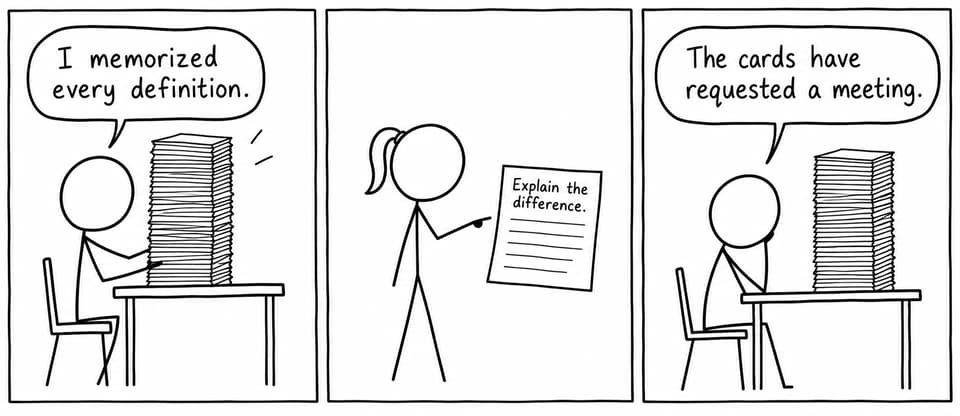
Two students confront the difference between recalling terms and explaining their significance.
Why the Sunnah has authority in Islam
The Qur'an is Islam's foundational scripture and is understood by Muslims as divine revelation. The Sunnah does not replace it. Most Muslims understand the Prophet's example as explaining and applying Qur'anic guidance.
Several Qur'anic passages are important here. Qur'an 33:21 presents the Messenger of God as an excellent example for those who hope in God and the Last Day. Qur'an 4:59 instructs believers to obey God and the Messenger, while Qur'an 59:7 tells its original audience to accept what the Messenger gives and avoid what he forbids. These verses help explain why prophetic guidance became authoritative in mainstream Islamic thought.
The relationship is visible in ritual practice. The Qur'an repeatedly commands prayer, or ṣalāh, while reports of the Prophet's practice provide substantial detail about its performance. A report recorded as Sahih al-Bukhari 631 instructs believers to pray as they had seen the Prophet pray. Hadith also contributes details connected with almsgiving, fasting, and pilgrimage.
Hadith can illuminate moral intention. The opening report in Sahih al-Bukhari teaches that actions are evaluated according to intentions. This connects outward conduct with niyyah, showing that Islamic ethics cannot be reduced to visible rule-following.
How Muslim scholars evaluated hadith
Muslim scholars developed detailed methods of criticism rather than treating every attributed statement as equally reliable. A mature analysis considers both parts of a report:
- The isnad identifies the sequence of narrators.
- The matn contains the substance of what was reported.
Scholars examined whether narrators could plausibly have met, whether the chain was continuous, and whether transmitters were considered accurate and trustworthy. They compared reports with stronger transmissions and looked for defects or contradictions. Different scholars could reach different conclusions, so classification involved learned evaluation rather than mechanical certainty.
In Sunni terminology, reports may be classified as sound (ṣaḥīḥ), good (ḥasan), or weak (ḍaʿīf), among other categories. Fabricated reports are described as mawḍūʿ. A weak report is not automatically fabricated, although its evidential value is limited.
A prophetic hadith reports something associated with Muhammad. A hadith qudsi transmits words attributed to God in meaning but is not part of the Qur'an and does not have the same scriptural status.
Sunni and Shia approaches to hadith and Sunnah
It is inaccurate to say that Sunni Muslims accept hadith while Shia Muslims reject it. Both traditions value transmitted teachings, but they differ over authoritative transmitters, collections, and methods of evaluation.
Sunni perspectives
Sunni scholarship gives prominence to reports transmitted through the Prophet's Companions and later narrators judged reliable. Six collections acquired special status as the Six Books. Sahih al-Bukhari and Sahih Muslim are generally regarded by Sunni scholars as especially authoritative.
This does not give every report in every collection identical status. Jurists consider authenticity, context, other evidence, and legal principles. Sunni legal schools can therefore respect the Sunnah while reaching different rulings.
Twelver Shia perspectives
Twelver Shia Muslims emphasize the Prophet's family, the Ahl al-Bayt, and teachings transmitted through the Imams. Their major compilations include four works known as the Four Books, including al-Kafi by al-Kulayni.
These collections are important, but Twelver scholars do not necessarily regard every report within them as authentic. Reports remain subject to evaluation. Shia scholarship also records the teachings of the Imams as authoritative interpretations of the Prophet's message.
The central difference concerns where reliable religious authority is located and how its transmission is assessed. This is a stronger comparative point than presenting Sunni and Shia Islam as uniform opposites.
Connecting the sources to the three fundamental questions
The IB World Religions framework asks students to explore three fundamental questions. Hadith and Sunnah help Muslims address each one.
What is the human condition?
Human beings are understood as morally responsible creatures who can remember God or become distracted by desire and habit. Reports about intention, mercy, pride, and repentance make this condition concrete through ordinary choices.
Where are we going?
Islamic teaching presents human life as directed toward death, resurrection, judgment, and the hereafter. Hadith expands discussion of accountability, divine mercy, paradise, and punishment alongside the Qur'an.
How do we get there?
The Sunnah offers a model of faithful practice. Prayer, fasting, charity, pilgrimage, remembrance, moral character, and social responsibility become paths through which belief is lived.
Mapping hadith and Sunnah across the five themes
The topic intersects with all five themes used in IB World Religions Islam study.
| IB theme | Connection to hadith and Sunnah |
|---|---|
| Rituals | Reports preserve guidance concerning prayer, fasting, pilgrimage, purification, and communal worship. |
| Sacred texts | Hadith collections transmit reports but are distinguished from the Qur'an in origin and authority. |
| Doctrines and beliefs | Reports contribute to discussions of prophethood, judgment, mercy, revelation, and religious authority. |
| Religious experience | Following the prophetic example can shape devotion, remembrance, belonging, and awareness of God. |
| Ethics and moral conduct | Reports address intention, honesty, family duties, generosity, justice, compassion, and social relations. |
This method prevents an essay from becoming a list of books. It shows why sources matter within lived religion. RevisionDojo's IB World Religions resource hub can help organise these connections through Study Notes, Flashcards, videos, and Questionbank practice.
How to write about hadith in an IB response
Begin by answering the command term. If asked to explain, show how hadith transmits or interprets the Sunnah. If asked to compare, choose a basis such as authority, transmitters, or collections. If asked to evaluate, weigh significance against authenticity, context, and interpretive diversity.
A reliable paragraph can follow four moves:
- Make a precise claim.
- Cite a relevant primary text or named collection.
- Explain how the evidence supports the claim.
- Add complexity through another tradition or interpretation.
For example, argue that the Sunnah makes ritual guidance concrete and use the report about following the Prophet's prayer as evidence. Then explain that Muslims rely on authenticated transmission rather than accepting every attributed report alike. A comparison could identify the different collections and networks of authority used by Sunni and Twelver Shia scholars.
Do not treat a translated quotation as self-explanatory. Identify whether it comes from the Qur'an or a hadith collection, state what it demonstrates, and avoid claims beyond its context. The guide to World Religions misconceptions helps with broad generalizations, while the World Religions study-guide collection places Islam beside other traditions.
Turn understanding into revision
Knowing vocabulary is the beginning, not the end. Create Flashcards for hadith, Sunnah, isnad, and matn, then use the Questionbank to practise distinctions and comparisons. RevisionDojo's AI Chat can test whether an explanation is precise, while its Grading tools can reveal where evidence has been named without being analysed.
Before an assessment, use Mock Exams for timed responses and Predicted Papers for unfamiliar formulations. The Coursework Library and IB World Religions investigation guidance can strengthen source awareness, while Tutors can help with interpretive questions requiring careful discussion.
The deepest lesson is modest but important. Islamic teaching cannot be represented by one quotation detached from its transmission, interpretation, and community. The Qur'an provides the foundational revelation; the Sunnah presents a prophetic model; and hadith preserves evidence through which that model is studied. RevisionDojo brings notes, practice, feedback, and expert support together so students can move from memorizing these relationships to explaining why they matter.