
For IB students sitting exams in May 2028 (started DP1 in August 2026).
To learn how to get a 7 in IB Physics 2028, build complete syllabus understanding, practise unfamiliar problems every week, and turn every mistake into a specific correction. A 7 does not require perfect papers or a flawless scientific investigation, but it does require consistently strong reasoning across Paper 1A, Paper 1B, Paper 2 and the internally assessed investigation.
Physics often feels difficult for a misleading reason. Students see an unfamiliar situation and assume they need a new formula. Usually, they need an old principle applied with more care.
That distinction should shape your preparation. Your goal is not to remember hundreds of solutions. It is to recognise the small set of physical ideas hiding inside hundreds of different contexts.
The May 2028 IB Physics framework
The current IB Physics course is the guide first assessed in 2025. Its content is organised into five themes: space, time and motion; the particulate nature of matter; wave behaviour; fields; and nuclear and quantum physics. Some sections contain additional higher level material.
As of October 2026, the IB has not published the final May 2028 examination schedule on its public schedule page. The precise Physics examination dates, 2028 grade boundaries and any session-specific instructions are therefore not yet published. Do not plan around dates or percentage targets circulating informally online.
Unless the IB announces a subsequent change, this is the assessment structure for your cohort:
| Component | SL | HL | Weighting |
|---|---|---|---|
| Paper 1A | 25 multiple-choice marks within a 1 hour 30 minute Paper 1 | 40 multiple-choice marks within a 2 hour Paper 1 | Combined with Paper 1B |
| Paper 1B | 20 data-based marks within Paper 1 | 20 data-based marks within Paper 1 | Paper 1A and 1B together: 36% |
| Paper 2 | 1 hour 30 minutes, 50 marks | 2 hours 30 minutes, 90 marks | 44% |
| Scientific investigation | Up to 3,000 words, 24 marks | Up to 3,000 words, 24 marks | 20% |
The investigation is internally marked by your teacher and externally moderated by the IB. Its four criteria are research design, data analysis, conclusion and evaluation, each worth 6 marks.
Always check instructions supplied by your school and the IB closer to May 2028. The RevisionDojo IB Physics course hub gives you one syllabus-aligned place for Study Notes, Flashcards, questions and revision tools as the course develops.
Your grade 7 checklist
A student pursuing an IB Physics top grade should be able to:
- explain each syllabus statement without hiding behind memorised wording;
- select a relevant principle before searching for an equation;
- manipulate equations and preserve units accurately;
- draw and interpret graphs, including gradients and intercepts;
- process uncertainty appropriately;
- distinguish random uncertainty from systematic effects;
- communicate complete working in multi-step responses;
- evaluate models, assumptions and experimental limitations;
- complete mixed, timed sets rather than practising only comfortable topics;
- maintain an error log that records why each error happened.
This is less glamorous than searching for a secret revision method. It is also far more dependable.
What 7-level performance looks like on Paper 1A
Paper 1A contains multiple-choice questions. Strong performance here depends on rapid interpretation, estimation and disciplined elimination, not blind speed.
Before calculating, ask three questions:
- What quantity is being requested?
- Which physical relationship controls it?
- What approximate size and direction should the answer have?
Annotated Paper 1A example
Suppose a question says that the speed of an object doubles while its mass remains constant. What happens to its kinetic energy?
A weak approach is to rely on the vague memory that energy increases with speed. A stronger response writes the governing relationship:
Then substitute the change, not unnecessary numbers:
Annotation: The important move is recognising proportionality. No calculator is needed, and the squared relationship rules out distractors based on a factor of two.
Paper 1A improves when you review your reasoning even after selecting the correct option. A lucky correct answer has not taught you anything. Use topic-filtered sets in the IB Physics Questionbank and learning hub, then record whether each miss came from knowledge, interpretation, algebra, units or time pressure.
What 7-level performance looks like on Paper 1B
Paper 1B assesses data-based reasoning. The context may look unfamiliar, but the required skills are familiar: read axes, identify trends, calculate gradients, process uncertainties and judge whether evidence supports a conclusion.
Imagine a graph of force against extension. A student chooses two nearby points and calculates a gradient without units. Another chooses two widely separated points on the best-fit line and writes:
Annotation: The second method reduces the proportional effect of reading uncertainty by using well-separated points. It also identifies the gradient as a physical quantity and includes its unit.
If asked whether the graph supports Hooke's law, do not merely write “yes, because it is straight.” A stronger answer explains that force is proportional to extension within the relevant region because the best-fit relationship is linear and consistent with passing through the origin within uncertainty.
Practise these habits through varied data sets, not by memorising graph phrases. RevisionDojo's thermal concepts notes and questions and wave characteristics resources help you move between explanation, mathematical representation and data.
What 7-level performance looks like on Paper 2
Paper 2 rewards sustained reasoning. The danger is not only reaching the wrong result. It is reaching a correct result through working that is too compressed to communicate your method reliably.
A strong solution generally follows this sequence:
- define the system or identify the interaction;
- state the governing principle;
- write the relevant symbolic equation;
- substitute values with compatible units;
- retain sensible precision during working;
- present the final answer with an appropriate unit;
- test whether its magnitude and direction are physically reasonable.
Annotated Paper 2 example
Suppose a body starts from rest and falls through height , with resistive forces neglected. Rather than searching immediately for a constant-acceleration equation, begin with conservation of energy:
Therefore,
Annotation: Starting symbolically reveals that mass cancels. It also makes later substitutions easier to check. The phrase “resistive forces neglected” justifies the energy model, so it is part of the physics rather than decorative wording.
For explanation questions, use a causal chain. For example: increasing temperature raises the particles' mean kinetic energy; collisions with the container become more frequent or involve greater momentum change; therefore the pressure rises when volume remains constant. Each sentence earns its place by linking cause to effect.
Once you know the content, use a realistic plan for getting a 7 in IB Physics to organise timed work. Predicted Papers and Mock Exams should be used later for full-paper decisions, while AI Grading tools and Tutors can help diagnose incomplete reasoning earlier.
What a strong Physics scientific investigation looks like
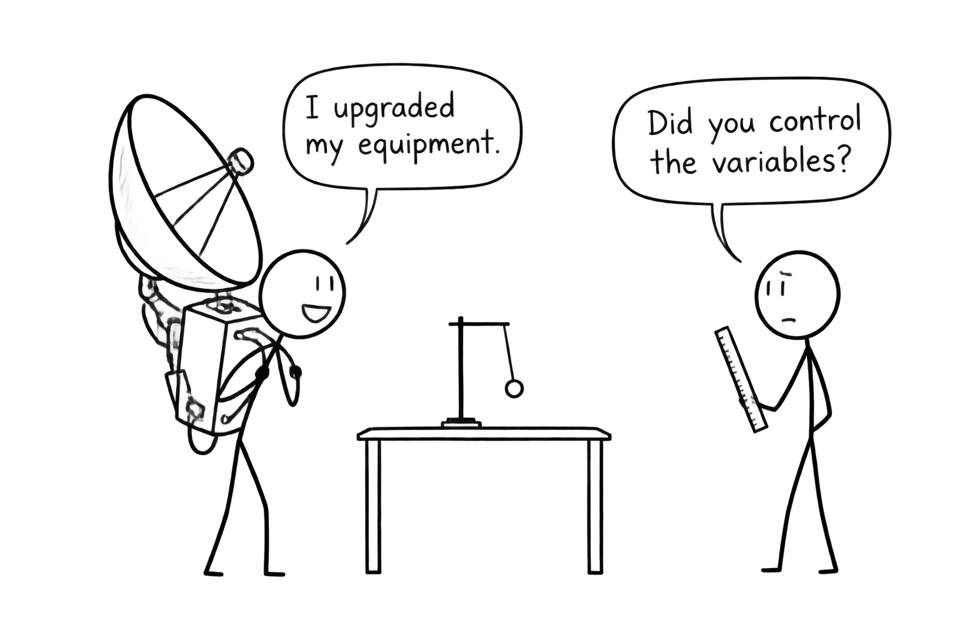
A sophisticated apparatus does not rescue a weak question. A strong investigation begins with a focused, measurable relationship and a design capable of producing enough suitable data to answer it.
For an illustrative pendulum investigation, “How does length affect period?” is a start, but it needs operational precision. A more useful question identifies the independent variable, dependent variable, relevant controls and defined range.
The report should then demonstrate strength across all four criteria:
Research design
Explain why the method can answer the question. Define how variables will be measured, justify the range and interval, control relevant factors and describe repeated measurements. Avoid listing apparatus without explaining its purpose.
Data analysis
Show transparent processing from raw measurements to the quantities used in your conclusion. Include units, appropriate uncertainties, graphs and sample calculations. A spreadsheet can calculate quickly, but your report must still make the logic visible.
Conclusion
Answer the research question using the processed evidence. Compare the result with an accepted model or value where appropriate, while accounting for uncertainty. Do not turn the conclusion into a second method section.
Evaluation
Identify specific limitations, describe their likely effect and propose realistic improvements. “Human error” is too vague. Timing a small number of oscillations introduces reaction-time uncertainty; timing more oscillations and dividing by their number is a relevant improvement.
Use the IB Physics IA grade 7 exemplars to study structure and criterion fulfilment, never to copy a question or method. The guide to distinctive Physics investigation ideas can help you test whether an idea is measurable and manageable. RevisionDojo's Coursework Library and grading tools are most useful when they sharpen your judgement, while your teacher's authentication and submission requirements remain decisive.
A two-year plan for May 2028
The advantage of starting in August 2026 is not that you can study intensely for two years. It is that you can compound small corrections for two years.
| Period | Main priority | Weekly evidence of progress |
|---|---|---|
| Aug-Dec 2026 | Learn foundations and mathematical habits | Notes consolidated, Flashcards reviewed, 15-25 focused questions |
| Jan-Jun 2027 | Connect topics and strengthen data skills | One mixed set, one graph task and an updated error log |
| Jul-Aug 2027 | Repair DP1 weaknesses | Diagnostic sets followed by targeted relearning |
| Sep-Dec 2027 | Complete content and execute the investigation | Regular mixed practice plus scheduled IA milestones |
| Jan-Feb 2028 | Shift toward exam conditions | Timed sections and deliberate markscheme review |
| Mar-Apr 2028 | Build whole-assessment consistency | Full Mock Exams, correction sessions and weak-topic loops |
| May 2028 | Preserve accuracy and readiness | Short targeted practice, formula recall and stable routines |
During DP1, spend more time learning and correcting than testing. After each lesson, turn the syllabus statement into questions you can answer without notes. RevisionDojo Study Notes and Flashcards can support recall, while AI Chat should be used to interrogate a step you do not understand rather than replace the step.
During DP2, increase mixed practice. The real examination will not announce which equation belongs to each question. Work across mechanics, fields, waves, thermal physics and quantum contexts so that selecting a model becomes part of the task. The guide to self-studying IB Physics is useful when you need a repeatable sequence of notes, retrieval and questions.
In the final months, simulate the decisions demanded by the assessment: when to move on, how much working to show and how to check units quickly. Do not measure readiness from hours studied. Measure it from errors that no longer recur.
The habit that makes a 7 more likely
A grade 7 is an aggregate result, not a requirement to be perfect in every component. The final boundary for May 2028 will be determined after the session, so no responsible guide can promise that a particular raw percentage will secure the grade.
What you can control is the quality of your feedback loop. RevisionDojo brings the Questionbank, Study Notes, Flashcards, AI Chat, Grading tools, Predicted Papers, Mock Exams, Coursework Library and Tutors into one connected IB resource. The tools matter because they shorten the distance between discovering a weakness and practising its correction.
Your specific next step is to open the RevisionDojo IB Physics Questionbank, complete ten questions from your weakest current topic without notes, and classify every lost mark as knowledge, interpretation, algebra, units or communication.