

In IB Physics, the hardest part of the Internal Assessment isn’t the math. It’s the moment you open a blank document, type “Research Question:” and realize you could investigate literally anything… which somehow makes it feel impossible.
The secret most top-scoring students discover late is quietly comforting: examiners don’t reward “big” experiments. They reward small questions asked carefully, measured honestly, and analysed deeply. Your IB Physics IA can be simple, even home-friendly, as long as it creates space for uncertainty, modelling, and thoughtful evaluation.
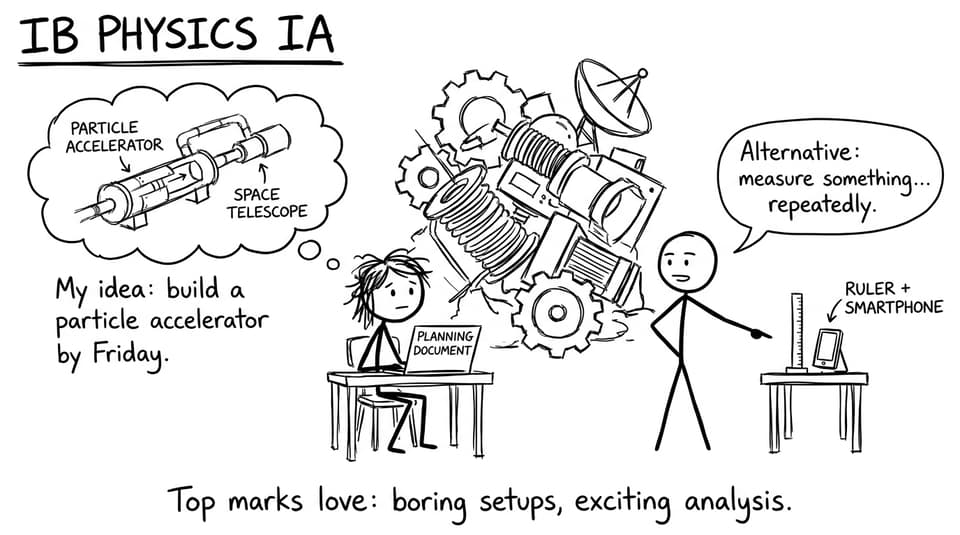
If you want inspiration that’s actually feasible (and still feels fresh), start by browsing IB Physics IA examples to see what “high-scoring simple” looks like in real life.
A quick checklist for a top-mark IB Physics IA
Before you fall in love with an idea, run it through this shortlist. It saves weeks.
-
One clear independent variable you can change in steps (distance, thickness, temperature, angle, volume).
-
One dependent variable you can measure repeatedly (time, voltage, intensity, frequency, speed).
-
Controls you can defend (ambient light, material, starting height, mass, humidity).
-
Enough trials for patterns, not anecdotes.
-
Analysis headroom: uncertainty propagation, linearisation, model comparison, residuals.
When you’re unsure what examiners look for in each criterion, keep RevisionDojo’s IB Physics Internal Assessment guide open as you plan.
What makes an IB Physics IA idea “unique” (without being risky)
“Unique” in IB Physics rarely means inventing new science. It means adding a twist that creates better data or better reasoning.
A basic idea becomes unique when you:
-
change the context (sports, music, cooking, phones, cycling),
-
improve the measurement method (video analysis, smartphone sensors, light sensors),
-
compare two models instead of confirming one,
-
or make uncertainty a core feature rather than a footnote.
If you’re revising alongside your IA, the fastest way to keep your fundamentals tight is to alternate between planning and targeted practice in the IB Physics Questionbank. It’s surprisingly effective for spotting which parts of the theory you’re hand-waving.
Unique IB Physics IA ideas (that still score high)
Below are idea families you can customise. Each one can be made SL-friendly or HL-deep depending on how far you push modelling and evaluation.
Mechanics ideas for IB Physics IAs
Mechanics is “common,” but it’s also where you can be extremely precise. Precision is a quiet advantage in IB Physics.
-
Rolling resistance with surface texture: How does surface roughness affect rolling deceleration of the same object? Add a twist by using different wheel materials or changing normal force.
-
Rotational inertia at home: How does mass distribution on a DIY wheel affect angular acceleration under a constant torque? The “unique” part is building a repeatable torque method.
-
Centripetal motion with real constraints: How does string length affect required centripetal force for a fixed speed? Make it richer by modelling air drag or measuring speed via video.
For extra syllabus support while you write, the IB Physics resources hub is useful because it connects notes, practice, and topic tools in one place.
Waves ideas for IB Physics IAs
Waves become high scoring when you stop treating them like “sound tricks” and start treating them like systems you can model.
-
Sound absorption vs material thickness: Use a phone microphone app (carefully controlled) to compare relative intensity after passing through materials.
-
Resonance in bottles, but quantified: How does air column length (water volume) change resonance frequency? Extend it by comparing open vs closed boundary conditions.
-
String frequency and tension, instrument-style: How does tension affect fundamental frequency on a homemade string instrument? Add depth by checking whether data fits an ideal string model.
If Wave Behaviour is your comfort zone, practicing topic-specific questions can sharpen your explanation fast. Try the IB Physics Topic C - Wave Behaviour page before you draft your theory section.
Electricity and magnetism ideas for IB Physics IAs
These often feel “impressive,” but you can keep them simple with careful controls.
-
Resistance and heating: How does wire thickness affect resistance and heating rate under constant voltage? This is great for uncertainty discussions and systematic errors.
-
Electromagnet design: How do coil turns affect magnetic field strength or lifting force? Add a model, then test how real results deviate.
-
Wireless transfer efficiency: How does distance affect induced voltage in a pickup coil? The analysis becomes unique when you compare against a simple field model.
When your calculations get messy, it helps to validate your physics with quick practice. The Mechanics Questionbank is also a solid place to train “method marks thinking” that carries into IA writing.
Thermal physics ideas for IB Physics IAs
Thermal projects are secretly powerful because they produce smooth curves and clean fits if you’re patient.
-
Cooling curves with container geometry: How does surface area (or container material) affect cooling constant k? Push it by comparing Newton’s law of cooling fits.
-
Insulation showdown: Which homemade insulator minimizes heat loss, and why? Make it unique by quantifying thickness, density, and trapped air.
-
Liquid heat retention: How do different liquids retain heat under identical conditions? Add a meaningful control discussion about evaporation and convection.
Modern physics ideas for IB Physics IAs
Modern physics can go wrong when it becomes “too theoretical.” Keep the equipment simple and the analysis strong.
-
LED brightness vs voltage: How does light intensity change with applied voltage for different LED colours? Add modelling with current-limiting considerations.
-
Radiation shielding (if safe and allowed): How does count rate change with absorber thickness? The uniqueness comes from uncertainty treatment and background correction.
-
Photoelectric-style investigations: If you can’t do true photoelectric effect, design a light-intensity vs sensor-response investigation and be explicit about limitations.
Common mistakes that quietly cap your IB Physics IA score
Many IB Physics IAs don’t fail because of the topic. They stall because of avoidable habits.
-
Too few data points: five points with one trial each is rarely convincing.
-
Uncontrolled measurement method: the phone sensor is fine, but the environment must be consistent.
-
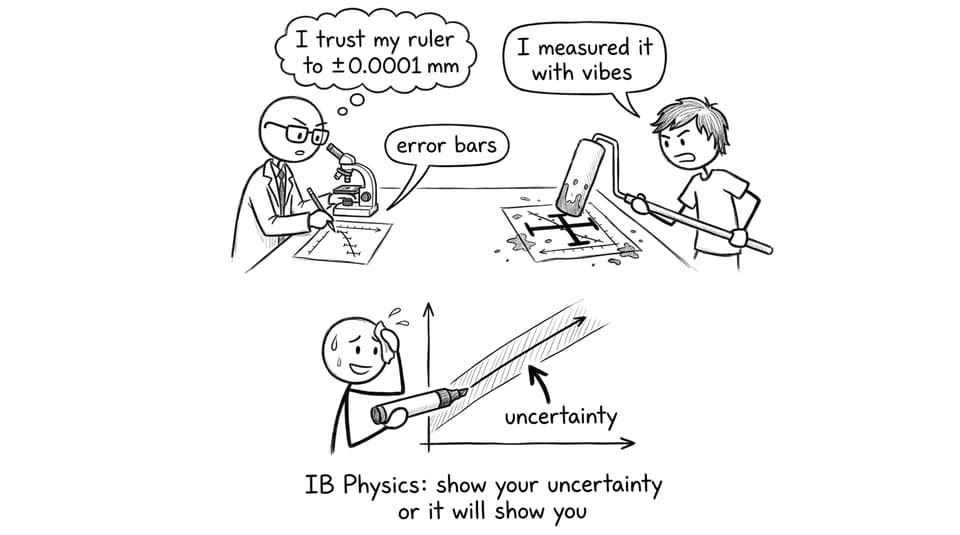
Treating uncertainty as decoration: error bars should influence your conclusion.
-
A research question that can’t be answered: “To what extent…” is only strong if you define exactly what “extent” means.
If you want a rubric-aligned way to self-check, use the IB Physics IA rubric explained guide alongside your draft, then run your work through the IB Physics IA Grader for a criteria-by-criteria reality check.
How to turn a “basic” IB Physics idea into a standout one
Take a classic: a pendulum.
A basic IA asks: “How does length affect period?” That’s fine, but it’s been done. A standout IB Physics IA asks something like:
-
What happens to period when the bob swings through different fluids (changing damping)?
-
How does period change if you move the pivot geometry (changing effective length and friction)?
-
Which model best explains the deviation at larger angles, and how do uncertainties support that?
Notice the pattern: your twist should create a better conversation with the data, not just a cooler photo.
Final thoughts: choose the IB Physics IA that lets you think
A top-mark IB Physics IA is rarely the one with the most equipment. It’s the one where the student can say, with evidence, “Here is what I measured, here is what it means, and here is how sure I am.”
If you want to move faster and feel less alone while you build it, RevisionDojo is built for this exact season of IB life: use the Questionbank to strengthen theory, Study Notes and Flashcards to keep definitions and relationships crisp, AI Chat to clarify concepts, the Grading tools to calibrate your draft, the Coursework Library for exemplars, and Predicted Papers and Mock Exams to keep exam prep moving in parallel. When you need human feedback, Tutors can help you tighten the research question and evaluation so your IB Physics work reads like it belongs at the top of the markband.
Explore the IB Physics resources and pick one idea you can measure well. In IB Physics, consistency is a superpower.