
For IB students sitting exams in May 2028 after starting DP1 in August 2026, learning how to get a 7 in IB Biology 2028 means mastering each syllabus idea, applying it to unfamiliar evidence and improving answers through frequent marking and correction. Preparation must cover Paper 1, Paper 2, the scientific investigation and confident use of the new Biology data booklet.
A 7 is rarely produced by one heroic month before the examination. It is built through smaller decisions: retrieving a definition without looking, explaining one mechanism precisely, analysing a graph rather than merely describing it, and returning to mistakes until they become difficult to repeat.
This guide reflects the Biology course first assessed in 2025 and information available for May 2028 candidates as of October 2026. The assessment structure includes Paper 1, Paper 2 and the internal scientific investigation. A dedicated Biology data booklet is being introduced for first assessment in 2028.
The final May 2028 timetable, grade boundaries and live examination questions have not been published. Boundaries can change between sessions, so no responsible guide can promise that a particular raw percentage will produce a 7. Follow the latest IB documents and guidance supplied by your school if later information differs from this article.
The 7-level checklist
A student working toward an IB Biology top grade should be able to:
- retrieve essential terminology, processes and examples without notes
- connect ideas across molecules, cells, organisms and ecosystems
- interpret unfamiliar graphs, diagrams, tables and experimental results
- use command terms to determine the required depth
- explain mechanisms through logical cause-and-effect chains
- design, process and evaluate an investigation independently
- navigate the 2028 data booklet without treating it as a substitute for understanding
- complete timed questions, mark them critically and maintain an error log
The RevisionDojo IB Biology resource hub combines Questionbank practice, Study Notes, Flashcards, AI Chat, grading tools, Predicted Papers and mock-building tools for this process.
Know the May 2028 assessment structure
Published IB Biology course information confirms that external assessment contributes 80% and the scientific investigation contributes 20% at SL and HL.
| Component | SL | HL | What it tests |
|---|---|---|---|
| Paper 1 | 36%, 1 hour 30 minutes | 36%, 2 hours | Multiple-choice questions in Paper 1A and data-based questions in Paper 1B |
| Paper 2 | 44%, 1 hour 30 minutes | 44%, 2 hours 30 minutes | Short-answer and extended-response application of biological knowledge |
| Scientific investigation | 20% | 20% | Research design, data analysis, conclusion and evaluation in an individual report |
Knowing the syllabus is necessary, but knowledge that cannot survive contact with an unfamiliar question is fragile. Paper 1B and Paper 2 reward students who can use evidence, while the investigation rewards defensible scientific decisions.
What changes for 2028 candidates
May 2028 students follow the framework introduced for first assessment in 2025. It is organised around unity and diversity, form and function, interaction and interdependence, and continuity and change. These themes connect different levels of biological organisation rather than treating every idea as an isolated chapter.
The main cohort-specific development is the Biology data booklet introduced for first assessment in 2028. It is intended for use during the course and written examinations, with clean copies provided in the examination. It supplies selected information, diagrams, equations and reference material, but it does not provide complete explanations or identify the concept being tested.
Read the guide to the IB Biology data booklet and the 2028 Biology data booklet update, then practise with the official copy supplied through your school.
What a 7 in IB Biology looks like on each paper
Paper 1A: accurate decisions under pressure
Paper 1A contains multiple-choice questions. Distractors often exploit an incomplete definition, reversed causal relationship or conclusion that extends beyond the evidence.
Try to predict the biological relationship before examining the options. Then eliminate each unsuitable choice using a specific reason. If two options remain, identify the exact word that changes their meaning.
Suppose a question asks why phospholipids form bilayers in water. Remembering a diagram is not enough. The mechanism is that hydrophilic phosphate heads interact with water, while hydrophobic hydrocarbon tails orient away from it. That reasoning remains useful when the wording is unfamiliar.
Paper 1B: evidence before memory
Paper 1B focuses on data-based questions. The central discipline is separating what the evidence shows from what your biological knowledge suggests.
Consider an illustrative dataset in which a control group has a mean response of 18 units and a treatment group has a mean response of 27 units. A precise observation would state that the treatment mean was 9 units higher, representing a 50% increase relative to the control.
This statement identifies the mean, quantifies both the absolute and relative differences, and avoids claiming statistical significance without suitable evidence. A 7-level candidate also considers uncertainty, anomalous results, sample size, controls and whether the evidence supports causation or only association. Practise these decisions through the IB Biology Questionbank, not only by rereading notes.
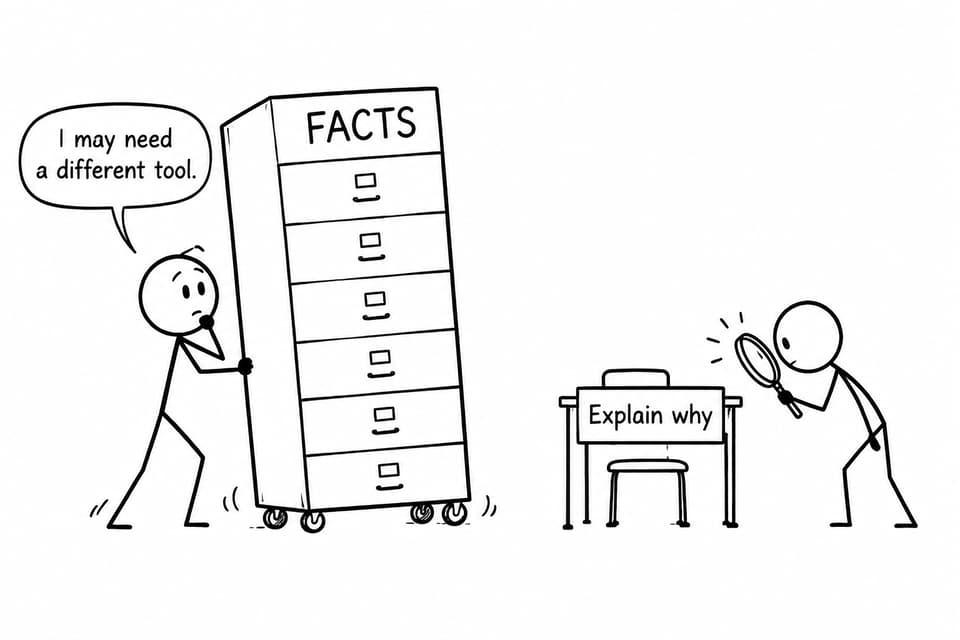
The student discovers that storing facts and explaining mechanisms require different tools.
Paper 2: build explanations in causal chains
Paper 2 combines concise responses with longer explanations. Strong answers are selective, accurate and shaped by the command term.
Imagine a question asking you to explain water movement into a plant cell. “Water enters by osmosis” names the process but does not explain it. A stronger response establishes that dissolved solutes lower the water potential inside the cell. Water moves across the partially permeable plasma membrane from higher to lower water potential. As water enters, the vacuole expands and turgor pressure increases until pressure potential limits further net movement.
That answer identifies the cause, direction, membrane and consequence. This is what “explain” demands: linked biological reasoning rather than adjacent facts. Use Study Notes to repair gaps, Flashcards to retrieve terminology and AI Chat to investigate relationships you cannot yet explain. Then return to written questions, because recognising an explanation is easier than constructing one.
How to produce a strong scientific investigation
The scientific investigation is an individual report with a maximum word count of 3,000 words. It is assessed through four equally weighted criteria: research design, data analysis, conclusion and evaluation. It contributes 20% of the final subject result.
Begin with a focused research question that identifies measurable variables and a biologically justified relationship. Your method should produce sufficient relevant data, manage important variables and record measurement uncertainty where appropriate.
Analysis must go beyond inserting a chart. Explain why each transformation, graph or statistical method is suitable. Label axes with quantities and units, preserve sensible precision, and distinguish variation in observations from instrument uncertainty.
Your conclusion should answer the research question using processed evidence and connect the findings to accepted biology without overstating certainty. Evaluation should identify specific limitations, explain their likely effects and propose realistic improvements.
| Vague evaluation | More analytical evaluation |
|---|---|
| Human error affected the results. | Judging a colour endpoint by eye may produce inconsistent stopping times and greater random variation. A colorimeter with a predefined absorbance threshold would make the endpoint objective. |
| More trials were needed. | Increasing repeats from three to at least five per treatment would make the mean less sensitive to an anomalous measurement. |
Use the IB Biology IA criteria guide before collecting data. The Biology IA common mistakes guide helps with variables, uncertainties and evaluation. You can examine authentic structures in the Biology Coursework Library, while keeping your question, analysis and writing independent.
RevisionDojo’s Biology IA grading tool can identify areas that may not satisfy the rubric. AI feedback is diagnostic, not an official IB mark or replacement for teacher guidance. A RevisionDojo Tutor can clarify experimental design or statistics without doing assessed work for you.
A two-year plan from August 2026 to May 2028
August-December 2026: build the system
After each lesson, create a concise concept map and several retrieval prompts. Within 48 hours, answer questions without notes. Record errors under four labels: knowledge, interpretation, command term and careless execution. Early practice teaches you what examinable understanding feels like.
January-June 2027: connect and apply
Mix current material with earlier topics. A session might combine membrane transport, gas exchange and water potential so ideas are retrieved in changing contexts.
Complete one data-based set each week. Annotate variables, units, patterns, exceptions, uncertainty and possible mechanisms. By the end of DP1, you should have an organised error log and clear map of weaker content.
July-December 2027: complete the investigation
Review DP1 during the summer rather than relearning it in your final term. Protect time for investigation pilot testing, data processing and revision after feedback.
Begin short timed sets and use the 2028 data booklet whenever it would be available in the examination. A reference booklet saves time only when you know where information is and how to apply it.
January-March 2028: practise full assessments
Make revision cumulative and build mixed mock exams rather than practising only favourite topics. Use IB Biology Predicted Papers as unfamiliar timed practice, while recognising that no prediction can reproduce the live May 2028 examination.
Review each mock carefully. Rewrite weak extended responses, redo calculations and explain why every corrected answer is better.
April-May 2028: consolidate
Narrow your attention to the syllabus, error log, official data booklet and realistic timed practice. Alternate full assessment sessions with targeted repair. Protect sleep and maintain a sustainable routine, because fatigue can turn known biology into avoidable reading errors.
Turn knowledge into marks
The distance between a 6 and a 7 is not always another stack of notes. Often it is noticing what the question truly asks. “State” requires a concise answer. “Describe” requires relevant features or trends. “Explain” requires reasons and mechanisms. “Evaluate” requires a balanced judgement supported by evidence.
RevisionDojo works best as a connected cycle. Study Notes establish the model. Flashcards test retrieval. Questionbank problems reveal whether it transfers. AI Chat unpacks confusion. Grading tools identify missing precision. Predicted Papers and Mock Exams develop timing. The Coursework Library clarifies standards, while Tutors provide human support when misconceptions persist.
A 7 cannot be guaranteed because grades depend on assessed work and session-specific boundaries. But preparation can become far less mysterious. Understand, retrieve, apply, review and repeat.
Your next step: open the RevisionDojo IB Biology Questionbank, choose one recently taught topic, complete ten questions without notes and record the reason for every lost mark.