
Somewhere between your third speaking recording and the tenth time you rewrite the same paragraph, you realize something quietly important: effort isn’t the issue. Feedback is.
That’s why finding the right tutor for IB Languages can feel like stepping out of fog. Not because a tutor “saves” you, but because a good one helps you see the next 1% improvement you couldn’t spot alone. And in IB Languages, those 1% gains stack fast.
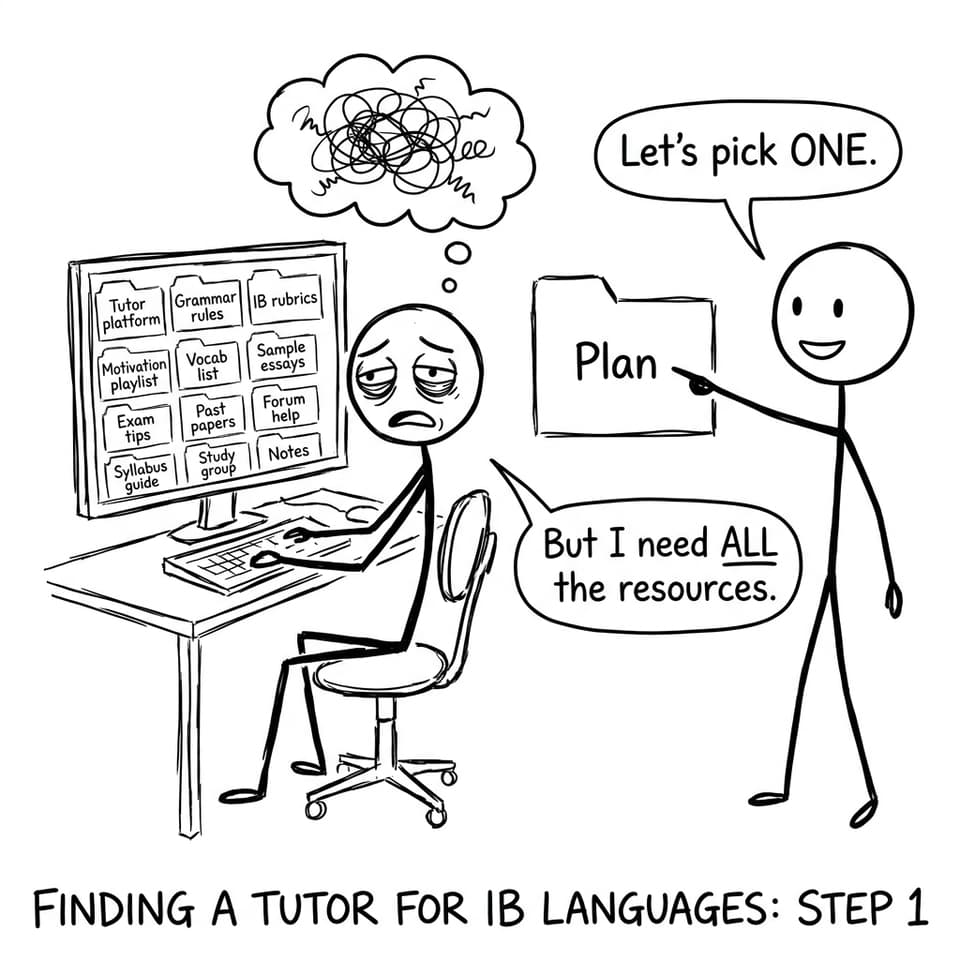
A quick checklist before you search (IB Languages)
Keep this short on purpose. You can refine later.
-
Your course: Language A (Lit/LangLit) or Language B/ab initio in IB Languages
-
Your weak point: speaking fluency, Paper 1/2 writing, listening, or grammar accuracy
-
Your timeline: mocks, finals, or “I need consistency starting this week”
-
Your feedback style: gentle coaching vs. direct correction
If you can answer these, you’ll stop shopping for a tutor and start matching.
What a great IB Languages tutor actually does
A tutor for IB Languages isn’t just someone who “knows the language.” They know what the IB rewards: clarity, control, organization, and the ability to do it under time pressure.
A strong tutor should be able to:
-
Diagnose patterns (not just fix typos)
-
Teach you repeatable structures for timed tasks
-
Build speaking confidence without letting errors fossilize
-
Make your practice measurable
If you want a benchmark for quality, look at an IB-only tutoring ecosystem like RevisionDojo Tutoring, where tutors are already oriented around IB outcomes.

Where to look for IB Languages tutors (and how to filter fast)
You can explore broad platforms, but your best shortcut is finding tutors who live in the IB world daily.
On RevisionDojo, you can browse Tutors and start with a fit-check lesson through the Tutoring overview. If you want context on how vetted IB tutoring works, these guides help:
How to run a trial lesson for IB Languages
Treat the first session like a mini-diagnosis. Bring one piece of work and one recording (even if it’s awkward). Ask for three things:
-
One strength you should keep repeating
-
One weakness that costs the most marks
-
One weekly routine you can actually maintain
Then make sure you leave with a plan that connects practice to feedback. For example: drill skills using a Questionbank, tighten memory using IB Flashcards with Spaced Repetition (SRS), and check progress with RevisionDojo’s AI Chat and grading tools.
If you want a structured practice loop, pair tutoring with RevisionDojo’s platform for IB: RevisionDojo for IB.
How to use RevisionDojo tools between sessions (IB Languages)
Tutoring works best when it’s not doing all the work.
Between sessions, keep it simple:
-
Use Study Notes to clarify rules you keep missing
-
Turn corrections into Flashcards (grammar, connectors, text-type phrases)
-
Use AI Chat to rehearse explanations and build sentence flexibility
-
Run timed practice in the Questionbank and review mistakes
-
Add accountability with Mock Exams and Predicted Papers for realistic pressure
This is how IB Languages stops feeling like “more exposure” and starts feeling like skill-building.
Final thought: choose the tutor, then build the system
The right tutor for IB Languages won’t just explain things well. They’ll help you build a routine that makes improvement inevitable.
If you want that routine in one place, use RevisionDojo as your hub: tutoring for strategy, Questionbank for deliberate practice, Flashcards for retention, AI Chat and grading tools for fast feedback, and Mock Exams plus Predicted Papers to pressure-test your skills. Start by exploring RevisionDojo Tutors and make your next session the one that finally feels like progress.