This site uses cookie tracking technologies. Learn more in our Cookie Policy.
IB Tutor Selection Guide: How to Choose the Best Fit | RevisionDojo
Join 600k+ Students Already Crushing Their Exams
Your first IB tutor search usually starts the same way: a burst of motivation, a few tabs open, and the quiet fear that you might pick the wrong person and waste precious weeks.
The truth is, most students don’t need a “perfect” tutor. They need a tutor who understands how IB marks are actually earned, spots patterns in their mistakes, and builds a routine they can repeat under pressure.
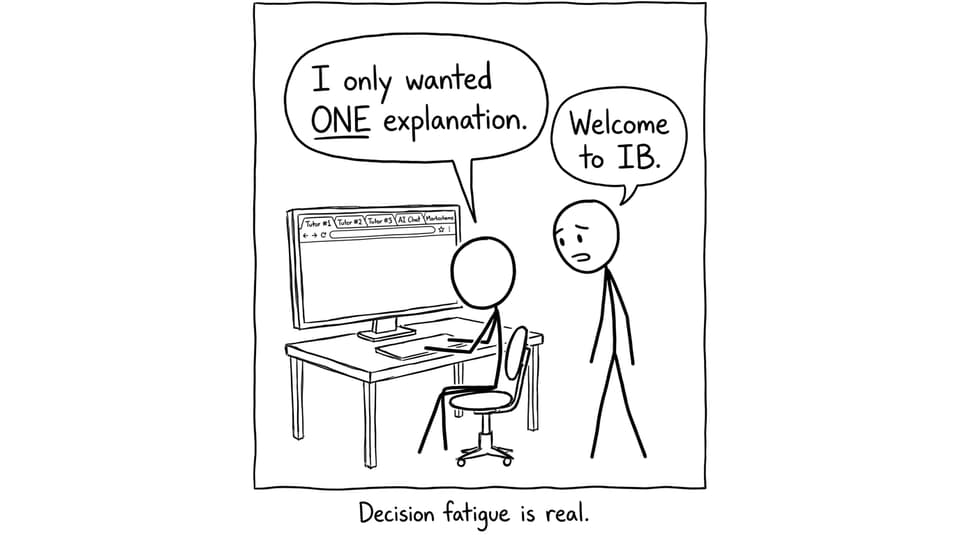
Decision fatigue while choosing a tutor
A quick IB tutor checklist (save this)
Before you book anything, screen for these five things:
IB-specific proof: they can talk in criteria, command terms, and paper skills (not just “content”).
A clear improvement loop: explain, practice, feedback, re-test.
Subject fit: STEM problem-solving vs essay coaching are different crafts.
Communication style: calm, precise, and willing to correct you.
Tools that support you between sessions: so momentum doesn’t die on Tuesday night.
If you want a curated place to start, browse RevisionDojo Tutoring and scan profiles by subject, level, and approach.
What “IB expertise” really looks like
A strong IB tutor doesn’t just know the syllabus. They know what examiners reward.
“Your definition is right, but it’s not mark-scoring yet.”
“Let’s match your method to the command term.”
That’s why pairing tutoring with criterion-aligned practice matters. After a session, you should be able to drill the same skill immediately using the RevisionDojo Questionbank and turn weak spots into a plan.
Rubric treasure map joke
Questions to ask in a trial lesson
Treat the first meeting like a diagnostic, not a sales call. Ask:
“How do you measure progress in IB?”
A good tutor will mention error patterns, timed practice, and feedback cycles. Vague answers like “we’ll go through topics” are a red flag.
“How will you adapt if I’m stuck?”
You want someone who can switch explanations, use different representations, and then test you again.
“What will I do between sessions?”
The best tutors give you a short weekly loop: a few targeted questions, a quick review method, and one timed block.
RevisionDojo makes this easy to maintain with Study Notes for fast clarification and Flashcards for daily recall.
AI vs human tutoring for IB: use both, on purpose
Here’s the calm answer: AI is great for speed. Humans are great for judgment.
Use AI Chat when you need an instant explanation at 11:47 p.m., or when you want another example in a different style. On RevisionDojo, Jojo AI is built for IB-style thinking, so it helps you stay aligned with exam expectations.
Final takeaway: choose the IB tutor who builds your loop
The best IB tutor is the one who turns your effort into marks: clear explanations, criteria-aware feedback, and a plan you can repeat.
To make that sustainable, use RevisionDojo as your support system between sessions: Questionbank for practice, Study Notes for clarity, Flashcards for recall, Jojo AI Chat for instant help, plus Grading tools, Mock Exams, Predicted Papers, a Coursework Library, and Tutors when you want a human to raise the standard.
If you’re ready to pick a tutor without guessing, start here: RevisionDojo Tutoring.