
Mathematical accuracy in the IB Math IA is rarely lost in one dramatic mistake. It usually slips away quietly: a unit that changes halfway down the page, a regression copied correctly but interpreted loosely, an assumption that feels “reasonable” until you test it.
If you’ve ever reread your IA and thought, I’m pretty sure this is right, you’re already close to the real standard. In the IB, “accuracy” isn’t just a correct answer. It’s a trail of evidence that convinces a skeptical reader that your mathematics is consistent, justified, and responsibly communicated.
This guide shows you how to evaluate mathematical accuracy in your IB Math IA the way an examiner would--calmly, systematically, and with checks that actually catch problems.
A quick accuracy checklist you can run in 20 minutes
Before you edit sentences or redesign graphs, run this IB Math IA accuracy pass:
-
Recalculate your key results using a second method (calculator/CAS/spreadsheet or manual).
-
Scan for unit consistency and dimensional sense in every major formula.
-
Re-state assumptions and test how sensitive your results are to them.
-
Check graphs: labels, scales, regression type, and whether conclusions match visuals.
-
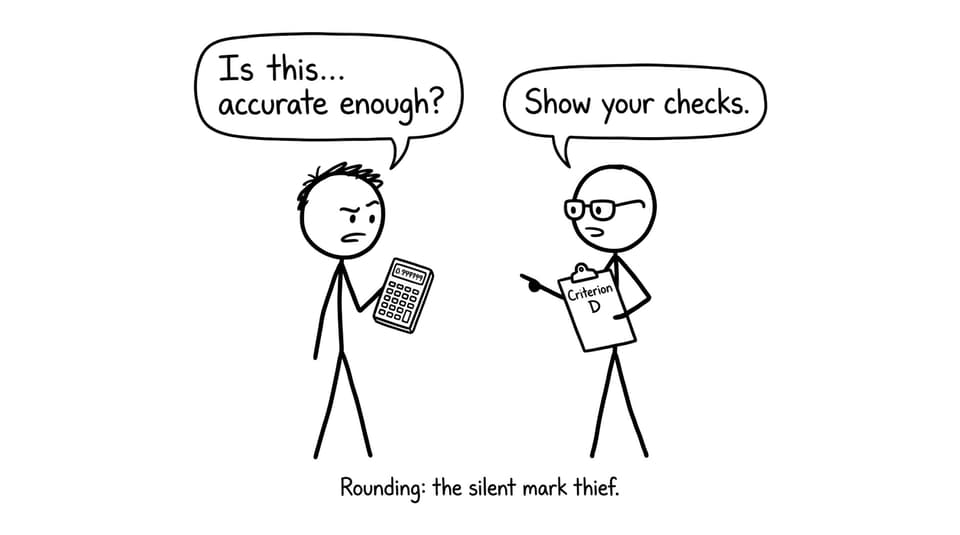
Audit rounding: keep precision during working, round at the end, and stay consistent.
-
Add uncertainty or error discussion wherever measurement or approximation exists.
For a rubric-aligned view of what examiners look for, start with Unpacking the IB Math IA Assessment Criteria and keep it open while you revise.
What “mathematical accuracy” means in an IB Math IA
In the IB, accuracy is a blend of precision and trust. It includes:
-
correct computations and algebra
-
valid logical steps (no hidden leaps)
-
consistent notation and definitions
-
appropriate units and dimensions
-
conclusions that match the math you actually did
This matters directly for the “Use of Mathematics” criterion, but it also spills into communication and reflection. If you want the accuracy standard in context, pair this article with How to Write a Top-Scoring Math IA (2025 Guide) and How to Structure Your IB Math IA Logically. A clean structure makes accuracy easier to prove.
Cross-check calculations the IB way (without rewriting everything)
A strong IB Math IA doesn’t just do calculations--it shows they’ve been verified.
Use a “two-engine” check
Pick the 3–5 calculations your conclusion depends on most (parameters, predicted values, optimized points, test statistics). Then redo each one with a different “engine”:
-
If you used CAS first, verify with a spreadsheet or manual substitution.
-
If you used calculator regression, verify with technology that outputs residuals too.
-
If you did manual algebra, verify by plugging the result back into the original equation.
A simple sentence can carry a lot of credibility: “Key parameters were recalculated using an independent method to confirm computational accuracy.”
If you keep making the same algebra slips in timed practice, use targeted drills in RevisionDojo’s Questionbank (and the Grading tools) to identify patterns, not just errors. For example, AA students can tighten calculus accuracy with IB Math AA Calculus Questionbank.
Units and dimensional consistency: the fastest accuracy win
In many IB Math IAs, the math is “correct” but the units quietly break the story.
Do a dimensional scan
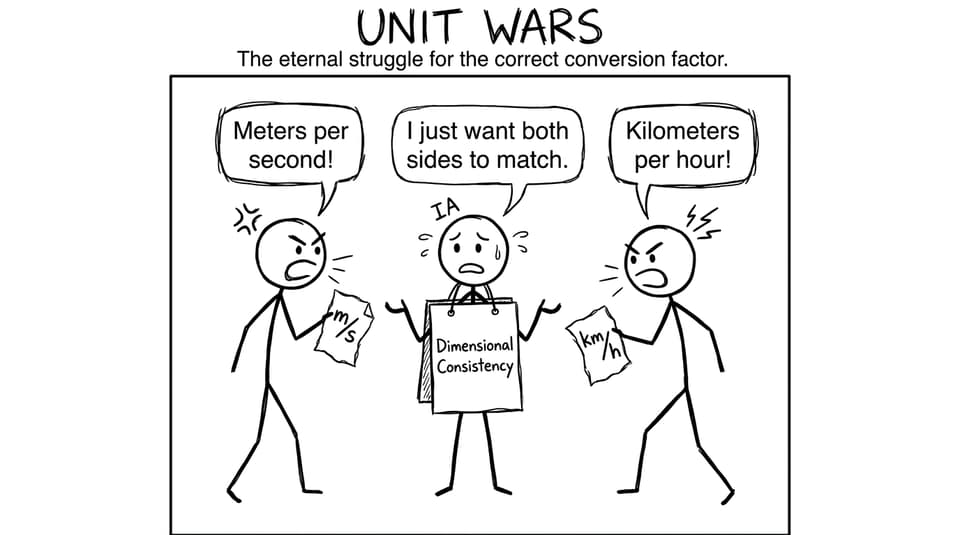
For every key equation, ask: do both sides reduce to the same base units? If you model force, energy, growth rate, or probability, your units should either match or be explicitly dimensionless.
Common IA problems:
-
mixing seconds and minutes mid-table
-
labeling an axis with one unit while using another in the model
-
treating percentages as decimals in one place and “%” in another
A practical habit: under each major formula, write the units once. It’s a small line that signals big care.
To tighten mathematical communication overall (symbols, definitions, notation), use How to Use Mathematical Language and Notation Correctly in the IB Math IA. In the IB, “accurate” includes “clearly stated.”
Assumptions: accuracy isn’t only arithmetic
Your IA can be numerically perfect and still feel inaccurate if assumptions are unrealistic or untested. Examiners notice when your model rests on a convenient simplification that you never revisit.
Test sensitivity, not perfection
Choose one assumption and vary it by a realistic amount. If your result changes significantly, that’s not a failure--it’s reflection.
Example moves that work in an IB IA:
-
Change a measured value within its uncertainty and recompute a key output.
-
Compare two plausible models (linear vs exponential; quadratic vs logistic) and justify the choice.
-
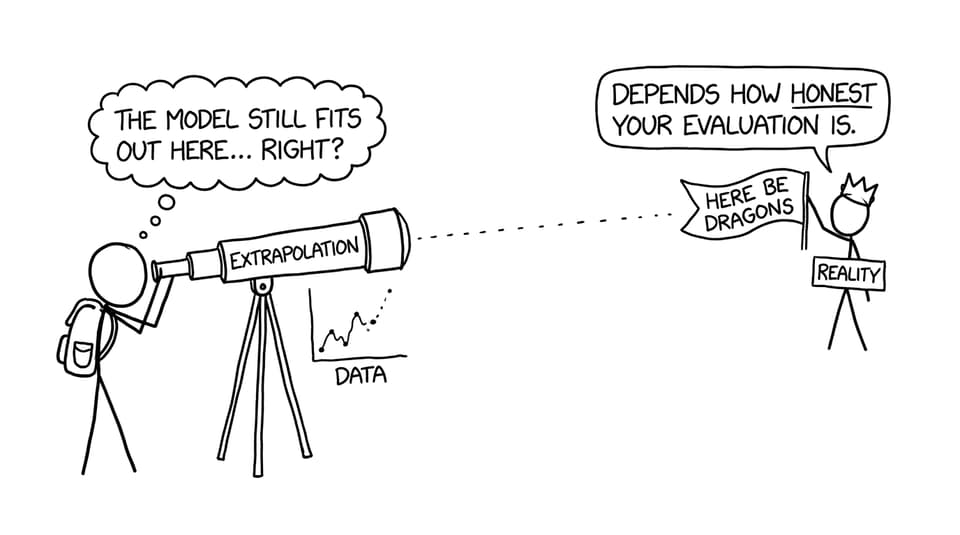
Restrict the domain and explain why predictions outside it are weaker.
For students doing data modeling, How to Use RevisionDojo to Prepare for IB Math IA Data Analysis pairs well here. It helps you check whether your model choice actually matches your data story.
Model fit and graphs: accuracy must look like accuracy
Graphs are where a lot of IB Math IA accuracy either becomes obvious or collapses.
Evaluate fit with at least two lenses
-
Numerical fit: use metrics like correlation and R² when appropriate.
-
Visual fit: inspect residuals or systematic deviations.
Then connect it back to meaning: does the model behave as expected? If a parameter implies something impossible (negative time, probability above 1, growth rate that contradicts the context), that’s an accuracy red flag.
If you’re unsure what counts as “good evaluation,” look at real standards through Using IA/EE Exemplars to Improve Your IB Math IA. Seeing how top students discuss limitations is often the missing piece.
Rounding, significant figures, and the illusion of precision
The IB doesn’t require you to carry 12 decimal places. It requires consistency.
-
Keep full precision in intermediate steps.
-
Round final results appropriately (often 3–4 significant figures, depending on context).
-
Match your table precision to your measurement precision.
A sneaky issue: students round in the table, then use the rounded values in later calculations, then wonder why results don’t match. If your chain of reasoning depends on a number, keep the unrounded version somewhere in your working.
A RevisionDojo workflow for accuracy (IA + exam prep)
Accuracy is a habit, not a one-time edit. RevisionDojo is built to make that habit easier across your IB workload:
-
Use the Coursework Library and IB Maths AI IA Examples to benchmark what “accurate and clear” looks like.
-
Use AI Chat to challenge your steps: “Where could a unit mismatch exist?” or “What assumption is weakest?”
-
Use Grading tools like IB Maths AA IA Grader or IB Maths AI IA Grader to self-audit against criteria.
-
Use Flashcards for error patterns (sign errors, transformation rules, regression interpretation).
-
Use the Questionbank, Mock Exams, and Predicted Papers to make accuracy automatic under time pressure.
-
If you’re stuck, RevisionDojo Tutors can help you validate method choice and checking strategy, not just “get the right answer.”
Closing: make accuracy visible, not assumed
In the IB, mathematical accuracy is less about never slipping and more about proving you can catch slips before they become conclusions. When your calculations are cross-checked, your units behave, your assumptions are tested, and your graphs tell the same story as your equations, your IA starts to feel inevitable--in the best way.
If you want a faster, calmer way to validate your draft, use RevisionDojo’s IA Guides, Exemplars, AI Chat, and Grading tools, then reinforce the same skills through the Questionbank, Mock Exams, and Predicted Papers. Accuracy is what carries your work from “probably right” to unmistakably IB-level.
