



You can usually tell, within the first 20 seconds, whether a presentation is going to land.
Not because the research is better. But because the speaker is present. They know where they’re taking you. In IB Theatre, that calm presence matters as much as the facts, because the Research Presentation isn’t a history lecture. It’s evidence that you can investigate a world theatre tradition, apply conventions in practice, and reflect like a theatre-maker.
This guide shows you how to deliver a confident, engaging IB Theatre Research Presentation that feels focused, alive, and examiner-friendly.
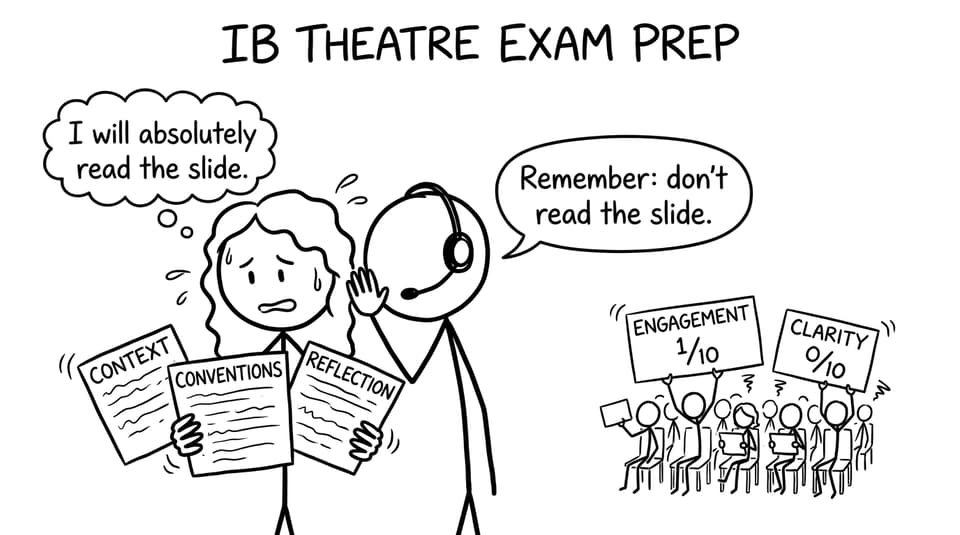
Quick checklist before you rehearse
-
Choose a simple throughline: one tradition, one question, 2-3 conventions.
-
Build a structure you can say out loud without notes.
-
Plan one short practical demonstration (even 15 seconds).
-
Design slides that support your voice, not replace it.
-
Practice reflection language: impact, limitation, discovery, next step.
If you’re still shaping content, start with How to Prepare for the IB Theatre Research Presentation and the Best World Theatre Traditions to Research guide.
Why delivery changes your mark in IB Theatre
A surprising truth about IB Theatre is that examiners reward clarity the way audiences do: they can’t credit what they can’t follow. Strong delivery signals that you understand your material deeply enough to perform it as an argument.
Delivery also proves you can connect the syllabus strands: theatre in context, theatre processes, and presenting theatre. If you want a wider map of what that means, read Dive into the World of IB Theatre: An In-Depth Syllabus Overview.
Build a structure that sounds inevitable
The easiest way to look confident is to remove decisions from the moment. A tight structure gives you that.
Use this spine (and keep returning to it):
Opening: your promise to the audience
Say your tradition and research question clearly. Then tell us what you’ll show, not what you’ll cover.
Example: “Today I’ll show how Convention X and Convention Y in [tradition] shape the audience relationship, and what changed when I tested them practically.”
Context: only what your conventions need
In IB Theatre, context matters when it explains a choice. Choose two contextual points that directly feed your conventions. For a workflow that keeps you focused, use Connecting Culture and Context in IB Theatre Research.
Conventions: go deep, not wide
Pick 2-3 conventions and unpack them:
-
What is it?
-
What does it communicate?
-
What does an audience learn from it?
-
What does it demand from the performer?
Application: the moment you become a theatre-maker
Demonstrate a gesture, spatial rule, vocal pattern, or staging choice. Describe what you tested, what shifted, and what you’d refine.
Reflection: evaluate like a practitioner
Reflection is where many IB Theatre students accidentally become descriptive. Keep it evaluative:
-
This was effective because…
-
This limitation mattered because…
-
Next time, I would…
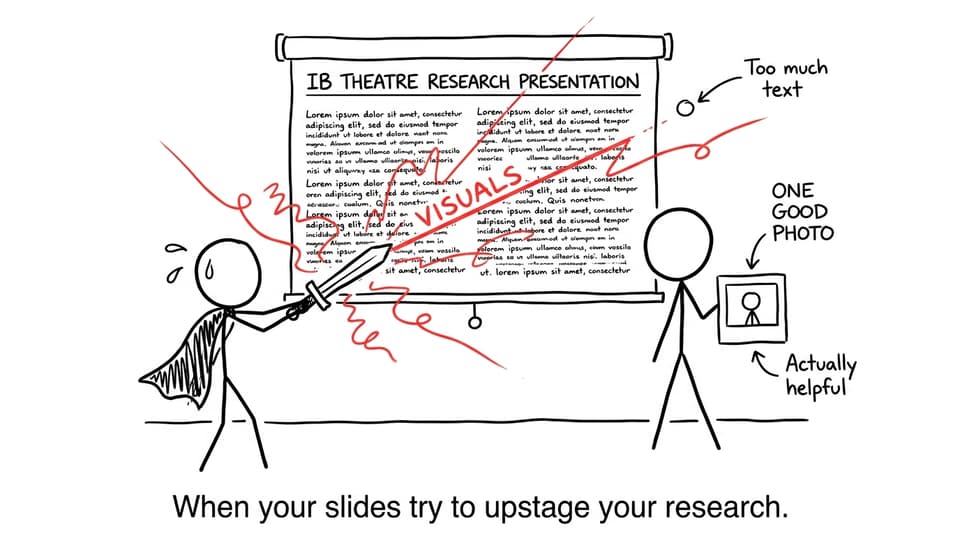
Use visuals without losing the room
Slides should function like stage lighting: they guide attention, they don’t steal it.
Rules that work:
-
One image or one short quote per slide.
-
Keywords, not paragraphs.
-
Label images with what the examiner should notice (one line max).
When you’re revising content, RevisionDojo’s Questionbank style of targeted practice is a good mindset: focus on one skill at a time, then tighten. Build your own “presentation questionbank” by rehearsing each section separately (intro only, conventions only, reflection only).
Rehearse like it’s performance, not memorization
Confidence is rarely a personality trait. It’s usually evidence of repetition.
Try this three-pass rehearsal:
Pass one: speak from beats
Use 5-7 cue cards with beats (Context, Convention 1, Test, Reflection). No full sentences.
Pass two: timed run with a pause rule
If you forget a phrase, pause. Don’t fill space with “um.” Pauses read as control.
Pass three: examiner simulation
Stand up. Use your slides. Do your demonstration. End with your reflection. Then ask someone to summarise your argument in one sentence. If they can’t, simplify.
To build long-term consistency across tasks, keep Best Study Strategies for IB Theatre Students (SL & HL) open while you plan your weekly routine.
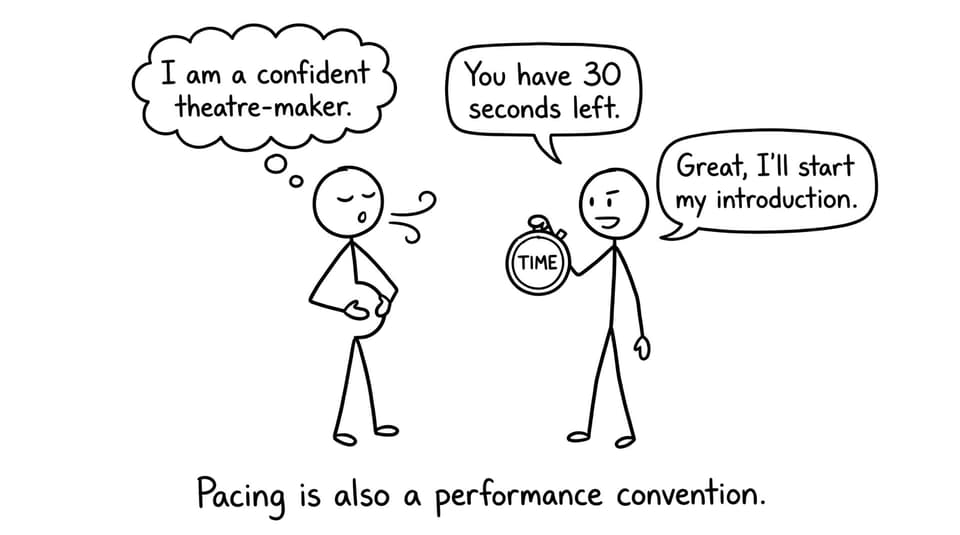
The engagement tools that quietly win marks
In IB Theatre, engagement doesn’t mean being loud. It means being intentional.
Use:
-
Eye contact on transitions: especially when you move from context to conventions.
-
Vocal variety on evaluation: lift energy when you state a discovery.
-
One rhetorical question: “What happens to the audience when the performer refuses realism?”
-
A clean ending: one sentence that answers your research question.
If you’re aiming for top marks across the course, How to Score a Level 7 in IB Theatre: Complete Guide is worth bookmarking.
Closing: make it feel like theatre, not a slideshow
A great IB Theatre Research Presentation feels like a guided journey: you invite the examiner in, you show them the world of the tradition, you test something real, and you end with a clear evaluation of what changed in you as a theatre-maker.
When you want that process to be easier, build your routine inside RevisionDojo: use Study Notes and Flashcards to lock in terminology, practice explanation under pressure with the Questionbank mindset, ask Jojo AI Chat for sharper reflection phrasing, and use Grading tools to check whether your evaluation is actually evaluative. Then rehearse once more, with the calm certainty that you’re not just presenting research; you’re presenting understanding.