


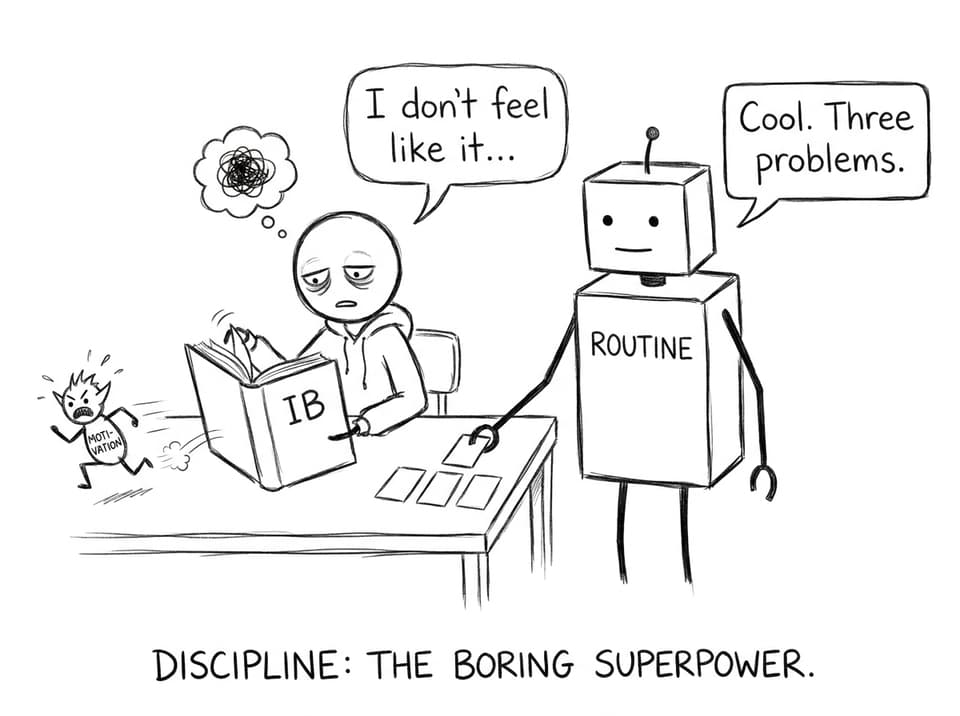
Discipline is strange: it rarely arrives with a surge of confidence. It usually shows up quietly, like you sitting down to do three problems on a day you’d rather not.
Most IB students think discipline is a personality trait. The top students know it’s closer to plumbing. Build a simple system, keep it running, and it delivers results whether you feel inspired or not.
This post is about building discipline through daily problem solving for IB exams. Not heroic study marathons. Not waiting for motivation. Just the small, repeatable loop that turns practice into identity.
The daily problem solving checklist (save this)
If you want the simplest structure for IB discipline, use this:
-
Pick a daily minimum you can finish in 10-30 minutes.
-
Do topic-matched questions, not random ones.
-
Check feedback immediately and write one error rule.
-
Track the streak so you’re protecting a system, not a mood.
-
Once per week, add a timed block to train pacing.
When you keep the minimum small, you stop negotiating with yourself.
Why daily problem solving builds IB discipline
Here’s the unfair advantage of daily problem solving: it lowers the cost of starting.
When you practice only on “good” days, every session feels like a big event. You need silence, time, energy, the right playlist, the perfect desk setup. When you practice daily, you train your brain to begin even when conditions aren’t perfect.
That’s what discipline actually is in the IB context: the ability to start on ordinary days.
Daily problem solving also creates feedback loops. One question reveals a gap. The gap tells you what to revise. The revision becomes the next set of questions. That loop is exactly how high scorers stop drifting and start steering.
A practical place to run this loop is RevisionDojo’s ecosystem: Study Notes for quick clarity, Flashcards for recall, Questionbank for daily problem solving, and AI Chat to unblock misconceptions fast. Then layer in Grading tools, Predicted Papers, and Mock Exams when you’re ready to simulate exam pressure.
Build your “minimum viable IB session”
The most sustainable IB discipline comes from choosing a minimum you can do on your worst day.
Try one of these daily minimums:
-
3 problems (if you’re rebuilding consistency)
-
5-7 problems (if you’re stable and improving)
-
10 problems (if you’re close to exams and have time to review deeply)
The key is that your daily problem solving minimum should feel almost too easy to begin. You can always do more, but you’re never allowed to do zero.
To keep it structured, use the RevisionDojo Questionbank to filter by topic and difficulty. Topic filtering removes decision fatigue, which is where most discipline quietly dies.
Choose topics with intention (not guilt)
A common IB trap is “rotation without reflection.” Students rotate topics to feel balanced, but they don’t rotate based on results.
A better approach:
-
Pick one weak micro-topic (not an entire unit).
-
Do a short set of daily problem solving questions on that micro-topic.
-
When accuracy stabilizes, move on.
If you need a bigger framework for exam preparation, use these guides as your compass:
And when your sessions start feeling long but unproductive, this one is a reality check:
Use a fixed study window to make discipline automatic
Pick a daily time that’s boring and repeatable.
Good options for IB students:
-
Right after school (before your brain negotiates)
-
After dinner (when the day is basically done)
-
The first 20 minutes after you sit at your desk
You’re not choosing the “best” time. You’re choosing the time you’ll actually keep.
This is also where RevisionDojo helps because everything is already in one place: notes, practice, feedback, and review tools. Less tab-hopping means less friction, which means more discipline.
If you want habit-focused guidance, read:
The quality rule: fewer problems, deeper review
Daily problem solving only builds IB discipline if you respect review.
A simple rule: review longer than you practiced at least once or twice per week.
During review, don’t just read solutions. Do this instead:
-
Identify what went wrong (content gap, method, command term, careless error, timing).
-
Write one sentence: an error rule.
-
Retest with 2-3 similar questions.
If you want to strengthen memory so your daily problem solving sticks, pair it with spaced repetition using:
This is the loop that keeps discipline from turning into mindless grinding: learn a small piece, recall it, apply it, review mistakes.
Add one weekly “pressure rep”
Discipline isn’t just doing questions. It’s doing questions when they feel heavier.
Once a week, add a timed session:
-
One timed section
-
A mixed-topic set
-
A short simulation that forces pacing decisions
Then use RevisionDojo’s Mock Exams and Predicted Papers to make pressure feel familiar, and its Grading tools to keep feedback honest. If coursework is draining your energy, the Coursework Library and Tutors can protect your schedule by reducing uncertainty and wasted effort.
To avoid burnout while you ramp up, keep this close:
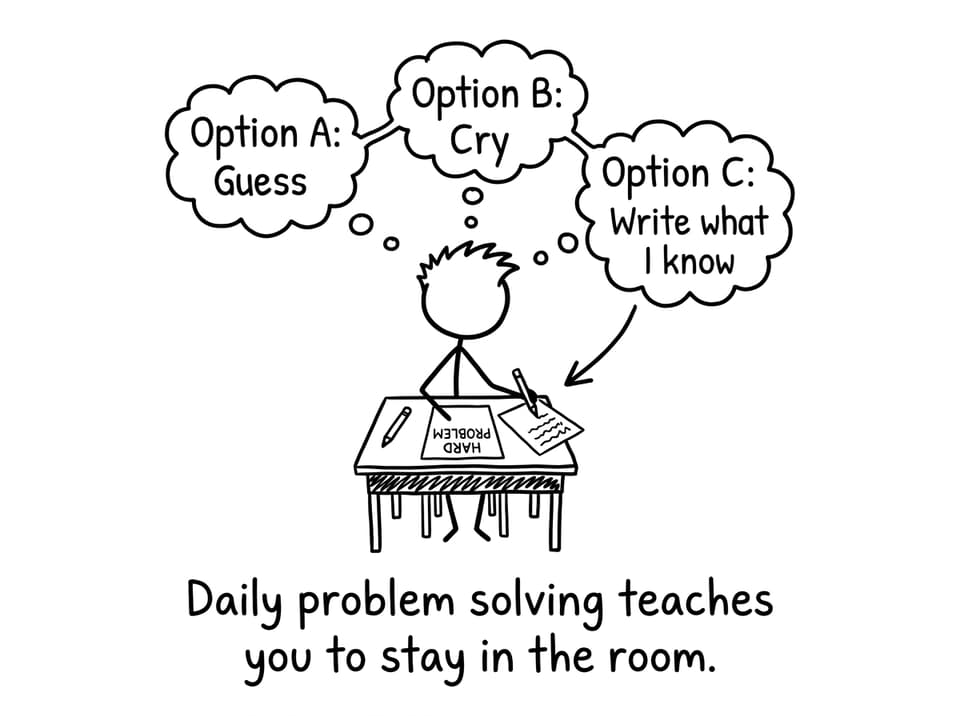
Common mistakes that quietly break IB discipline
Daily problem solving fails for predictable reasons. Watch for these:
-
The goal is too big. If you dread starting, shrink the minimum.
-
You do random questions. Random feels productive but doesn’t fix weaknesses.
-
You skip review. Without review, you repeat the same mistakes with more confidence.
-
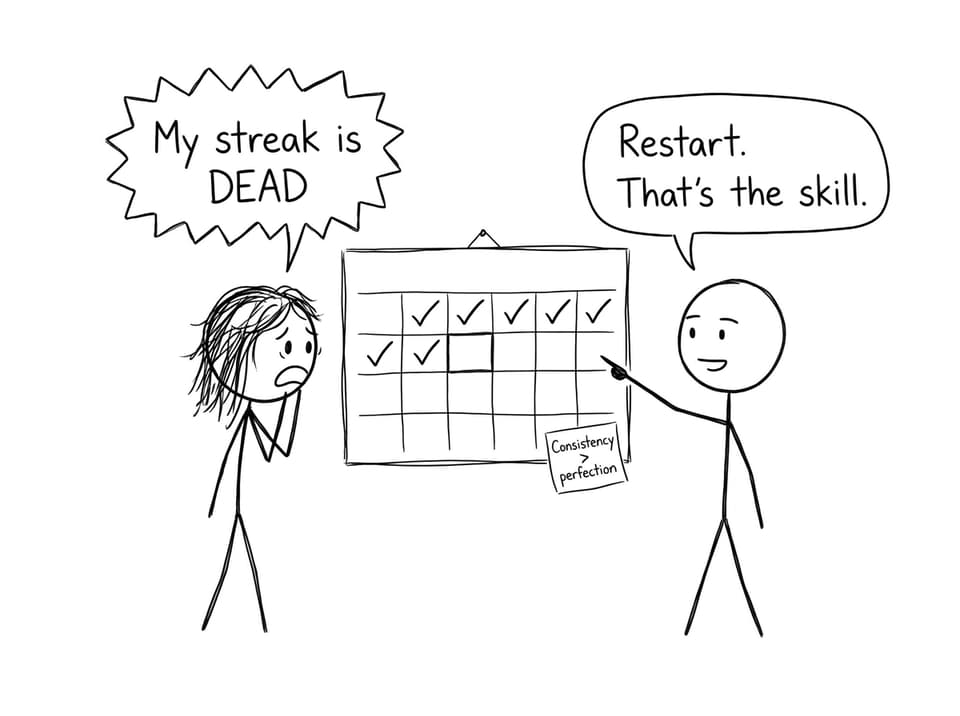
You miss one day and “wait for Monday.” Restart immediately. That restart is the discipline.
-
You confuse time spent with marks earned. Track accuracy and patterns, not just hours.
Closing: discipline is built in ordinary minutes
The most effective IB students aren’t constantly motivated. They’re constantly returning.
Daily problem solving is the cleanest way to build that return reflex. You sit down. You do the minimum. You review one mistake. You come back tomorrow. Weeks later, the hard questions start to feel familiar, and discipline stops feeling like effort and starts feeling like who you are.
If you want one platform that supports the entire IB loop, build it in RevisionDojo: Questionbank for daily problem solving, Study Notes for quick clarity, Flashcards for retention, AI Chat for fast unblocking, and Grading tools, Predicted Papers, Mock Exams, Coursework Library, and Tutors when you need higher-stakes support.
Your next step is simple: open a topic, do three questions today, and let the streak do the talking.