


Building habits during IB is strange because the stakes feel huge, but the actions that change your grades are usually small.
One afternoon, a student told me they were "waiting for motivation" to start revision. They weren't lazy. They were tired. And in IB, tired is the default setting for long stretches: six subjects, deadlines, coursework, and the quiet pressure of exams sitting in the background like a tab you can't close.
But motivation is a mood. Habits are a system.
If you can build habits that stick during IB, you stop negotiating with yourself every day. You stop relying on heroic weekends. You start accumulating something calmer and more powerful: proof.
Below is a practical, exam-focused guide to building habits that stick in IB without burning out. We'll keep it simple, repeatable, and grounded in what actually improves exam performance.
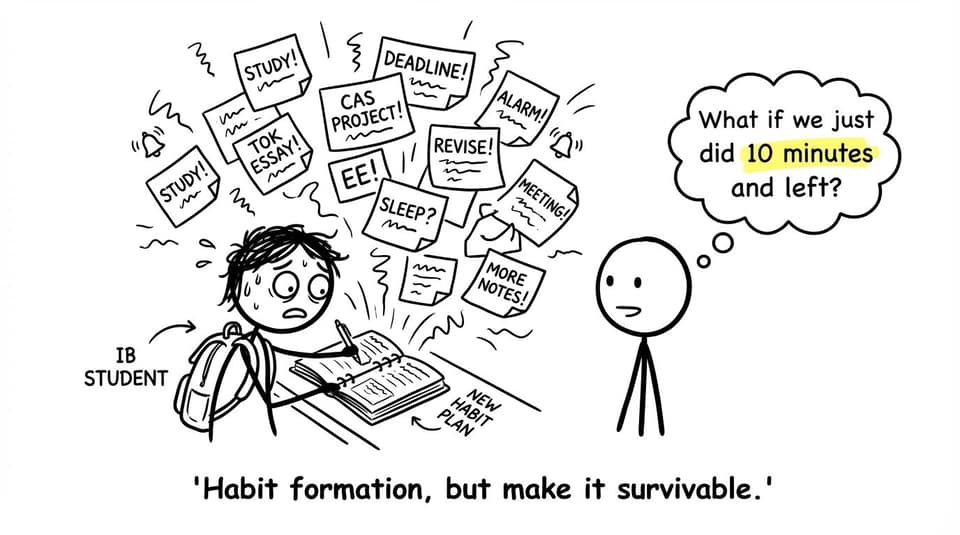
A quick IB habits checklist (copy this)
If you only want the core system for IB habits, use this:
- Pick one daily "minimum" habit you can do in 10-20 minutes.
- Tie it to a fixed trigger (same time, same place, same opening action).
- Make the habit measurable (flashcards count, questions attempted, error log written).
- Use active recall more than rereading.
- Review mistakes like data, not like self-judgment.
- Add one weekly timed practice habit.
- Protect sleep and recovery like part of your IB plan.
For a broader structure, this pairs well with How to Study for IB Exams: Step-by-Step Guide.
Why habits matter more than motivation in IB
In IB, the problem isn't usually "I don't care." It's "I care too much, so starting feels heavy." When the goal is vague ("revise Chemistry"), your brain treats it like a threat. When the goal is tiny ("do 12 Questionbank questions on Topic 4 and log errors"), your brain can comply.
Habits shrink the emotional cost of starting.
Motivation says: "I'll work when I feel ready."
Habits say: "I work at 7:30 because that's what I do."
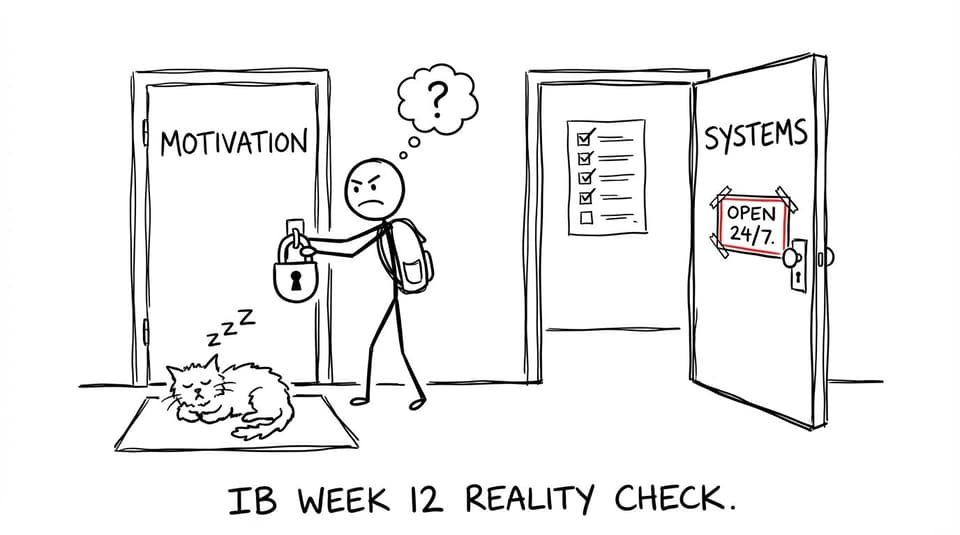
A good IB habit isn't impressive. It's available on your worst day.
Start with the smallest habit that still counts (the IB minimum)
A habit that sticks has one job: survive busy days.
Choose a minimum that is:
- Short (10-20 minutes)
- Concrete (a number you can finish)
- Useful for exams (recall or practice)
Examples that work for IB:
- 15 minutes of spaced repetition flashcards
- 10 exam-style questions on one subtopic
- 1 paragraph rewrite of a weak response using feedback
If you use RevisionDojo, the cleanest minimum habit is:
- 10 minutes of Flashcards + 10 minutes of Questionbank
Start here:
The point is not to "finish a topic." The point is to keep the chain unbroken during IB.
Make IB habits automatic with triggers and friction
Most students try to force discipline. High scorers quietly remove decisions.
Use a trigger you can't miss
Pick one:
- Right after school
- After dinner
- The first 20 minutes after you sit at your desk
Then make the first action stupidly easy:
- Open RevisionDojo
- Click Flashcards
- Start the session
This matters because in IB, starting is often the hardest part.
Add friction to distractions
Friction is not moral. It's mechanical.
- Put your phone in another room
- Log out of social apps on your laptop
- Use one browser window, full screen
You're not trying to become stronger. You're trying to make distraction slightly annoying.
If you want a system-level approach to daily structure, see The Ultimate Daily IB Study Schedule.
Build the IB "loop" that makes habits stick
The most reliable IB habits follow a loop:
Learn -> Recall -> Apply -> Review -> Repeat
RevisionDojo is designed to make that loop easy to run, especially when you're tired:
- Study Notes for fast understanding
- Flashcards for spaced repetition and daily recall
- Questionbank for exam-style application
- AI Chat to get unstuck without losing momentum
- Grading tools for rubric-aligned coursework feedback
- Mock Exams for realistic timing
- Predicted Papers for exam-style rehearsal
- Coursework Library for exemplars and structure
- Tutors for targeted human support
If you want the full "why this works" view, read RevisionDojo App: The Smarter Way to Prep for IB Exams.
The daily loop (30-45 minutes)
A practical daily habit for IB exam prep:
- 10 minutes: Flashcards (spaced repetition)
- 20 minutes: Questionbank set (one topic)
- 10 minutes: error log (3 mistakes, 3 rules)
- 5 minutes: ask AI Chat one focused question
This is small enough to repeat. Repetition is what makes IB feel lighter over time.
Use "identity" habits: become the kind of IB student who...
A habit sticks when it becomes self-image.
Instead of "I need to study," you want: "I'm someone who does a short recall session daily during IB."
Here are three identity shifts that help:
- "I am a person who starts small."
- "I am a person who practices under time."
- "I am a person who reviews mistakes without drama."
Those sentences sound simple. That's the point. The best IB habits are boring in the moment and valuable in hindsight.
Weekly habits that protect exam performance (and sanity)
Daily habits build memory. Weekly habits build exam skill.
The weekly timed habit (the one most IB students delay)
Once a week, do something timed.
- A timed section
- A mini-mock
- A full paper when you're closer to exams
Then review longer than you practiced.
For "final stretch" thinking, IB Last 24 Hours Study Plan is useful even earlier than the last day, because it teaches narrowing and execution.
The weekly review habit (15 minutes that saves hours)
Once a week, ask:
- What topic cost me the most marks?
- What question type keeps repeating?
- What is my next smallest fix?
This turns IB studying into steering, not spiraling.
If you struggle with planning overload, Time Management in IB: Tools and Techniques That Actually Work pairs well with habit-building.
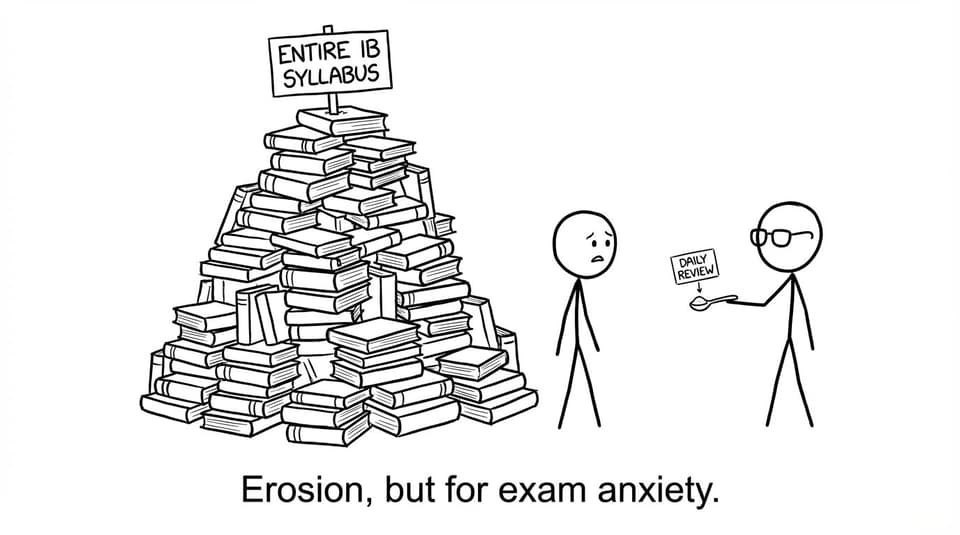
The mistake log: the habit that quietly raises IB grades
Here's the uncomfortable truth: in IB, most lost marks are predictable.
- Misreading command terms
- Skipping units
- Weak evaluation structure
- Vague definitions
- Not linking back to the question
A mistake log turns those into rules.
Keep it painfully simple:
- Mistake: "I described, didn't evaluate."
- Fix rule: "End with a justified judgment and a limitation."
Do this three times per session. In a month, you have a personalized IB mark-boosting document.
How to use RevisionDojo to make IB habits effortless
Tools don't create discipline, but they can reduce friction. In IB, friction is everything.
Here's a simple way to build habits using RevisionDojo features:
- Start each session with Flashcards to warm up recall.
- Move into Questionbank and filter by topic to avoid random practice.
- Use AI Chat to clarify one misconception instead of opening ten tabs.
- Save bigger sessions for Mock Exams and Predicted Papers when you have time to review properly.
For students who need a bigger "system" mentality, How 45-Point IB Students Prepare for Exams is a strong blueprint.
Closing: the calm way to win IB is to be boring on purpose
The most successful IB students aren't always the most intense. They're the most consistent.
They build habits that stick by making the daily action small, tying it to a trigger, and using feedback to guide the next session. Then, when exams arrive, they're not trying to become a new person in two weeks. They're just continuing what they've already practiced.
If you want one place to run the full IB habit loop: Study Notes, Flashcards, Questionbank, AI Chat, Grading tools, Predicted Papers, Mock Exams, Coursework Library, and Tutors; start with RevisionDojo and make your next session small enough to do today.