If you’ve ever watched your to-do list multiply while your certainty shrinks, you already understand the emotional core of the IB.
One minute you’re thinking, “I just want a flexible path to the Diploma.” The next, you’re comparing time zones, subject menus, fee structures, interview dates, and tech requirements while quietly wondering how you’ll keep your grades steady once the programme starts.
That’s why this IB guide focuses on something simple: momentum. Not hype. Not vague reassurance. Just a clear, step-by-step path to applying for the IB Online Diploma Programme (DP) Pilot, plus a realistic plan for how to stay exam-ready once you’re in.
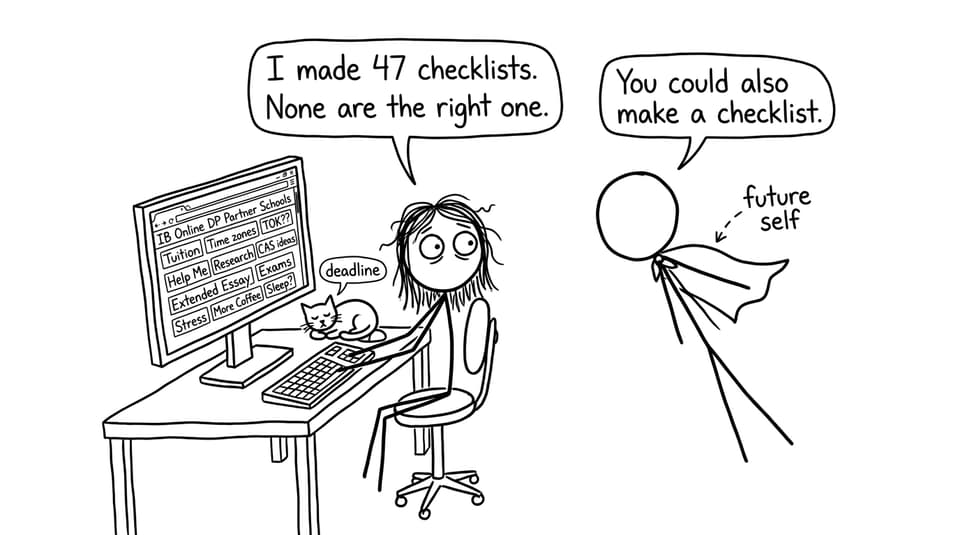
Student with too many tabs, trying to apply for IB Online DP
The IB Online Diploma Programme in one minute
The IB Online Diploma Programme (DP) Pilot launched in 2022 and allows students to complete the full IB Diploma through authorized online partner schools. The curriculum, core, and assessment standards align with the traditional Diploma Programme: six subjects plus TOK, the Extended Essay, and CAS.
Two grounding truths help before you apply:
You do not apply directly to the IB organization. You apply through a partner school.
Use this checklist as your calm starting point. It’s short on purpose.
Confirm you meet typical entry requirements (education level, prerequisites, English proficiency if required).
Choose the right authorized online partner school (subjects, time zone, support style).
Prepare transcripts, recommendations, and your motivation letter.
Submit the application and prep for the interview.
Review the offer carefully (costs, exam arrangements, tech requirements).
Build your “first 30 days” study system so the IB doesn’t feel like a sprint on day one.
Step-by-step: How to apply for the IB Online Diploma Programme
Step 1: Understand what the IB Online DP expects from you
The Online DP is flexible, but it’s not lighter. The workload is still the IB workload, just delivered through a blend of live sessions and independent study.
Step 2: Choose an authorized online partner school that matches your reality
Here’s the part students often underestimate: fit matters more than prestige.
The IB works with a limited set of authorized schools to deliver the Online DP Pilot. As of 2025, partners include:
Aoba-Japan International School (Aoba)
Dwight Global Online School
Eastwood Global
King’s InterHigh
OnWorld: Nazaret Global Education and Montserrat School (Barcelona)
Scotch Global
SEK Education Group
When you compare schools, focus on:
Time zone logistics (live lessons, office hours, support access)
Subject availability (especially HL offerings)
Teaching model (more synchronous vs more self-paced)
Exam arrangements (where you’ll sit in-person exams)
Support structure for TOK, EE, CAS, and internal assessments
A small but powerful tactic: write down what you need on your worst week, not your best week. The IB is rarely hard because one topic is hard. It’s hard because everything arrives at once.
Step 3: Gather your application materials (and make them do real work)
Most Online DP partner schools ask for a familiar set of documents:
Academic transcripts (often 2-3 years)
Teacher references or recommendations
Motivation letter/personal statement
Proof of English proficiency if applicable
Sometimes a placement test or additional writing sample
Your motivation letter matters more than students expect. Not because it needs to be poetic, but because it’s evidence you understand what the IB is asking of you.
Include:
why the Online DP (not just “flexibility,” but what you’ll do with it)
how you’ll manage weekly workload across six subjects
what you’ll do when you fall behind (this is the honest part)
Step 4: Submit the application and prepare for the interview
After you apply through your chosen school’s portal, many schools will invite you to an online interview.
Expect questions like:
Why the IB, and why online?
What’s your approach to time management?
How do you handle setbacks or heavy weeks?
What are your long-term goals?
The best interview prep is not memorizing answers. It’s building a small track record you can talk about: a weekly routine, a revision habit, a method for getting feedback.
A practical idea: start using exam-style practice early so you can say, “I already revise like an IB student.” RevisionDojo’s Questionbank is built for that; it’s a fast way to prove to yourself (and eventually your school) that you can study independently with markscheme-aligned feedback.
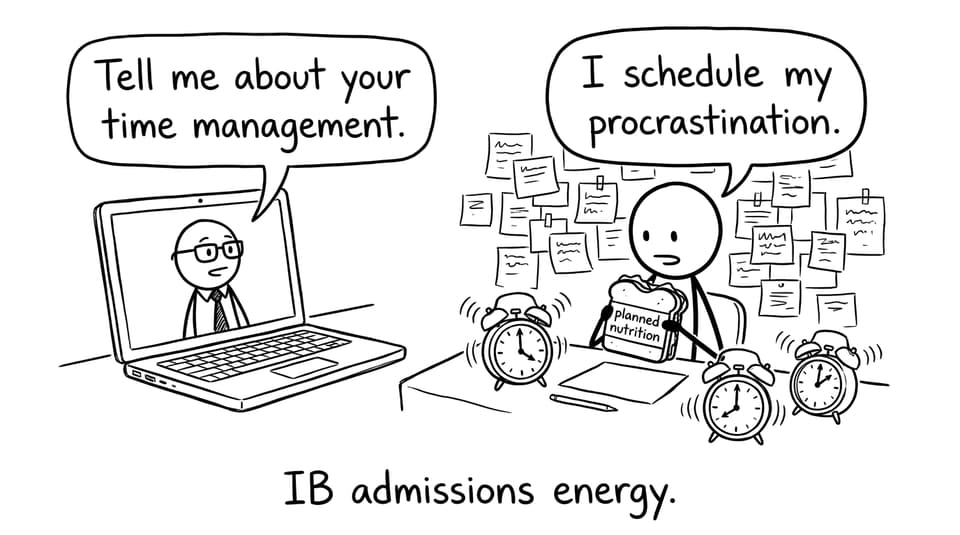
Online interview joke about time management in IB admissions
Step 5: Review your offer and confirm enrollment carefully
If you receive an offer, read it like you would read a contract. Because it is.
exam logistics (where and how in-person exams will be administered)
academic calendar and start date
Costs vary widely, but tuition is commonly in the $8,000 to $15,000 USD per year range depending on the institution and options. Ask directly about scholarships and payment plans.
Step 6: Set up your learning environment (so the IB doesn’t eat your focus)
Online learning rewards consistency and punishes friction. Remove friction before you start.
Have:
stable internet
a reliable laptop with camera/microphone
a quiet study spot
a system for organizing deadlines (calendar + weekly review)
Then build a revision workflow you can sustain.
A clean approach many students use:
Learn content with concise explanations and structured summaries
Practice questions immediately
Get feedback fast
Log mistakes
Repeat
RevisionDojo is designed around that loop: Study Notes, Flashcards, AI Chat for quick clarification, Grading tools for written responses, and timed practice through Mock Exams and Predicted Papers.
To see the full IB tool ecosystem in one place, start at RevisionDojo for IB.
Step 7: Start the programme with an exam-first mindset
Here’s an uncomfortable but freeing truth about the IB: you’re not just learning content. You’re learning how marks are awarded.
So even during your first term, do small, regular exam-style reps:
2-3 short question sets per week per subject
one timed mini-section weekly (rotating subjects)
one “review and redo” session using a mistake log
When you’re ready for realistic full-paper rehearsal, use RevisionDojo’s IB Predicted Papers to practice timing and question patterns in exam format.
And if you’re unsure how online students are graded and examined in the IB, read How Online IB Students Are Assessed and Examined. It clears up confusion that causes a lot of unnecessary stress.
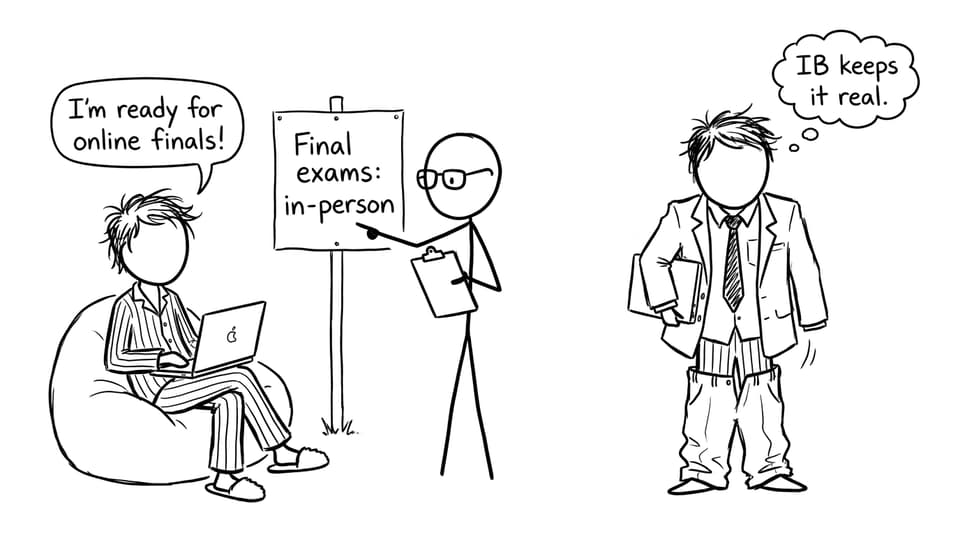
Joke about expecting online finals but IB exams are in-person
A calm “first month” plan for IB Online DP students
Use this as a practical runway after enrollment.
Week 1: Set up folders, calendars, and a baseline routine. Create flashcards immediately for new terms.
Week 2: Begin regular exam-style practice using the Questionbank. Keep a mistake log.
Week 3: Add one timed session. Review with markscheme language. Ask targeted questions using AI Chat.
Week 4: Do one longer mixed-topic practice per subject. Start planning TOK/EE/CAS rhythms.
If you want a more detailed rhythm, adapt one of these:
Closing: Your IB application is step one; your system is step two
Applying for the IB Online Diploma Programme is not just about getting accepted. It’s about choosing a structure you can live inside for two years.
Pick the partner school that fits your time zone and your learning style. Submit a clear application that shows you understand the IB workload. Then start building exam skills immediately, because confidence in the IB comes from proof, and proof comes from practice.
When you’re ready to turn intention into results, RevisionDojo is the fastest place to build that proof: Questionbank drills, Study Notes, Flashcards, AI Chat, Grading tools, Predicted Papers, Mock Exams, and a Coursework Library that reduces background stress. Start with RevisionDojo and make your IB plan feel doable this week, not “someday.”