


The moment the IB stopped being a place
In most students’ minds, the IB has always been tied to a building: corridors that smell like printer toner, a library that becomes your second home, a teacher’s whiteboard filled with half-erased TOK prompts.
But the IB was never meant to be a place. It was meant to be an idea: rigorous learning that travels with you.
That idea took a very literal step forward when the IB launched the Online Diploma Programme Pilot in March 2022. For the first time, students could complete the full two-year Diploma Programme online, with the same curriculum demands and the same expectations.
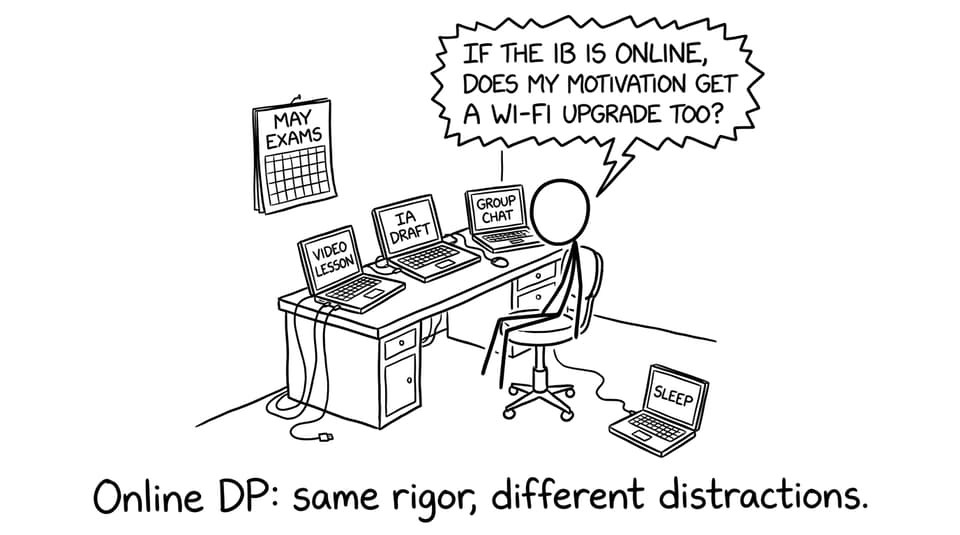
If you’re an IB student preparing for exams, this matters for a surprisingly practical reason: the online shift didn’t change what the IB rewards. It clarified it. Structure, independent thinking, disciplined practice, and feedback loops matter more than the room you’re sitting in.
IB Online DP in 30 seconds (quick checklist)
If you just want the essentials of how the IB Online Diploma Programme works, use this:
-
The IB Online Diploma Programme Pilot began in March 2022.
-
Students study the same DP subjects and assessments as in-person schools.
-
Teaching includes live lessons and asynchronous learning.
-
Teachers are IB-trained and quality is monitored via partner schools.
-
IB exams are still taken in person at approved exam centers.
-
TOK, EE, CAS, and IAs are supported online.
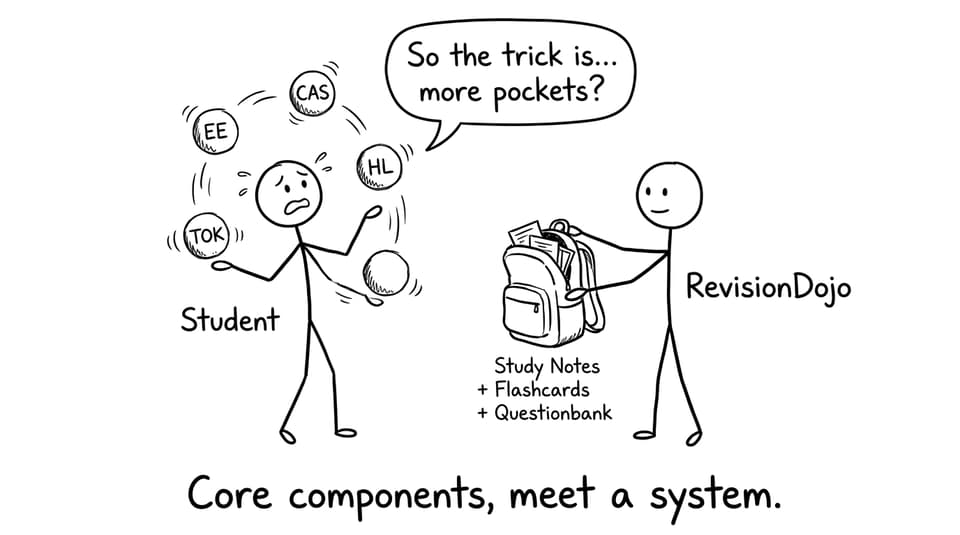
For the exam-focused side of your own journey, it helps to anchor your work around practice and feedback. RevisionDojo is built for that, with the Questionbank, Study Notes, and Flashcards forming a simple loop: learn, recall, apply.
Why the IB moved online (and why it wasn’t sudden)
The IB has been evolving since 1968. Not in dramatic plot twists, but in the slow way that serious institutions change: by testing what works, expanding access, and protecting standards.
The push toward an online Diploma Programme came from a tension the IB has always carried.
On one side: the mission to develop inquiring, knowledgeable, caring young people, with international-mindedness at the center.
On the other: the reality that access to an IB school is uneven. Plenty of students have the motivation and ability, but not the logistics. Distance. Health. Frequent relocation. Commitments to elite sport or performance. A family that moves countries mid-programme.
An online model doesn’t remove difficulty. It removes one specific barrier: needing to be in the same place every day for two years.
And that’s the important philosophical detail. The IB didn’t go online to make things easier. The IB went online to make the same challenge reachable.
Technology made it possible, but the pandemic made it urgent
By the early 2020s, digital learning tools had matured enough that “online school” could mean something more than emailed worksheets.
Then COVID-19 happened, and the world ran a large, unplanned experiment.
Schools discovered what students already suspected: online learning can work, but only when expectations are explicit and support systems are real. The IB watched that experiment closely. It saw that students could still produce strong analysis, complete coursework, and sustain learning rhythms in a virtual environment when teaching was structured and feedback was frequent.
That context helped set the stage for the IB Online Diploma Programme Pilot in 2022. It wasn’t a random innovation. It was the next step in a long-standing goal: expand access while keeping the same academic standard.
For your exam prep, there’s a parallel lesson here. The method changes, but the standard doesn’t. If you want a practical system for that standard, the workflow described in RevisionDojo App: The Smarter Way to Prep for IB Exams is a strong blueprint.
The partner school model: how the IB protected quality
A fully online Diploma Programme raises a difficult question: who ensures consistency?
The IB answered with a partner school model. Instead of opening a single global online “mega-school,” the IB selected a small group of approved partner schools to deliver the Online DP Pilot, each meeting strict quality and pedagogical requirements.
Those partner schools include:
-
Aoba-Japan International School (Aoba)
-
Dwight Global Online School
-
Eastwood Global
-
King’s InterHigh
-
OnWorld (Nazaret Global Education and Montserrat School in Barcelona)
-
Scotch Global
-
SEK Education Group
This matters because the IB’s reputation is built on reliability. If the online programme didn’t feel like the IB, it would fail quickly. So the system leaned on experienced institutions that already understood IB teaching culture, training expectations, and assessment demands.
How the IB Online Diploma Programme actually works
It helps to be concrete. The Online DP Pilot doesn’t replace IB expectations with “online-friendly” versions. It delivers the same programme through different logistics.
Teaching and learning (live + asynchronous)
Students learn through a blend of live classes and asynchronous work. That matters for time zones, pacing, and independence.
But the deeper point is this: online learning exposes weak study habits faster. If you rely on last-minute intensity, you’ll feel it sooner. If you rely on consistent practice, you’ll benefit sooner.
This is why active recall tools scale so well for the IB. A small daily Flashcards session compounds. A short Questionbank drill reveals misunderstandings immediately. RevisionDojo is built around that loop, and guides like IB Flashcard System: Active Recall for Better Memory explain how to make it sustainable.
Coursework and the DP Core (supported online)
The Online DP Pilot supports:
-
Internal Assessments (IAs)
-
Theory of Knowledge (TOK)
-
Extended Essay (EE)
-
Creativity, Activity, Service (CAS)
Online support matters because DP Core work is often where stress quietly accumulates. When deadlines stack, exam revision suffers.
This is one reason RevisionDojo includes tools beyond just studying: Grading tools to tighten your rubric alignment, a Coursework Library to reduce uncertainty, and Tutors when you need a human to walk you through the hard parts.
Exams are still in person
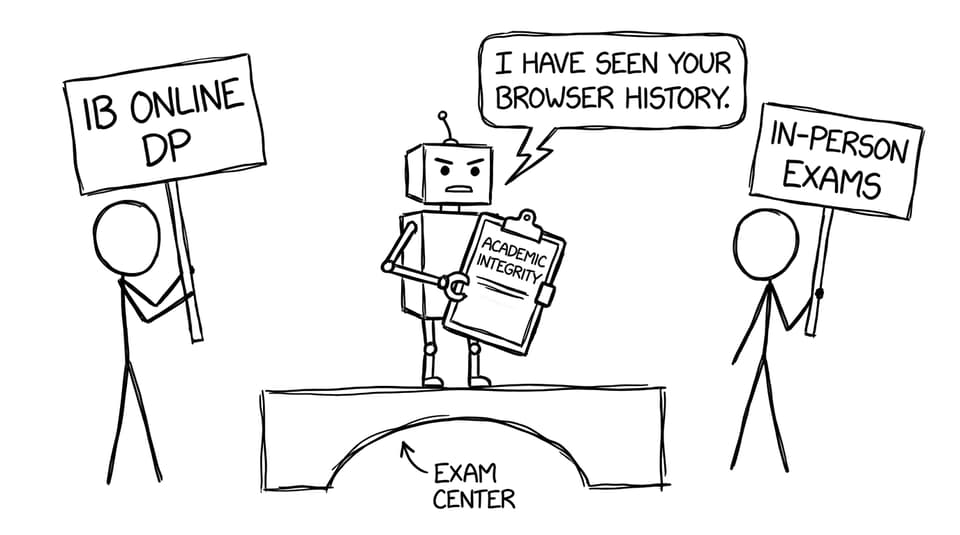
Here’s the key detail students sometimes miss: IB exams are still sat in person at approved exam centers linked to partner schools.
That isn’t a contradiction. It’s a statement of priorities. The IB can innovate on delivery while keeping assessment integrity stable.
Early growth: what the first cohorts showed
Pilot programmes live or die by evidence.
-
The first cohort sat exams in May 2024, with around 60 candidates.
-
The following session in May 2025 grew to roughly 140 students across three partner schools.
-
Projections for May 2026 suggest close to 200 students.
Those numbers are not massive by global IB standards. But for a pilot that protects quality by moving slowly, the trend matters. It signals demand, and it suggests the model is workable.
If you’re preparing for IB exams, the hidden takeaway is that the IB is increasingly comfortable with flexible learning models. That puts more responsibility on you to create structure.
A practical way to build that structure is to combine:
-
content clarity (Study Notes)
-
daily recall (Flashcards)
-
exam-style application (Questionbank)
-
timed rehearsal (Mock Exams and Predicted Papers)
You can see how this loop works in articles like IB Question Bank | How to Use It Effectively and IB Predicted vs Specimen Papers: What They Mean.
Why the IB Online Diploma Programme matters to your exam season
The online DP story isn’t just history. It’s a mirror.
Online learning forces a student to face the real ingredients of IB success:
-
Time management (not motivation) is the foundation.
-
Feedback loops beat “more hours.”
-
Exam technique is a skill, not a personality trait.
-
Consistency beats intensity.
RevisionDojo was built for these ingredients: you learn with Study Notes, prove it with the Questionbank, lock it in with Flashcards, and simulate pressure using Mock Exams and Predicted Papers. If you want a calm but effective exam-season approach, IB Exams Without Pausing Your Life is a good companion.
The road ahead (and your next step)
The IB Online Diploma Programme Pilot is still in an exploratory phase, and the IB is clearly taking a measured approach: collect evidence, refine the model, then expand.
But the bigger evolution is already visible. The IB is slowly separating “rigor” from “location.” The programme is becoming more portable, while the standards remain stubbornly the same.
So here’s a useful way to think about your own IB exam season: you don’t need perfect conditions. You need a system that survives imperfect conditions.
Build that system with RevisionDojo: use the RevisionDojo for IB hub to start, drill weak areas in the Questionbank, tighten memory with Flashcards, and keep your workload honest with timed practice and fast feedback. The IB will keep evolving. Your habits can too.