


The moment you realize your IA isn't really "finished"
You hand in your IA and feel that rare, clean kind of relief. The tabs close. The drafts stop multiplying. For a day or two, you almost forget about it.
Then someone says the sentence that makes every IB student sit up straighter: "Your IA mark can change after moderation."
And suddenly the IA is alive again. Not in your Google Doc, but in your head. You start replaying tiny choices: that graph label, that justification, that paragraph you meant to tighten but didn't. You wonder how often IA marks change after moderation, and whether your carefully earned mark is stable or just a temporary estimate.
This article answers that question calmly and honestly: how often IA marks change after moderation, what "change" actually means, and what you can do right now so your IA is less vulnerable to adjustment.
Quick overview: what to know about IA moderation (checklist)
- Your IA is marked by your teacher first, using IB criteria, but it's not final until external moderation.
- Moderation typically adjusts a school's cohort (a group), not a single student in isolation.
- IA marks change after moderation when the moderator judges the teacher's marking to be too generous, too harsh, or inconsistent.
- The adjustment can move marks up or down, and sometimes not at all.
- You can't control the moderation decision, but you can control how clearly your IA earns its marks.
If you want the process in full context, read: How IB Internal Assessment (IA) Moderation Works: A Clear Guide.
What "IA marks change after moderation" actually means
Most students imagine moderation like a remark: an examiner re-reads your IA and decides whether your number should be higher or lower.
Moderation is different.
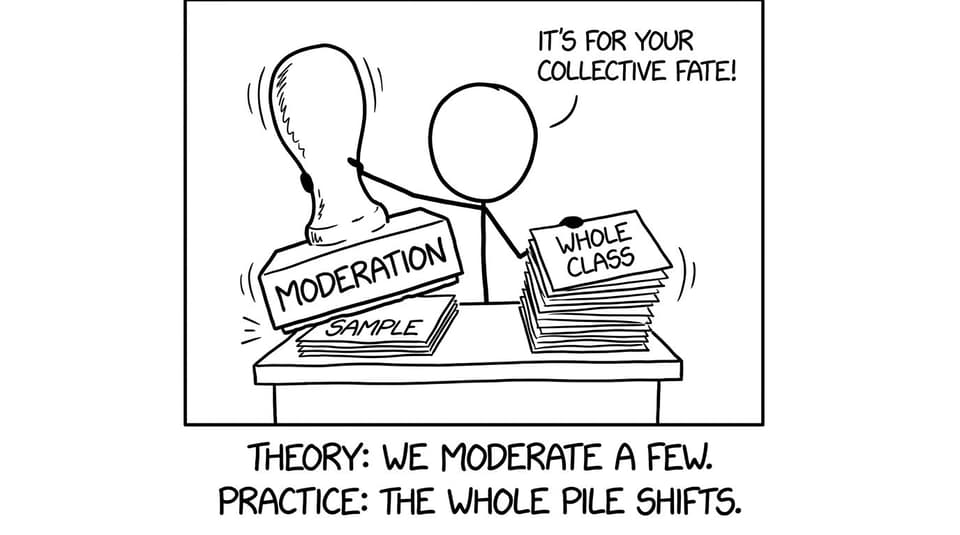
In most subjects, the IB reviews a sample of IAs from your class. The moderator compares your teacher's marking to global IB standards. Then the IB may apply an adjustment to the entire cohort's IA marks so the overall marking standard aligns.
So when we ask how often IA marks change after moderation, we're really asking: how often does the IB decide a school's internal marking standard needs correction?
RevisionDojo explains the roles clearly in: Who grades the IAs?.
How often do IA marks change after moderation?
Here's the careful truth: the IB does not publish a simple, universal statistic like "X% of IA marks change." It varies by subject, session, and school context.
But you can still understand the pattern.
The most common outcome: small shifts or no shift
In many schools, IA marks change after moderation only slightly, or not at all. That's what happens when:
- teachers have strong standardization within the department,
- marking is clearly justified by annotations and rubric evidence,
- and the cohort's sample aligns with the moderator's expectations.
If your department actively standardizes, the chance of a dramatic IA adjustment tends to be lower. Schools can even make this process more systematic using tools designed for consistency, like: Using RevisionDojo to Standardize Internal Assessments Across Departments.
When IA marks change after moderation, it's usually a cohort correction
Moderation is built to correct two big problems:
- Leniency drift: a teacher gives slightly higher marks than the global standard.
- Harshness drift: a teacher marks more strictly than the global standard.
If the moderator sees a consistent difference in the sample, the IB may adjust the whole cohort.
This is why two students in different schools can write equally strong work and still need moderation to reach fairness. The IA is personal, but the standard has to be global.
Bigger changes are less common, but they happen
Larger adjustments can occur when:
- the marking is inconsistent across criteria,
- annotations don't justify the marks,
- multiple teachers mark without proper internal standardization,
- or the cohort's marks cluster unrealistically high/low compared with the sample evidence.
The key point: bigger shifts usually reflect a bigger mismatch between internal marking and IB expectations, not a personal "punishment" for a single student.
What makes an IA more likely to be adjusted?
If you're trying to predict risk, don't focus on rumors like "moderation always drops marks." Focus on evidence.
Weak rubric evidence (the silent mark killer)
Moderators can only reward what they can see. A strong IA doesn't just contain good thinking, it shows good thinking in the exact places the criteria demand.
That means:
- clear method justification,
- visible processing and decision-making,
- explicit links back to the research question,
- evaluation that is honest and specific.
If you want a practical guide on making your analysis harder to underrate, use: How to Use Data Effectively in Your IA Analysis.
Over-reliance on presentation instead of reasoning
Some IAs look impressive but don't earn marks where the rubric counts. This is especially common in design-leaning or visually polished work. Presentation can support clarity, but it can't replace justification.
A good reminder of this rubric reality is in: How Is the IB Design Technology IA Graded?.
Teacher marking that isn't standardized
If two teachers interpret "analysis" differently, the cohort can look inconsistent. Moderation exists to correct that.
From a student's perspective, you can't fix department processes. But you can make your IA more "unarguable" by mapping every major paragraph to a rubric demand.
What you can do if you're worried your IA marks will change
Worry feels productive because it burns energy. But it doesn't improve outcomes.
A better move is to build a buffer: make your IA so criteria-aligned that even if moderation adjusts the cohort, your work remains as protected as possible.
Use a rubric-first rewrite pass
Before final submission, do one pass where you only ask:
- Where is the evidence for each criterion?
- If someone skimmed, could they still find it?
- Did I earn marks, or did I imply I earned them?
This is exactly the kind of cycle that becomes easier when you can iterate quickly with rubric-aligned feedback.
On RevisionDojo, many students do that through the grading loop: upload a draft, get criterion-level commentary, then revise with intention. See: IB IA/EE/TOK Grader: How RevisionDojo Delivers Rubric‑Aligned Feedback.
Don't let the IA dominate exam-season decisions
Even if your IA marks change after moderation, your exams still matter enormously. The dangerous habit is spending April and May acting like the IA is a lottery ticket that will decide everything.
Instead, treat your IA like a percentage you've already earned as well as possible, then shift your energy to controllable marks: timed practice, error logs, and targeted topic work.
A grounded weekly structure helps: What's a Realistic IB Study Plan for a 6 in Each Subject?.
The calm math of how much the IA matters
It's useful to remember why the IA anxiety spikes: the IA often counts for a meaningful portion of your final grade.
RevisionDojo breaks down typical weightings here: The Impact of Internal Assessments (IA) on Your Final IB Grade.
But here's the reflective part most students miss: because the IA is only one component, the best protection against moderation fear is not obsession. It's balance.
- Use Study Notes to tighten understanding.
- Use Flashcards to keep definitions and processes available under stress.
- Use the Questionbank to convert knowledge into marks.
- Use AI Chat when you're stuck and need a fast explanation or a better plan.
- Use Mock Exams and Predicted Papers to make time pressure feel normal.
- Use Grading tools for coursework iterations.
- Use the Coursework Library to see what "good" looks like.
- Use Tutors when you need a human to diagnose patterns you can't see.
That full loop is explained well in: RevisionDojo App: The Smarter Way to Prep for IB Exams.
Closing: the healthiest way to think about IA moderation
So, how often do IA marks change after moderation?
Often enough that you should take the IA seriously. Not so often that you should let it hijack your exam season.
Moderation is the IB doing what it promised: making grades comparable across thousands of classrooms. Your best move is to make your IA criteria-aligned, clearly evidenced, and easy to justify. Then, once it's submitted, move on with discipline.
If you want one place to do that without guessing, use RevisionDojo as your control panel: refine your IA with rubric-aware Grading tools, learn content with Study Notes, keep memory sharp with Flashcards, drill weak areas in the Questionbank, ask AI Chat the questions you're embarrassed to ask out loud, prove readiness with Mock Exams and Predicted Papers, and lean on the Coursework Library and Tutors when you need examples or a human plan.
Your IA might shift after moderation. Your preparation doesn't have to.