
The quiet moment when the IA becomes real
The first time most students truly feel their IA is not when they start writing it. It’s later, usually at night, when they open their grade tracker and realize the numbers don’t care about effort. They care about weighting.
That’s when the question shows up: how much does the IA actually affect your final IB grade?
The honest answer is that an IA can be the difference between “I’m fine” and “why did my grade drop?” because it’s not a side quest. In most subjects, it’s a meaningful slice of your final result, and it can either stabilize you or expose you. This guide breaks down typical IA weight, what moderation really means, and how to build an IA that protects your grade without stealing your entire exam season.
IA impact overview (fast checklist)
If you only have two minutes, remember this:
-
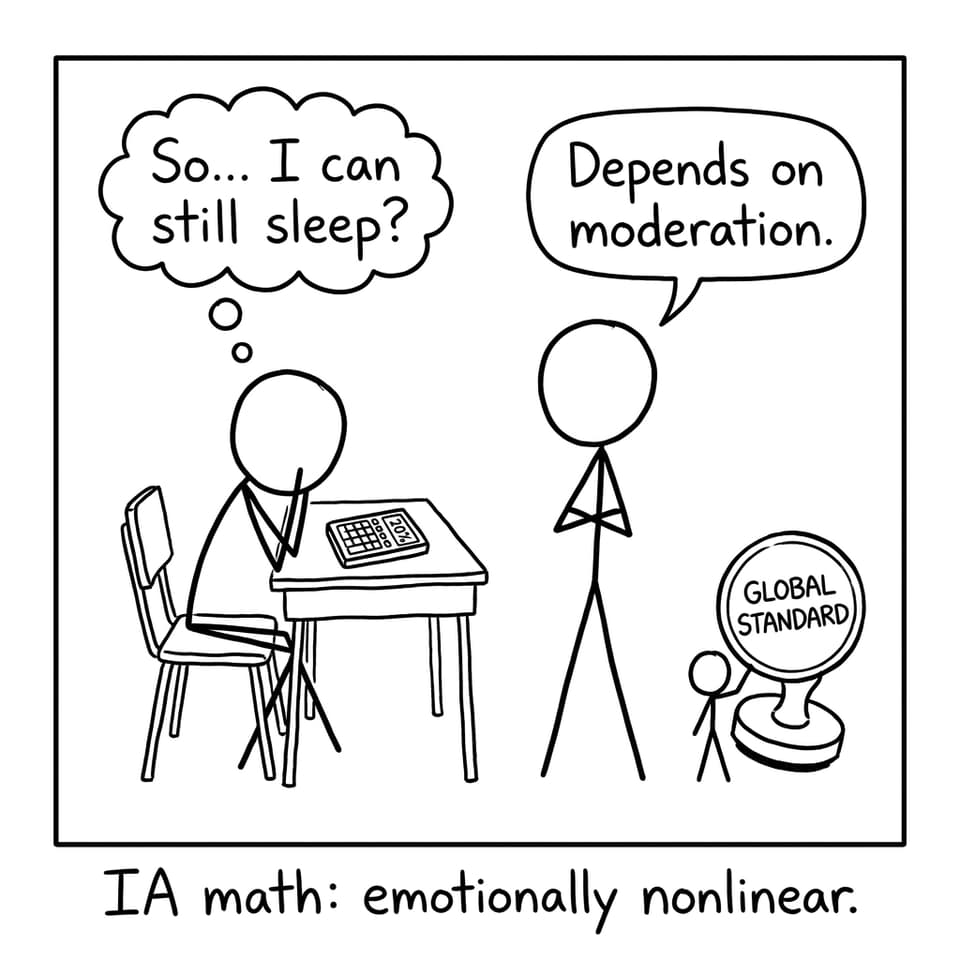
IA weighting is usually 20-30% of the final subject grade (it varies by subject).
-
A strong IA can buffer a weaker exam, but it rarely rescues a completely unprepared one.
-
Your teacher marks your IA first, but IB moderation can adjust the marks to match global standards.
-
The best strategy is to write an IA that is easy to mark because the evidence clearly matches the rubric.
-
Tools help, but the workflow matters: plan, draft, rubric-check, revise, and only then polish.
For deeper subject-specific structure support, RevisionDojo’s IB IA Guides are a good anchor point.
How much is the IA worth in your final grade?
Most students hear a rumor like “the IA is only 20%” and mentally translate it into “not that important.” But 20% is enormous when you think in outcomes.
Here’s a safe general way to understand IA weighting:
-
Standard Level (SL): typically 20-30%, depending on the subject.
-
Higher Level (HL): often 20-30% as well, but with higher expectations for complexity, analysis, and clarity.
Common examples students run into:
-
In many Math courses, the IA (exploration) is often around 20%.
-
In many sciences, the IA is often around 20%, usually an investigation with analysis and evaluation.
-
In many humanities, the IA component is often around 20%, usually a structured investigation or report.
The exact percentage depends on your subject and syllabus version, but the strategic takeaway stays consistent: your IA is not “extra.” It is part of your grade architecture.
If you want a broader refresher on what the IB expects across subjects, read IB Internal Assessment: A Complete Guide.
Why the IA can change your grade more than you expect
The IA is a stabilizer, not just a score
Exams are one moment under pressure. An IA is slow pressure, spread over weeks. That difference matters.
A good IA can stabilize your grade because:
-
it rewards skills exams don’t always capture (research design, method choice, sustained reasoning)
-
it’s less vulnerable to a single bad day
-
it can lift your final mark when the exam is merely “fine”
But it can also quietly drag you down if it’s underdeveloped, rushed, or unclear.
The IA teaches the exact skills examiners reward
Even if your IA topic never appears in your final exam, the habits transfer:
-
writing with the rubric in mind
-
explaining assumptions instead of hiding them
-
showing analysis rather than describing results
Those habits are also why RevisionDojo pairs coursework support with exam practice: the Study Notes, Flashcards, and Questionbank keep content sharp, while Grading tools and the Coursework Library keep your IA aligned.
IA moderation: what it is, and why you should care
Moderation sounds mysterious until you frame it as quality control.
Here’s the basic reality:
-
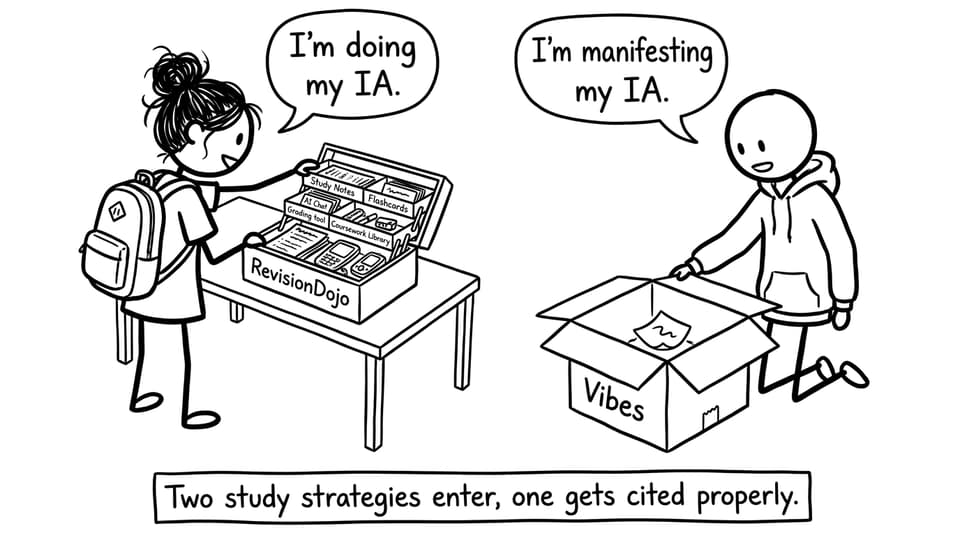
Your teacher marks your IA using IB criteria.
-
The IB then selects a sample of IAs from your school.
-
External moderators review that sample to check if marking matches the global standard.
-
If the school’s marks are consistently lenient or harsh, the IB can adjust marks up or down.
This is why a “generous” teacher isn’t a guaranteed advantage, and why a “strict” teacher isn’t automatically bad. Moderation is trying to make your IA comparable to everyone else’s.
A practical guide you should read before final submission: How IA Moderation Works (and How to Protect Your Grade).
How to make your IA “moderation-proof”
The goal is not perfection. The goal is clarity that survives a second marker.
Choose a research question that forces analysis
Many IAs lose marks because the question invites description. A strong IA question creates a natural need to analyze relationships, patterns, limitations, and implications.
Use this for calibration: How to Write a Strong IA Research Question.
Build evidence that maps to the rubric
A simple technique that works across subjects:
-
For each criterion, write one line: “What evidence proves I meet the top descriptor?”
-
Then add: “Where is it in my IA?” (page/section)
If you can’t point to evidence, the marker can’t award the marks.
Don’t leave evaluation until the final night
Evaluation is where many students either gain separation or collapse into vague statements.
Use a structure that shows judgment:
-
identify the biggest limitation
-
explain the impact on validity
-
propose a realistic improvement
-
connect it back to your research question
RevisionDojo has targeted guidance here: How to Write a Compelling IA Evaluation Section.
Proofread like a marker, not like a friend
A marker is not trying to “get what you mean.” They are trying to see if you demonstrated what the rubric asks for.
This checklist helps: How to Proofread and Polish Your IA Before Submission.
How RevisionDojo helps you score higher on your IA (without losing exam time)
The hardest part of IB is not doing one thing well. It’s doing everything at once.
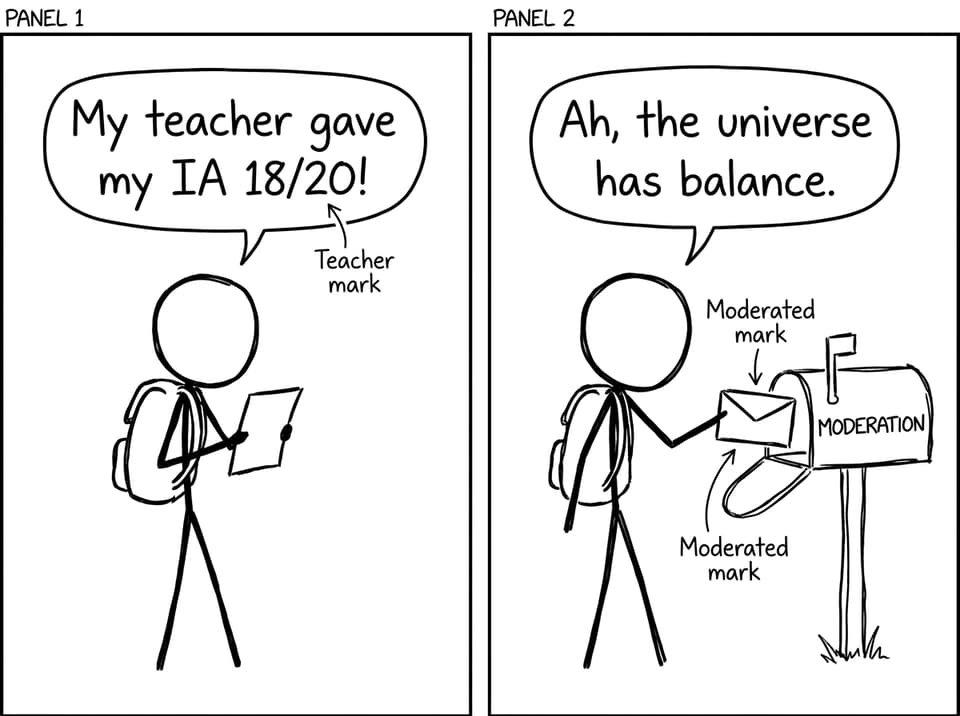
RevisionDojo is built for that tension. When your IA is demanding attention, you still need an exam routine that doesn’t collapse. That’s why students use:
-
Coursework Library to study real exemplars and understand what “enough” looks like: IB Coursework Examples: IA, EE and TOK Exemplars
-
Grading tools to check rubric alignment early (before you waste hours polishing the wrong section)
-
AI Chat to ask targeted questions like: “Which criterion is this paragraph serving, and what evidence is missing?”
-
Study Notes + Flashcards to keep content moving during coursework weeks
-
Questionbank to keep exam technique sharp, with feedback loops
-
Mock Exams and Predicted Papers to rehearse timing and stamina when exams get close
-
Tutors when you need strategic, human-level triage
If you want a clean “one place” workflow, start with RevisionDojo App: The Smarter Way to Prep for IB Exams.
Closing: treat the IA like a lever, not a chore
The IA is one of the few parts of IB where you can earn a meaningful chunk of your grade through sustained, controlled work. That’s the real impact of the IA: it turns your final grade from a single high-pressure moment into a more balanced picture of your ability.
If you want your IA to lift your grade (and to survive moderation), build it with rubric-visible evidence, tighten the evaluation, and keep a small exam routine running in the background. RevisionDojo makes that workflow easier: plan with the IB IA Guides, calibrate with the Coursework Exemplars, improve with AI Chat and Grading tools, then stay exam-ready with Study Notes, Flashcards, Questionbank, Mock Exams, Predicted Papers, and Tutors.
Your IA isn’t just coursework. It’s leverage. Use it.