
If you’ve ever handed in an IA and immediately replayed every paragraph in your head, you already understand the real fear: it’s not just “Is this good?” It’s “Who decides if this is good?”
The uncomfortable truth is that an IA is assessed by more than one set of eyes, even if you only ever meet one of them. And once you understand the chain of responsibility: teacher marking, IB moderation, and possible mark adjustments; you can write an IA that’s much harder to misread.
Who grades the IA, step by step?
Here’s the clean version of the process most IB students need:
-
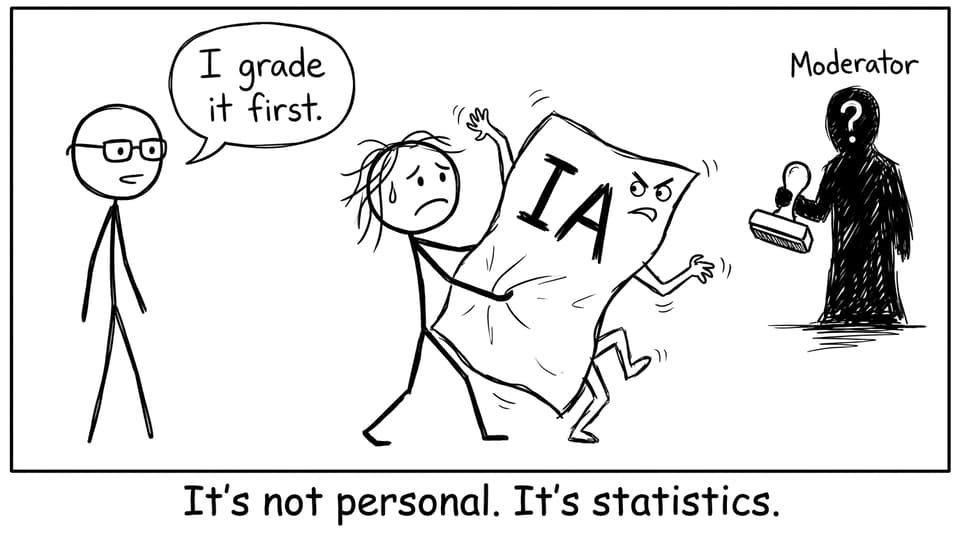
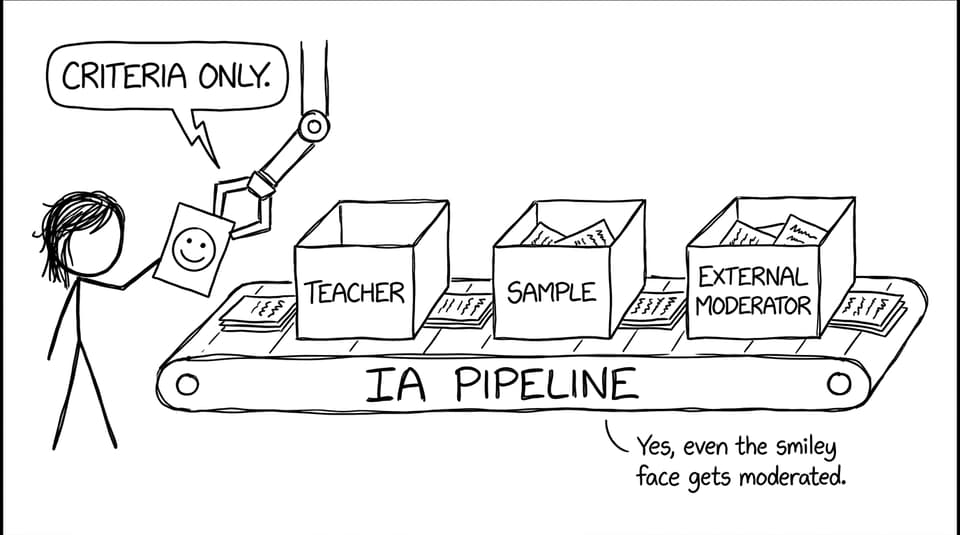
Your subject teacher marks your IA first, using official IB criteria.
-
The IB requests a sample of IA work from your cohort.
-
An external moderator re-marks that sample.
-
If the teacher’s marking is consistently generous or harsh, the IB can apply an adjustment.
That’s the whole story. The rest is learning what each stage actually means for you.
Your teacher grades your IA first (internal assessment)
Your IA is initially graded by your subject teacher. This is “internal assessment” in the literal sense: the assessment happens inside your school.
Teachers don’t grade on vibes (even when it feels like they do). They grade against IB descriptors: specific criteria that describe what different performance levels look like. In other words, they’re translating your project into a mark that can survive outside your classroom.
This is why it helps to treat feedback like a negotiation with the rubric, not with a person. If you want a calmer starting point, RevisionDojo’s IB Internal Assessment Guides are built around that same idea: structure first, evidence second, polish last.
Then the IB moderates the IA (external moderation)
After your teacher marks the IA, the IB runs moderation to keep standards consistent across schools worldwide.
Moderation usually works through sampling. The IB asks your school for a set of IA submissions that represent a spread of marks (not just the top work). An external moderator then re-marks that sample using the same criteria.
If the moderator’s marks and your teacher’s marks align closely, the original marking standard is essentially validated. If they don’t align, especially if the difference shows a consistent pattern, the IB may adjust marks to bring your cohort in line with the global standard.
If you want the deeper breakdown, read How IA Moderation Works in the IB (Without the Panic). It’s one of those explanations that makes the whole system feel less personal.
Can moderation change your IA mark?
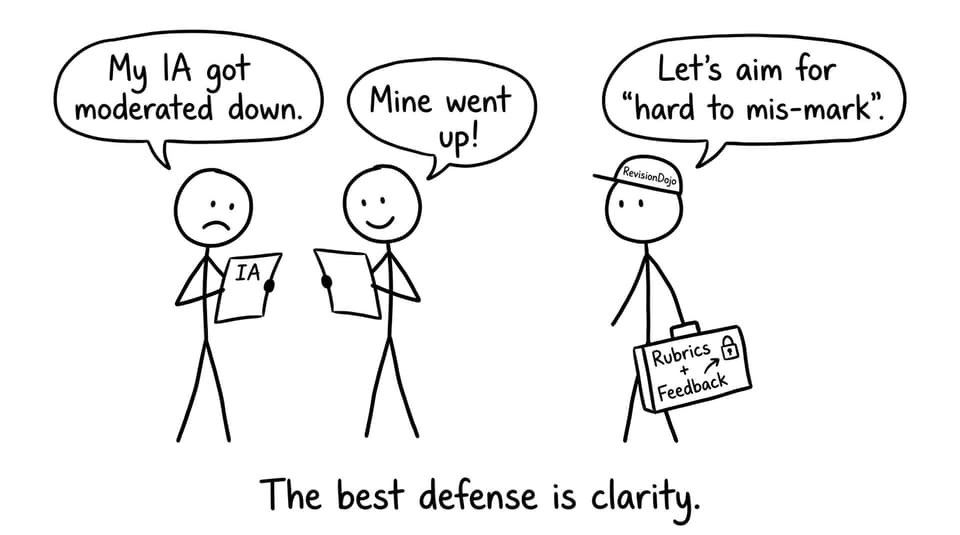
Yes. Your IA mark can go up, down, or stay the same after moderation.
The important nuance: moderation is often about patterns, not one student’s story. If the sample suggests the teacher’s marking is consistently lenient, the cohort may shift down. If the teacher’s marking is consistently harsh, the cohort may shift up.
This is why the best strategy is to make your IA “obvious to mark.” Not flashy. Not long. Just unmistakably aligned to the descriptors.
A practical way to do that is to run a rubric-first draft cycle using tools designed for criteria alignment. RevisionDojo’s IB IA Grading Service and IB Internal Assessment Feedback guide both show what that looks like in real student workflows.
How to protect your IA score (make it hard to mis-mark)
Think of moderation as a stress test. Your goal is to produce an IA that holds up when a stranger reads it fast.
Use “visible evidence” for every criterion
If the criterion wants justification, write the justification. If it wants evaluation, label the evaluation. Don’t imply. Show.
Reduce ambiguity with signposting
Small phrases can prevent big misinterpretations: “This supports my research question because…”, “A limitation is… therefore I would improve by…”.
Build a feedback loop that doesn’t depend on teacher availability
When deadlines pile up, feedback becomes scarce. That’s where RevisionDojo fits naturally into real IB life:
-
Use the Coursework Library to compare structure across strong exemplars.
-
Use AI Chat to ask rubric-based questions like “Which criterion am I not proving clearly?”
-
Use Grading tools to iterate drafts with criterion-by-criterion focus.
-
Keep exam skills moving with the Questionbank, Study Notes, and Flashcards so your coursework doesn’t quietly drain your exam prep.
Closing: treat the IA like a message to a stranger
The healthiest mindset shift is this: your IA isn’t written for the person who knows you. It’s written for a marker who doesn’t.
Yes, your teacher grades your IA first. Yes, the IB may moderate it. And yes, marks can move. But the students who do best are rarely the ones who write the longest drafts; they’re the ones who make the rubric impossible to miss.
If you want that kind of clarity, build your system inside RevisionDojo: plan with the Coursework Library, tighten drafts with Grading tools, unblock confusion with AI Chat, and keep exam momentum with Study Notes, Flashcards, Questionbank, Mock Exams, Predicted Papers, and Tutors when you need a human edge. Your IA becomes calmer when your process is repeatable.