

Your Design Technology project can look incredible and still lose marks.
That’s the quiet shock many students feel when they get their feedback: the prototype worked, the pages looked polished, the effort was real… yet the grade didn’t match the hours.
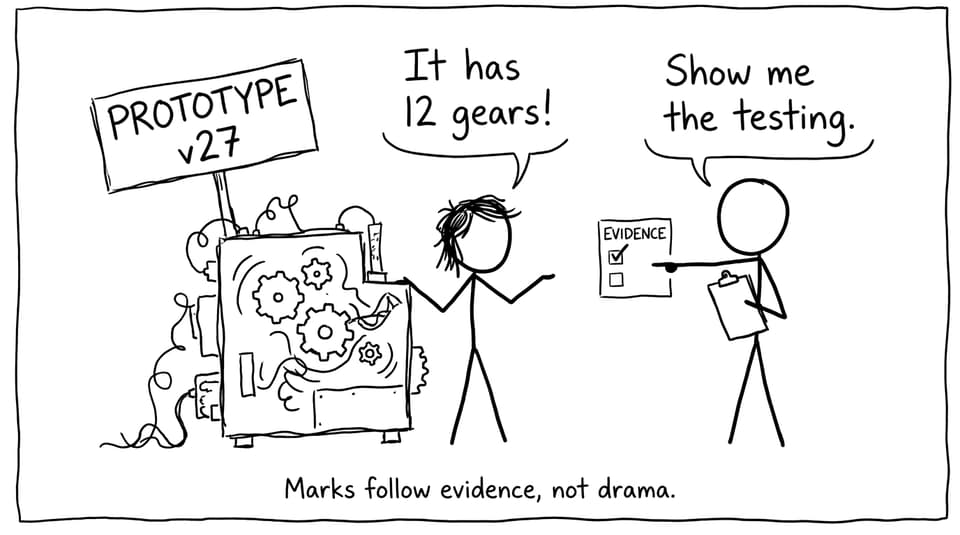
The reason is simple: IB Design Technology doesn’t reward effort in the abstract. It rewards evidence of good design thinking. The IB Design Technology IA is graded like an argument, not an art show: every claim needs justification, every decision needs a reason, and every improvement needs proof.
If you’re preparing for exams, understanding IA grading also helps your written answers. The same habits that earn IA marks (criteria-first thinking, justified choices, evaluation with evidence) are exactly what examiners reward across IB Design Technology.
The IA grading flow (and why moderation matters)
The IB Design Technology IA is:
-
Marked internally by your teacher
-
Moderated externally by the IB
Moderation is the part students forget. It means your teacher can’t just give points for “how impressive” something feels. They need to point to the rubric and show why your work earns each mark. If the evidence isn’t there, moderation can pull marks down.
If you want a clear view of how the rubric language translates into marks, bookmark the Design Technology IA grading rubric tool and use it as a self-check while you draft.
Quick checklist: what high-scoring IAs always show
Use this as a fast filter. If you can’t point to these in your document, IB Design Technology examiners won’t be able to award marks.
-
A specific, real design problem with a defined user
-
Research that directly changes your design decisions
-
Design requirements that are testable (not vibes)
-
Iteration that is explained and evidenced (not just claimed)
-
Testing that produces data or observable outcomes
-
Evaluation tied back to requirements, with honest limitations
To see what strong approaches look like in practice, compare with IB Design Technology IA examples and what top projects look like.
What IB Design Technology is actually grading
A useful mindset shift: the IB Design Technology IA does not primarily grade the object you made.
It grades how well you:
-
identify and frame a design opportunity
-
justify decisions using research and user needs
-
develop ideas and iterate based on testing
-
evaluate outcomes critically
In other words, you’re being graded on your decision trail.
Where students gain (or lose) the most marks
A design problem that is narrow enough to prove
High marks start early. Strong IB Design Technology IAs don’t begin with “I want to make a better water bottle.” They begin with a user and a constraint: a person, a context, a measurable need.
A sharp problem statement gives you something to test later. A vague one forces you into generic evaluation, and generic evaluation is hard to reward.
If you’re unsure whether your problem is product-led instead of problem-led, read the most common IB Design Technology IA mistakes before you sink more time into drafting.
Research that earns marks because it changes things
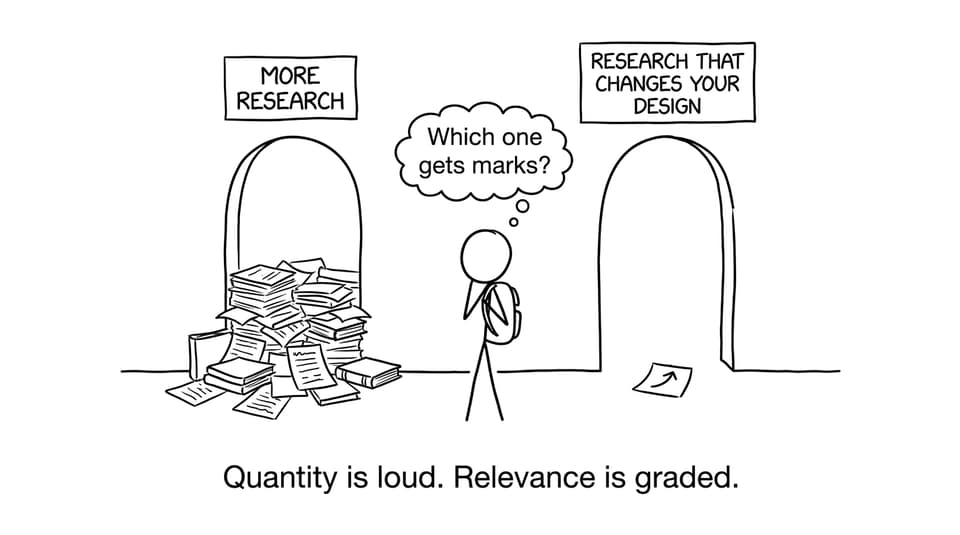
Research isn’t graded by weight. Examiners look for usefulness.
A good rule: every chunk of research should end with “So I will…”
-
“Users struggle with grip strength, so I will adjust handle diameter based on ergonomic ranges.”
-
“Material testing shows PLA warps above X°C, so I will change material choice or design ventilation.”
That’s what research is for in IB Design Technology: not background, but leverage.
Iteration: the easiest marks to miss
Many students document “versions” without documenting learning.
Iteration in IB Design Technology is not:
- “I redesigned it because I had time.”
Iteration is:
- “Test 1 showed failure at X load. I changed joint geometry. Test 2 improved by Y%.”
If you’re not sure you have enough iteration, use RevisionDojo’s Coursework Library for exemplar patterns, then apply them to your own project using the IB Design Technology exemplars collection.
Testing that produces evidence (not confidence)
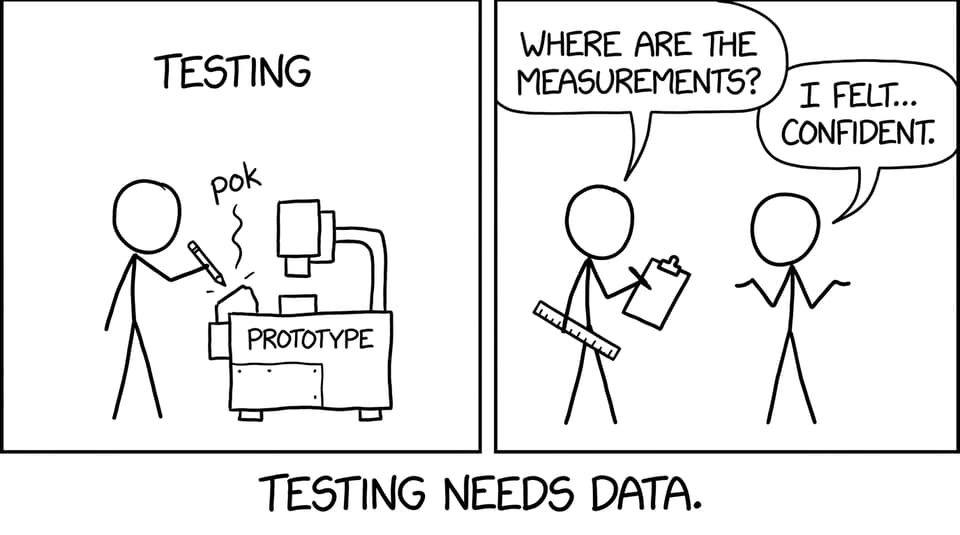
Testing is only valuable if it creates proof.
Good IB Design Technology testing includes:
-
measurable outcomes (time, force, temperature, accuracy)
-
structured user feedback (with questions aligned to requirements)
-
photos or screenshots that show process and change
Be careful with phrases like “successful” or “worked well.” Examiners can’t award marks for adjectives unless they’re backed by results.
Evaluation that is honest, specific, and requirement-based
Evaluation is where top bands separate.
Strong IB Design Technology evaluation:
-
returns to each design requirement
-
uses testing results and user feedback as evidence
-
admits limitations without panic
-
proposes realistic improvements linked to what failed
If you want a submission-ready self-audit, the final-stage workflow in how to finalise and submit the IB Design Technology IA is a good last-week checklist.
How RevisionDojo helps you aim for rubric marks, not extra pages
Most students don’t need to work harder. They need better alignment.
RevisionDojo is built to keep your IB Design Technology work criterion-focused:
-
Grading tools (including the IA rubric grader) to check rubric alignment early
-
Study Notes and Flashcards to sharpen terminology you’ll reuse in IA writing and exams
-
AI Chat to turn vague requirements into testable, measurable ones
-
Coursework Library to learn patterns from strong exemplars
-
Questionbank, Mock Exams, and Predicted Papers to connect IA thinking to exam performance
-
Tutors for feedback loops when you’re stuck mid-iteration
If you want the all-in-one hub, start with RevisionDojo’s IB Design Technology resources or the updated IB Design Technology (new syllabus) hub.
Closing: chase evidence, and IB Design Technology grades follow
When students ask how the IB Design Technology IA is graded, they’re usually hoping for a secret trick.
There isn’t one.
There’s just a dependable pattern: define a real problem, make testable requirements, let research change your design, iterate with proof, and evaluate honestly. Do that, and your work becomes easy to award marks to.
If you want your IA and exam prep in one place, build your workflow around RevisionDojo’s IB Design Technology hub, then use the Questionbank, Study Notes, Flashcards, AI Chat, Mock Exams, and Grading tools to turn effort into marks that survive moderation.