
The number 45 can make the IB Diploma sound like a complicated calculation. For parents, it can also create a more personal worry: What exactly must my child do to earn the Diploma, and how close are they to succeeding?
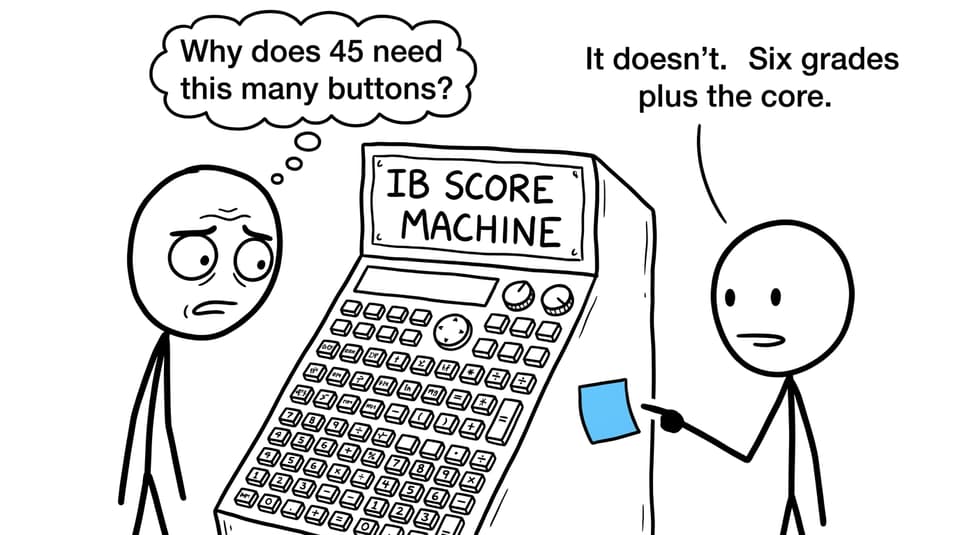
The short answer is reassuringly simple. An IB Diploma score consists of up to 42 points from six subjects, each graded from 1 to 7, plus up to 3 core points from Theory of Knowledge (TOK) and the Extended Essay (EE). That produces the maximum score of 45.
Students normally need at least 24 points to receive the Diploma, but 24 is not an automatic pass. They must also satisfy the IB's minimum requirements for Higher Level and Standard Level subjects, complete Creativity, Activity, Service (CAS), avoid an E in TOK or the EE, and meet the other Diploma conditions.
How is IB scored out of 45?
The entire calculation can be summarized in three lines:
| Score component | Maximum contribution |
|---|---|
| Six academic subjects, each graded 1 to 7 | 42 points |
| Combined TOK and Extended Essay result | 3 points |
| Total possible Diploma score | 45 points |
Suppose a student receives the following six subject grades:
6 + 6 + 5 + 5 + 5 + 4 = 31 subject points
If their combined TOK and EE grades produce two core points, their final result is:
31 + 2 = 33 points out of 45
This example is hypothetical, but the calculation is exact. A student achieves 45 only by receiving a 7 in all six subjects and earning all three available core points.
Parents who want to test different combinations can use RevisionDojo's IB Grade Calculator. For a broader explanation of the two connected scoring systems, see the IB grading system from 1 to 7 and 45.
Where the 42 subject points come from
Every Diploma student takes six academic subjects. A typical programme includes three Higher Level subjects and three Standard Level subjects, although some students take four at Higher Level.
Each subject receives a final grade from 1 to 7, with 7 being the highest. Six grades of 7 would therefore produce 42 subject points.
One detail often surprises families: an HL grade does not receive extra numerical weight in the overall total. A 6 at HL contributes six Diploma points, just as a 6 at SL does. HL courses involve greater depth and teaching time, but the grade itself is not multiplied.
The HL and SL distinction still matters for passing. Under the IB's published criteria, a student taking three HL subjects must earn at least 12 points across them. A student taking three SL subjects must earn at least nine points across those subjects. If four HL subjects are registered, the three highest HL grades count toward the HL minimum.
How assessments become a grade from 1 to 7
A final subject grade is not simply an exam percentage divided by ten. It is built from the student's performance across the assessed components of that particular course.
For most subjects, written examinations form a significant part of the assessment. Students may also complete internal assessments, oral work, investigations, portfolios or other subject-specific tasks. Internally assessed work is generally marked by teachers and moderated by the IB, while external components are marked by IB examiners.
Each component has a defined weighting. The weighted marks are combined into a final subject mark, which is then converted into a grade from 1 to 7 using grade boundaries. Those boundaries are subject- and session-specific, so a grade 7 should not be interpreted as 70 percent.
This is why a single disappointing exam does not always determine the final grade. Its effect depends on the paper's weighting, the student's other exam components and any coursework included in the subject. RevisionDojo's guide to how IB grade boundaries work explains this conversion in more detail.
How TOK and the Extended Essay add up to three points
TOK and the Extended Essay are each graded from A to E. The two letter grades are placed into the IB core points matrix, which awards between zero and three additional points.
| TOK grade | EE A | EE B | EE C | EE D | EE E |
|---|---|---|---|---|---|
| A | 3 | 3 | 2 | 2 | Failing condition |
| B | 3 | 2 | 2 | 1 | Failing condition |
| C | 2 | 2 | 1 | 0 | Failing condition |
| D | 2 | 1 | 0 | 0 | Failing condition |
| E | Failing condition | Failing condition | Failing condition | Failing condition | Failing condition |
For example, a B in TOK and a C in the EE produce two core points. A C and a D produce zero points but are not, by themselves, a failing combination. An E in either component is a failing condition for the Diploma.
These three points can look small beside the 42 subject points, but they may change a total from 31 to 34 or from 38 to 41. More importantly, TOK and the EE cannot be ignored simply because a student is strong in their academic subjects.
Students can clarify expectations using RevisionDojo's TOK essay and exhibition guide, review models in the IB Coursework Library, and obtain criterion-based guidance through the IB Coursework Grader. Feedback from these tools should support the student's own thinking and be used in accordance with school and IB academic integrity requirements.
Why CAS matters even though it adds no points
CAS stands for Creativity, Activity, Service. It contributes zero numerical points, but completion is required for the Diploma.
That distinction matters. CAS is not an optional extra that students can compensate for with stronger exam grades. A student could have enough academic points and still not receive the Diploma if the school has not confirmed that the CAS requirements were met.
For parents, the practical response is not to monitor every activity. It is to encourage the student to keep their evidence and reflections current, communicate with their CAS coordinator and address missing requirements early. Administrative gaps are easier to solve months before results than days before a deadline.
Is 24 points an automatic IB pass?
No. A total of 24 is the main numerical threshold, but the IB Diploma is awarded only when all applicable conditions are satisfied.
According to the IB's current published passing criteria, a candidate must:
- earn at least 24 total points;
- complete the CAS requirements;
- receive a grade in all six subjects, TOK and the Extended Essay;
- receive at least a 2 in every academic subject;
- have no more than two subject grades of 2;
- have no more than three subject grades of 3 or below;
- earn at least 12 points across the three HL subjects that count;
- earn at least nine points across three SL subjects, or at least five if taking two SL subjects;
- avoid an E in TOK or the Extended Essay; and
- avoid a disqualifying academic misconduct penalty.
The easiest way to understand this is to separate total points from Diploma eligibility. A student can reach 24 but miss an HL minimum, leave CAS incomplete or trigger another failing condition. The headline number matters, but the pattern beneath it matters too.
What counts as a good IB score?
A good score is one that secures the Diploma and supports the student's realistic university or career plans. There is no universal number that every student must reach.
The IB's final statistical bulletin for the May 2025 session reported a mean total of approximately 30.6 points among Diploma candidates. That provides context, not a personal target. Results vary by assessment session, and university expectations differ by country, institution, course and sometimes by required HL grades.
A university may care about the overall total, specific HL results or both. Families should therefore check current entry requirements directly rather than treating broad score bands as guarantees. RevisionDojo's guide to what makes a good IB score can help students interpret their position without turning every prediction into a verdict.
How parents can support progress without adding pressure
The final score looks like one large outcome, but it is built through many smaller decisions: improving one IA criterion, learning a weak topic, answering one command term more precisely or managing time better in a mock exam.
A useful parent checklist is simple:
- Ask which component the student is currently improving, not only what total they expect.
- Encourage honest tracking of subject grades and HL/SL minimums.
- Confirm that TOK, the EE and CAS remain on schedule.
- Support routines that include sleep, breaks and realistic weekly goals.
- Treat predicted grades as planning information rather than final IB exam results.
This approach keeps attention on controllable actions. RevisionDojo's guide to predicting an IB score before exams similarly emphasizes timed evidence, consistent marking and repeated testing rather than intuition alone.
Each IB point is usually built through small wins
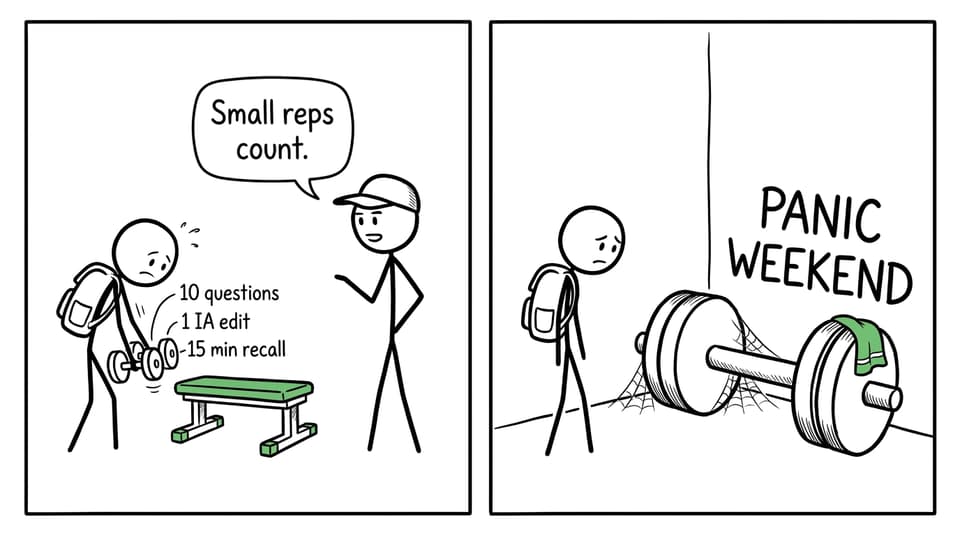
A Diploma point rarely appears because of one heroic weekend. It is more often the accumulated result of understanding a concept, retrieving it later, applying it to an exam-style question and learning from the mistake.
That is where RevisionDojo becomes the ultimate IB resource: not as a last-minute rescue, but as a daily system. Students can learn through Study Notes, retain ideas with Flashcards, apply them in the Questionbank, and use AI Chat when a precise explanation is needed. Grading tools and the Coursework Library support rubric-aware revision, while Predicted Papers and Mock Exams build timing and stamina. When a student needs individual strategy or human explanation, Tutors provide another layer of support.
The RevisionDojo IB exam preparation app brings those stages into one connected routine. A short study session today may not feel like a point. But enough accurate, repeated sessions can move an assessment mark across a grade boundary, and that is how the total changes.
Understanding the score makes it less intimidating
The 45-point system becomes manageable once its parts are visible: 42 points from six subjects, up to three from TOK and the Extended Essay, and a mandatory CAS requirement that carries no points.
For a parent, the next step is not to calculate every possible result. It is to check that the student understands the Diploma conditions, knows where current marks are coming from and has a sustainable plan for the next small improvement.
The final number arrives on results day. The habits that create it are built much earlier. RevisionDojo helps students make those habits focused, measurable and easier to repeat.