


Introduction: When Your IB Progress Becomes Visible
There’s a moment every IB student knows too well: you walk out of a test thinking, I studied a lot, but the score says something colder. Not because you’re incapable. Usually because your effort wasn’t aimed at the exact skill the IB exam rewards.
That’s where data matters. Not “big data” or complicated spreadsheets, but the simplest truth teachers can collect: what you miss, where you miss it, and whether it’s changing.
The best IB teachers use data the way great coaches use game film. Not to judge. To adjust. And when schools pair that mindset with a platform like RevisionDojo, students preparing for exams feel the difference quickly: clearer targets, tighter feedback, and fewer wasted hours.
A quick checklist: What good IB learning data looks like
If you want your teacher’s “data-driven” approach to actually help your IB exam prep, it should answer these questions:
-
What exactly am I losing marks on? (topic + skill, not just a percentage)
-
Is it consistent? (a pattern across weeks, not one bad day)
-
What’s the next practice action? (a short set, a reteach, a timed section)
-
Can I see growth over time? (proof that the fix worked)
-
Does it match IB marking logic? (criteria, command terms, exam-style tasks)
If you’re using RevisionDojo at school, this kind of clarity is the point of tools like the RevisionDojo for Schools dashboards.
Why IB teachers often collect data but can’t use it (yet)
Most IB teachers already have the raw ingredients: quizzes, homework results, IA checkpoints, and mock exam scripts. The bottleneck is rarely effort. It’s friction.
Data without structure becomes noise
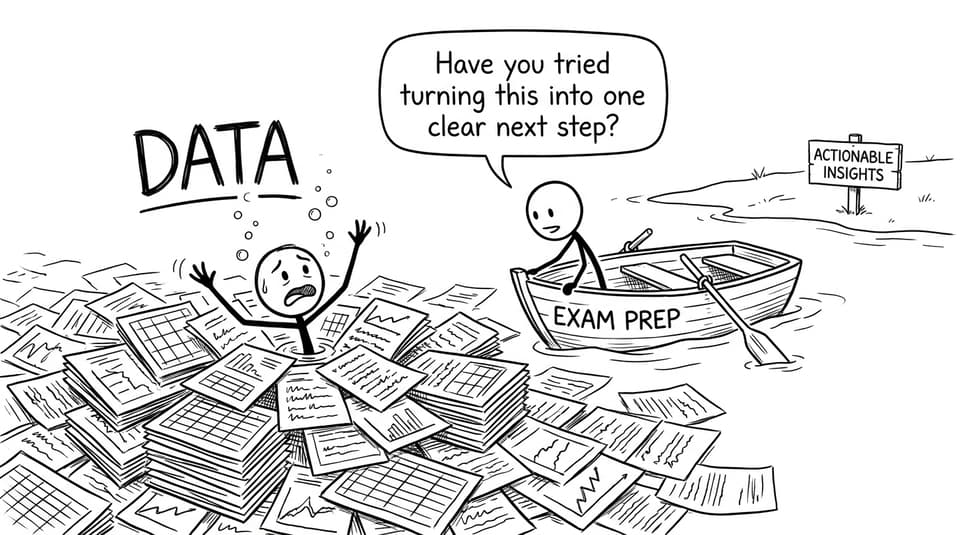
A spreadsheet can hold thousands of numbers and still fail to answer the one question you care about: What should we do next lesson? If results aren’t tagged by topic, command term, or paper skill, patterns hide in plain sight.
Data meetings happen too late
If the only “analysis moment” is after a major assessment, students spend weeks repeating the same mistake patterns. For IB students preparing for exams, late feedback feels like trying to steer a ship after you’ve already hit the rock.
Exam performance is skill-shaped, not just content-shaped
Two students can “know the topic” and score differently because one handles the command term better, structures the response, and manages time. That’s why data that tracks skills (not just chapters) is so valuable.
How RevisionDojo turns IB data into next steps you can feel
RevisionDojo was built around a simple promise: make IB performance data usable fast, for teachers and students.
Teachers get patterns, not piles
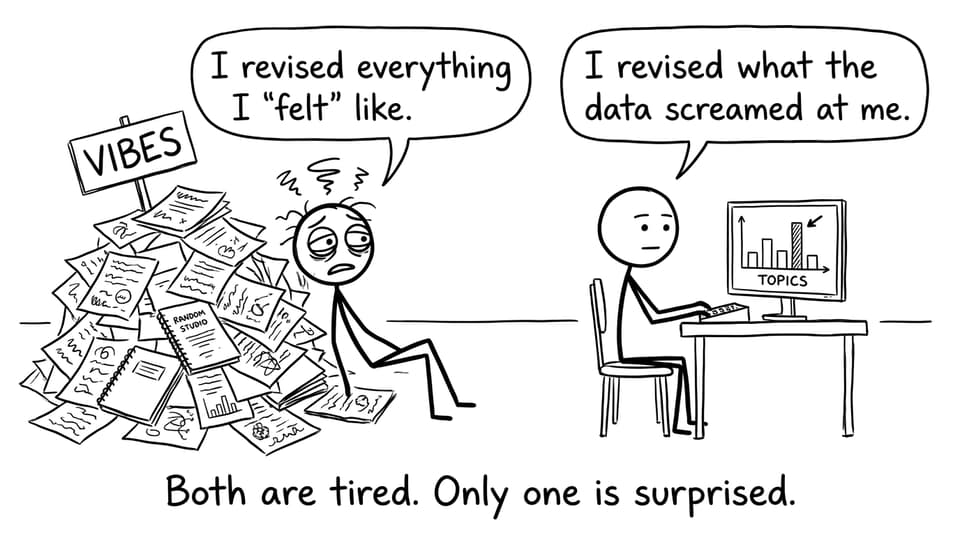
When your practice and assessments live in one place, teachers can spot what matters: the most-missed subtopics, recurring misconceptions, and skills that collapse under time pressure. This is the difference between “revise Chapter 6” and “you’re consistently dropping evaluation marks on Paper 2 style questions.”
Students often see this workflow through tools like:
-
IB Question Bank | How to Use It Effectively for targeted drills
-
RevisionDojo App: The Smarter Way to Prep for IB Exams to run the full loop (learn, practice, review)
Students get ownership, not mystery
For IB students preparing for exams, the best kind of data is the kind you can act on today. RevisionDojo’s ecosystem supports that:
-
Questionbank sets that match your weak areas
-
Study Notes to patch understanding quickly
-
Flashcards to keep fragile facts alive
-
AI Chat to unblock confusion without losing an hour
-
Grading tools to make feedback concrete (especially on written work)
-
Predicted Papers and Mock Exams to rehearse timing and stamina
-
Coursework Library to see what strong work looks like
-
Tutors when you need a human strategy reset
If you want a practical example of how teacher analytics changes student revision, see IB Success: How Teacher Analytics Power Your Revision.
A real classroom example: the command term problem hiding in your scores
Imagine an IB History class where students “know the content” but essays keep landing below expectations. On the surface, it looks like a knowledge gap.
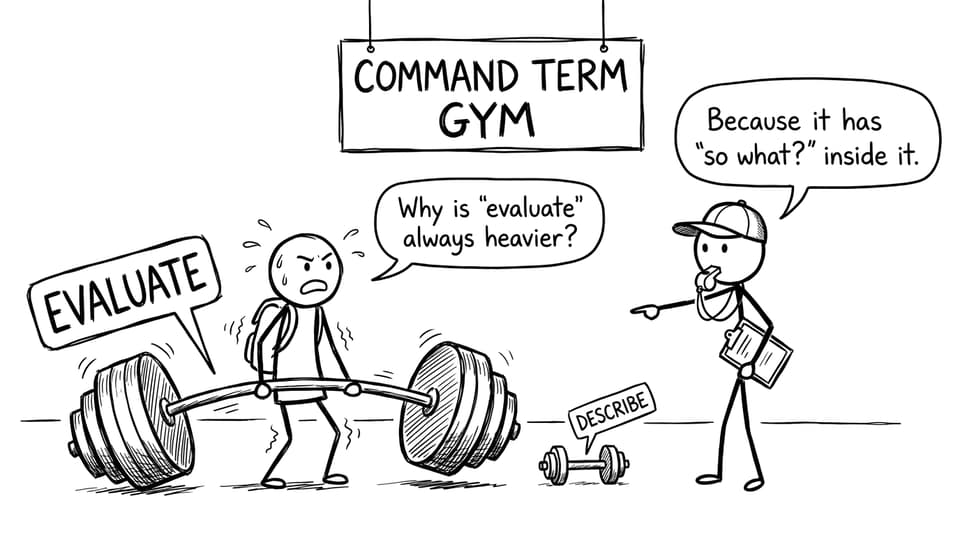
But data often reveals something sharper: students underperform specifically on evaluate questions. That’s not a content issue. It’s a thinking-and-structure issue.
A teacher who can see that pattern can do something precise:
-
Assign short, focused practice on evaluative paragraph structures
-
Use the Questionbank to drill the same command term across multiple topics
-
Use AI Chat to clarify what “evaluation” actually looks like in an examiner’s eyes
-
Recheck performance after two weeks to confirm the change
That’s what “data-driven” should mean in the IB: not surveillance, but steering.
How you can benefit (even if you’re not the teacher)
Even if you never see your teacher’s dashboard, you can ask for data in student language:
-
“Which IB topics are my biggest mark leaks?”
-
“Is it content, command terms, or timing?”
-
“What’s one drill I should do this week to fix it?”
Then run the simplest loop:
-
Clarify one weakness using IB revision made easy with RevisionDojo
-
Drill it in the Questionbank
-
Review mistakes and convert them into Flashcards
-
Pressure-test weekly using IB Predicted vs Specimen Papers: What They Mean
FAQ
How can data actually improve my IB exam score, not just track it?
Data improves your IB score when it changes your next 60 minutes of work. A raw percentage doesn’t tell you what to do; a pattern does. If your results are broken down by topic and skill, you can stop “revising everything” and start fixing the two or three mark leaks that repeat. That usually means fewer notes and more targeted practice. It also means your teacher’s feedback becomes more specific: not “add detail,” but “your evaluation doesn’t weigh both sides.” Over a few weeks, those small corrections stack into visible score movement.
What kind of IB data should teachers focus on close to exams?
Close to IB exams, the most useful data is exam-shaped: performance by topic, command term, and paper style. Teachers should also track timing issues, because a student who understands content can still lose marks by rushing. Another key category is “error type” (misread question, missing definition, flawed structure, calculation slip). When teachers can see which error type dominates, interventions become simpler and faster. Tools like Questionbank analytics, Grading tools feedback, and timed Mock Exams create cleaner signals than isolated classroom tests. The goal is a short list of priorities, not a long report.
I’m an IB student: how do I use this approach without feeling judged by numbers?
Treat IB data like a compass, not a verdict. A low score is not your identity; it’s a snapshot of what happened under certain conditions. When you focus on trends across several attempts, the emotion drops and the usefulness rises. Make your data personal and practical: pick one weakness, run a targeted set, and reattempt after 48 hours. If the number improves, you have proof you can change outcomes. If it doesn’t, you’ve still learned what not to do, and you can ask smarter questions in class or in AI Chat. Over time, the calm comes from knowing you have a method, not from hoping you’ll feel “ready.”
Conclusion: IB data is only powerful when it becomes action
The quiet advantage in the IB isn’t studying more. It’s studying with feedback that points to the next step. When teachers use data well, students preparing for exams stop guessing and start steering.
If you want that system in one place, RevisionDojo is built for it: Questionbank, Study Notes, Flashcards, AI Chat, Grading tools, Predicted Papers, Mock Exams, Coursework Library, Tutors, and the school dashboards that turn classroom effort into measurable improvement.
Explore how your school can bring that clarity to every IB student: RevisionDojo for Schools.