



In the IB, a lot of marks are lost quietly.
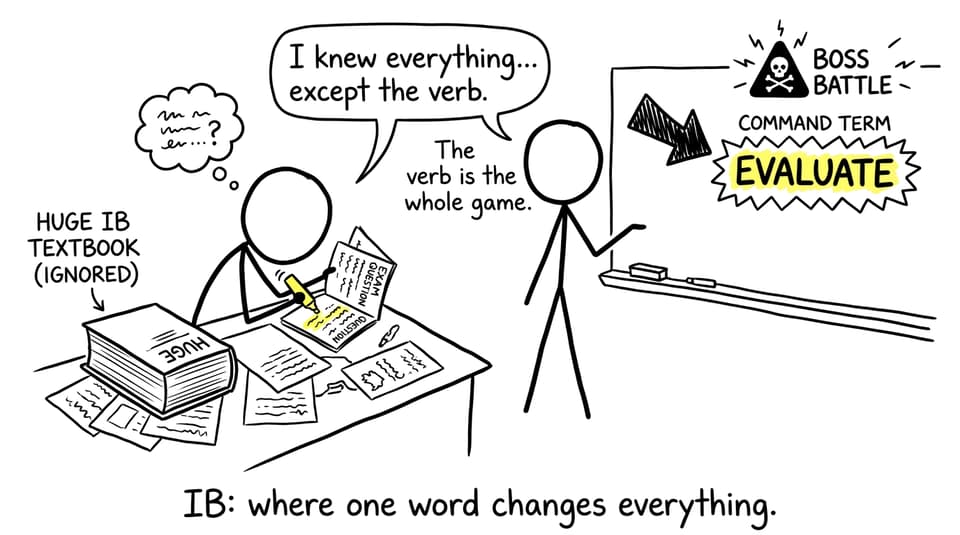
Not because a student didn’t revise, or because the topic was unfamiliar. But because they wrote a strong answer to the wrong task.
It happens when the student sees “photosynthesis” and starts unloading everything they know, while the question is really asking them to evaluate a claim, contrast two pathways, or justify a choice. In IB exams, command terms are not decoration. They are the steering wheel.
Teachers can’t control exam nerves, but they can make the verbs feel familiar long before the exam hall does.
A fast classroom checklist for IB command terms
Use this as a simple weekly rhythm to build IB command terms mastery without turning lessons into vocabulary drills:
-
Make students circle the command term before they write.
-
Teach an “answer shape” for each high-frequency verb (bullets, PEEL, balanced judgement, etc.).
-
Practice “same topic, different verb” at least once a week.
-
Give feedback on whether they did the verb, not only whether they knew content.
-
Track patterns: who struggles with analyze vs evaluate vs explain.
For students, the fastest way to make this feel systematic is to use a platform that bakes in repetition and feedback, like the RevisionDojo Questionbank.
Why IB command terms confuse even strong students
Command terms look small, but they demand different thinking moves.
In IB marking, you’re not only rewarded for being correct. You’re rewarded for being correct in the requested way. That’s why students commonly:
-
Blur definitions (e.g., treating analyze like describe).
-
Write “smart” paragraphs that never actually reach a judgement for evaluate.
-
Over-explain on low-mark tasks that only needed a short response.
-
Panic under time and default to memorized content.
A helpful framing to teach is: topic words tell you what to talk about. The command term tells you what the examiner needs to see.
If your students need a quick reference to revisit independently, pair your routines with this guide: IB Command Terms: The Hidden Key to Exam Marks.
How IB teachers can train “answer shapes” (not just definitions)
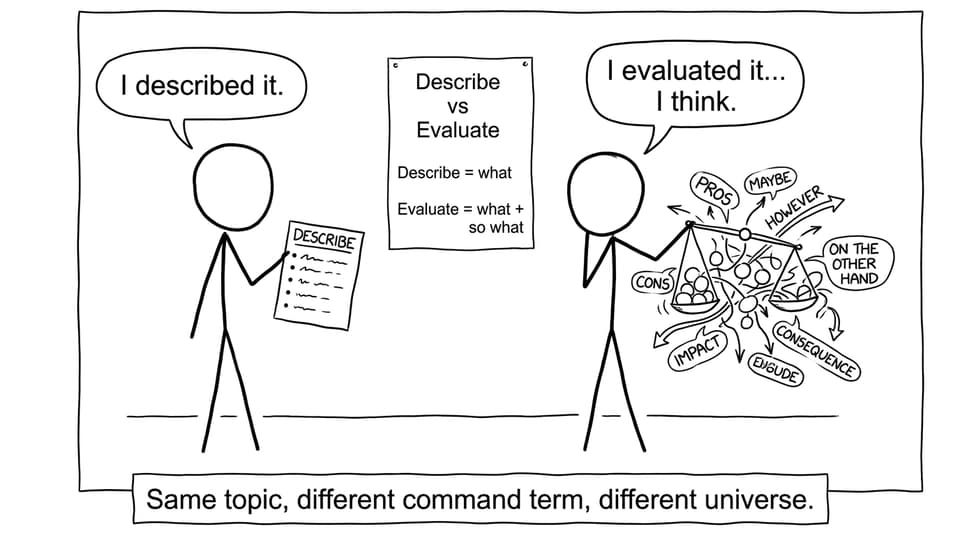
A definition is memory. An answer shape is performance.
Try teaching each command term with a default structure students can follow under pressure:
Describe / Outline
Students should produce clear features or a sequence. Encourage labels, short sentences, and “what happens” clarity.
Explain
Require because language: cause, mechanism, and consequence. In many IB subjects, this is where marks live.
Analyze
Teach “parts + relationships.” Students must break something down and show how pieces connect.
Evaluate / Discuss / To what extent
Give them permission to be structured, not poetic:
-
set criteria
-
weigh strengths/limits
-
reach a justified judgement
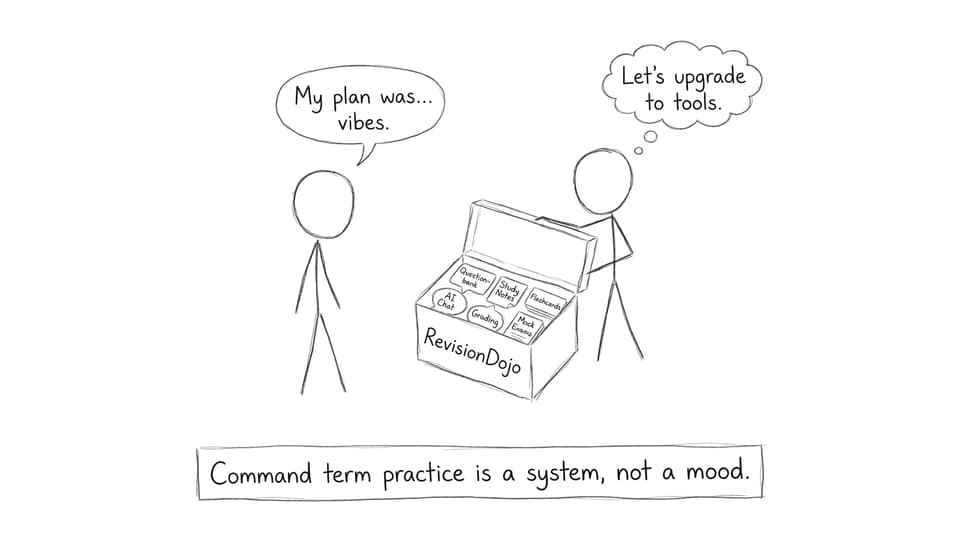
To reinforce this across homework and timed drills, students can practice with feedback loops in RevisionDojo’s RevisionDojo App: IB exam prep system, which connects Study Notes, Flashcards, AI Chat, Grading tools, and Mock Exams into one routine.
Building command term mastery with RevisionDojo (student-facing wins)
Students preparing for IB exams usually don’t need more motivation. They need fewer vague sessions.
RevisionDojo helps command terms become automatic because students repeatedly see the verb, attempt the task, and get feedback while the mistake is still fresh. A practical loop looks like this:
-
Learn the content quickly with RevisionDojo for IB and targeted Study Notes.
-
Lock in key phrasing with IB Flashcards with Spaced Repetition (especially useful for “define/state” precision).
-
Drill the exact skill using the Questionbank so the same command term repeats across topics.
-
Use AI Chat to ask, “Did I actually evaluate, or did I just explain?”
-
For longer responses, use Grading tools to see what “top-band” execution looks like.
-
Rehearse timing with IB Predicted Papers and structured Mock Exams.
If you want a student-friendly primer on the habit itself, link them to: How to Use IB Command Terms Effectively in Exam Responses.
A simple “command term clinic” teachers can run (15 minutes)
Once per week, run a short clinic:
-
Pick one command term (e.g., evaluate).
-
Give students one familiar topic and two different prompts: explain vs evaluate.
-
Have them label the answer shape before writing.
-
Swap answers and highlight sentences that “do the verb.”
-
Finish with one targeted Questionbank set for homework.
Over time, students stop fearing the verbs because they’ve seen the trick: the IB rewards visible thinking, not hidden knowledge.
FAQ
How many IB command terms should students memorize?
Students don’t need to memorize a huge list in isolation, and teachers don’t need to teach them like spelling words. In the IB, the high-frequency command terms repeat constantly, and those are the ones that should become automatic. The best approach is to learn a smaller set deeply: what the verb means, what the examiner expects, and what the answer should look like on paper. Once the “answer shape” is stable, students can handle unfamiliar wording by mapping it to a familiar thinking move. This is also why practice matters more than posters: seeing IB command terms in real questions trains recognition under time pressure. On RevisionDojo, students get repetition through the Questionbank and reinforcement through feedback and analytics.
What’s the biggest mistake students make with IB command terms?
The most common mistake is answering the topic instead of answering the task. In IB exams, students often start writing before they’ve decided what success looks like for that verb. They might “explain” when asked to “evaluate,” which means they provide lots of correct content but never make a justified judgement. Another frequent issue is mixing compare/contrast or analyze/describe, where the response stays at a surface level. Teachers can reduce this by insisting on a 10-second routine: circle the command term, translate it into an answer shape, then plan. RevisionDojo supports this mindset by making students practice the same verbs repeatedly across many questions.
How can RevisionDojo help teachers make command terms consistent across subjects?
Consistency is hard when each subject teacher explains verbs slightly differently, even though the IB expects stable thinking skills. RevisionDojo acts like a shared training ground: students encounter command-term-driven questions across subjects in one place. Teachers can direct students to specific practice sets via the Questionbank, then use performance trends to identify which verbs cause the most mark loss. Students can also use AI Chat to ask for “examiner-style” feedback: what is missing for justify or evaluate in their response. For extended answers, RevisionDojo’s Grading tools help students see whether their structure matches the task, not just whether their facts are correct. When students experience that same feedback logic across subjects, IB command terms stop feeling like personal teacher preferences and start feeling like exam reality.
Closing: teach the verb, unlock the marks
In the IB, command terms are the smallest words with the largest consequences.
When teachers train students to notice the verb, choose an answer shape, and practice it until it’s instinctive, exam technique stops being a mystery. It becomes a routine.
If you want students to build that routine with less friction, point them to RevisionDojo’s ecosystem: the Questionbank, Study Notes, Flashcards, AI Chat, Grading tools, Predicted Papers, Mock Exams, Coursework Library, and Tutors all exist to make IB practice more consistent than motivation ever is.
For schools and teachers, explore: RevisionDojo for Schools