



You can know a topic perfectly and still lose marks in an IB exam.
It happens in a strangely quiet way: you write what you know, the page fills up, and it feels like a good answer. Then the feedback comes back with the same message students hate reading: “Not focused on the question.”
Most of the time, that isn’t a content problem. It’s a command terms problem.
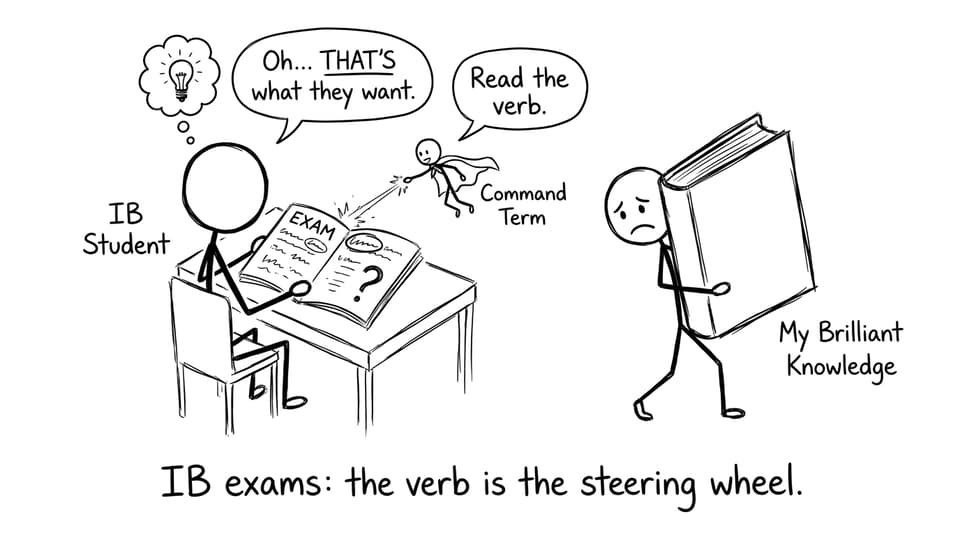
In the IB, command terms (analyse, evaluate, compare, discuss, outline, etc.) are the steering wheel. Content is the engine. If you don’t steer, you can drive a powerful car straight into the wrong wall.
What command terms mean in IB exams
Command terms are the instruction verbs in IB questions. They tell you how to respond, not just what to write about.
A quick way to feel the difference:
-
Describe = what it looks like, what happens, what the features are.
-
Explain = why/how it happens (cause, mechanism, effect).
-
Analyse = break it into parts and show relationships.
-
Compare = similarities and differences in a structured way.
-
Evaluate = weigh strengths and limitations using criteria, then judge.
If you treat analyse like describe, you may write accurate paragraphs but miss the thinking skill the markscheme is rewarding.
For a deeper walkthrough with examples, keep this open while you practise: IB Command Terms: How to Use Them to Score More.
A 30-second checklist before you write (save this)
When an IB question lands, run this mini-routine:
-
Circle the command term.
-
Underline the topic words (the content you must use).
-
Look at the marks (depth signal).
-
Translate the command term into a shape (bullets, paired comparisons, balanced judgment).
-
Write a one-line plan that includes the command term.
That last step matters because it forces honesty: “Am I actually evaluating, or am I just explaining loudly?”
Why IB command terms directly affect your marks
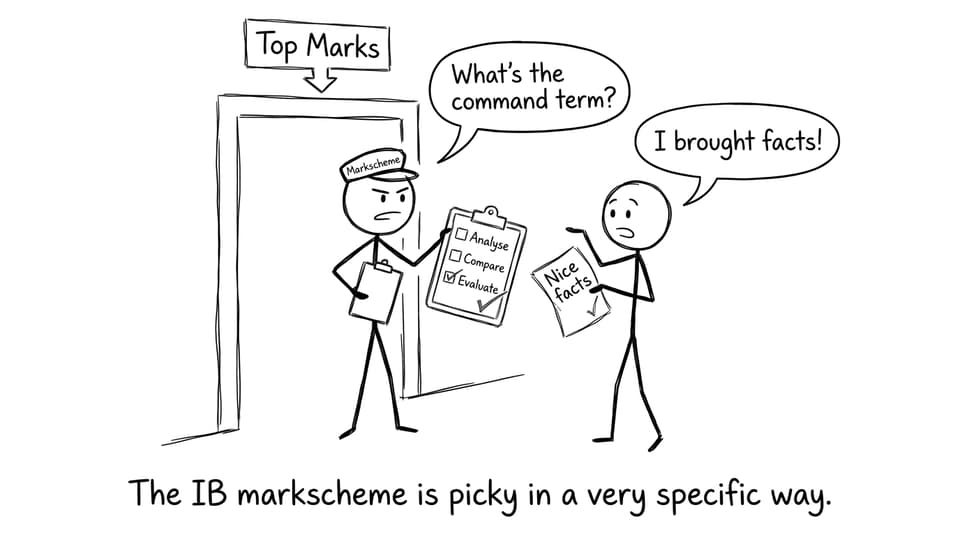
The IB doesn’t only reward knowledge. It rewards performance under a specific task.
Command terms map closely to assessment objectives: lower-demand verbs often test recall and basic understanding, while higher-demand verbs require analysis, synthesis, and judgment.
That’s why misunderstanding a single verb can cap your score even if your facts are strong. You answered a different question than the one the examiner is marking.
If you want a calm, repeatable system for building that exam skill, this pairs well with command-term practice: IB: How to Get a 7 (A Calm, Repeatable System).
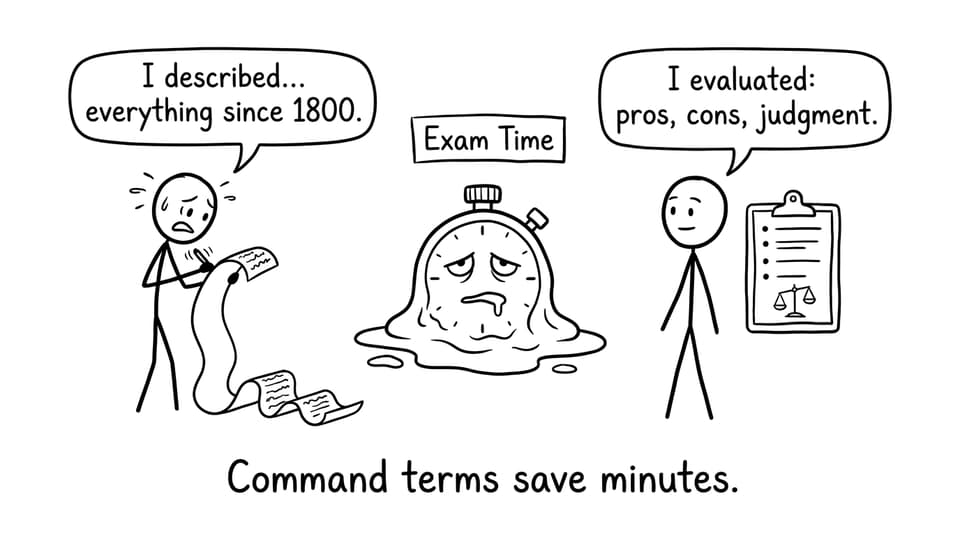
Command terms change your time strategy
In an IB paper, time disappears faster than your confidence.
Command terms help you spend time where marks live:
-
Identify/State: one line, no story.
-
Outline: brief summary, main points only.
-
Explain: 2-4 linked steps (cause, mechanism, effect).
-
Analyse: parts + relationships (often multiple paragraphs or structured steps).
-
Evaluate/Discuss: balance + evidence + conclusion.
You can build this instinct by drilling exam-style prompts repeatedly. RevisionDojo’s Questionbank is ideal for this because it forces you to meet the verb again and again until it feels normal.
Using RevisionDojo to master IB command terms (without memorising lists)
Memorising definitions helps a little. Practising them in context helps a lot.
Here’s a practical loop many IB students can sustain:
Build the “command term library” in your head
-
Turn tricky verbs into quick prompts using IB Flashcards with Spaced Repetition (SRS).
-
If you want the workflow behind daily flashcards, this guide is useful: IB Flashcard System: Active Recall for Better Memory.
Practise the verbs where they actually appear
-
Use the Questionbank to practise short responses and extended responses.
-
Review your mistakes and label them: content gap vs. command term gap.
Rehearse full exam conditions
-
Run realistic timed practice using IB Predicted Papers and then patch weaknesses with targeted drills.
-
If you’re unsure how to balance different practice resources, read: IB Predicted vs Specimen Papers: What They Mean.
And when your brain blanks on what a question wants, this is the exact moment to use a quick diagnostic read: IB Exam Panic: What to Do If You Don't Understand.
Conclusion: treat the IB verb like the whole question
If you want a simple upgrade that pays off across every IB subject, start here: do the verb.
Command terms aren’t decoration. They’re instructions. And once you learn to see them clearly, your revision gets calmer because it becomes more predictable: you know what the examiner is asking you to do.
Build the habit with RevisionDojo: learn quickly with Study Notes, drill the verbs in the Questionbank, lock them in with Flashcards, get unstuck with AI Chat, and rehearse under pressure with Predicted Papers and Mock Exams. That’s how IB knowledge becomes IB marks.