


When the clock is loud and your pen feels heavier than it should, IB exams have a quiet way of revealing a truth: knowledge isn’t the same as marks. Many students walk out thinking, “I knew that,” and they’re right. But somewhere between what they knew and what they wrote, a single word decided the outcome.
That word is usually a command term.
In IB questions, command terms are the steering wheel. Content is the engine. If you floor the accelerator but turn the wheel the wrong way, you still end up in the ditch. The good news is that command terms are learnable, repeatable, and surprisingly calming once you treat them like instructions instead of decoration.
A quick IB command terms checklist (use this before you write)
Use this 30-second checklist on every IB response:
-
Circle the command term (what you must do)
-
Underline the topic words (what you must talk about)
-
Count the marks (how much depth is needed)
-
Translate the task into a deliverable: “I need to weigh both sides and conclude”
-
Build a micro-plan: 2-4 bullet points that match the command term
If you want a deeper refresher on why this matters, keep this open: The importance of understanding command terms in IB exams.
What IB command terms really are (and why they cost marks)
Command terms are the instruction words in IB questions that tell you the type of thinking to show: recall, explanation, analysis, or judgement. They’re consistent across subjects, even if the examples change. “Describe” in Geography and “describe” in Biology still means “give a detailed account,” not “explain why.”
They cost marks because examiners award credit for the right kind of response. A perfectly accurate paragraph can still underperform if it’s the wrong shape. For instance:
-
Writing a list when the question asks you to explain (no cause-and-effect)
-
Giving only pros when the question asks you to discuss (no balance)
-
Stating opinions when the question asks you to evaluate (no criteria)
A practical way to train this is to do command-term-specific practice in a question set. RevisionDojo’s Questionbank is built for that kind of repetition, with exam-style prompts and feedback loops that make patterns obvious.
High-impact IB command terms (and how to answer them like a marker)
Below are the command terms that show up everywhere in IB exams, plus a simple “examiner-friendly” way to respond.
Describe vs Explain (the most common mismatch)
Describe = what it is, what happens, what it looks like, what the steps are.
Explain = why/how it happens, with a mechanism or cause-and-effect chain.
A strong IB habit: if you see explain, force yourself to write the word “because” at least once in each main point. If you can’t, you’re probably still describing.
When you’re rebuilding clarity on a topic, combine short notes with immediate practice. Use RevisionDojo’s main IB hub to jump into your subject quickly, then practise the same command term across multiple questions.
Analyze (break it down and show relationships)
Analyze means you’re not just listing parts. You’re showing how parts connect.
A reliable structure:
-
Identify the components (briefly)
-
Explain the relationship between them
-
Link back to the question focus (the “so what”)
In IB History, that might look like connecting economic pressures to political decisions. In Biology, it might be linking a change in one variable to a process outcome. The subject changes; the thinking pattern doesn’t.
If you freeze mid-analysis, use targeted help rather than re-reading everything. RevisionDojo’s AI Chat workflow is useful here: ask one tight question (“What relationships should I show?”), then go right back to practice.
Compare and contrast (two columns beat one paragraph)
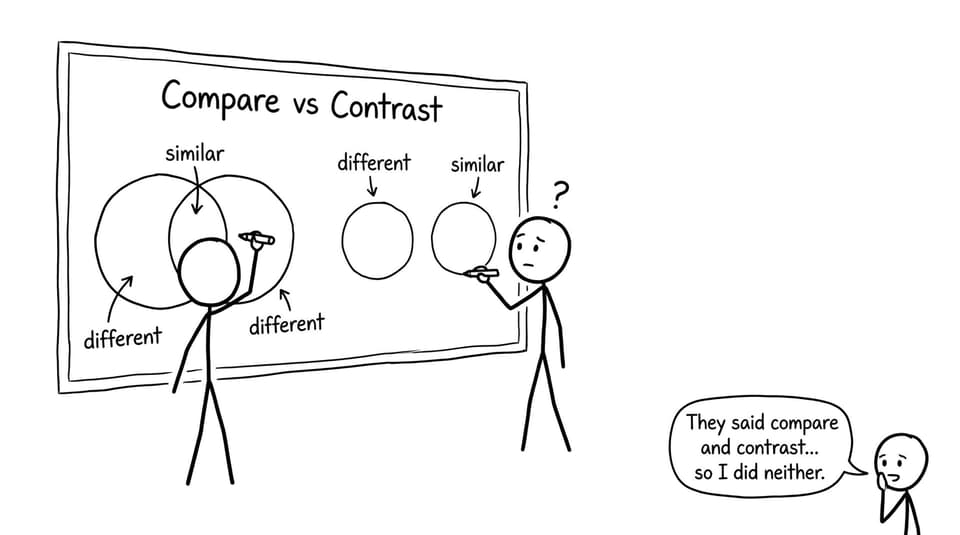
This term is a classic mark-leak because students do only one half.
-
Compare = similarities
-
Contrast = differences
-
Compare and contrast = both
A simple method that works across IB subjects:
-
Use paired sentences: “Both A and B…, however A…, whereas B…”
-
Or use a mini-table in planning, then write it as paragraphs
Discuss (balanced argument, then a reasoned conclusion)
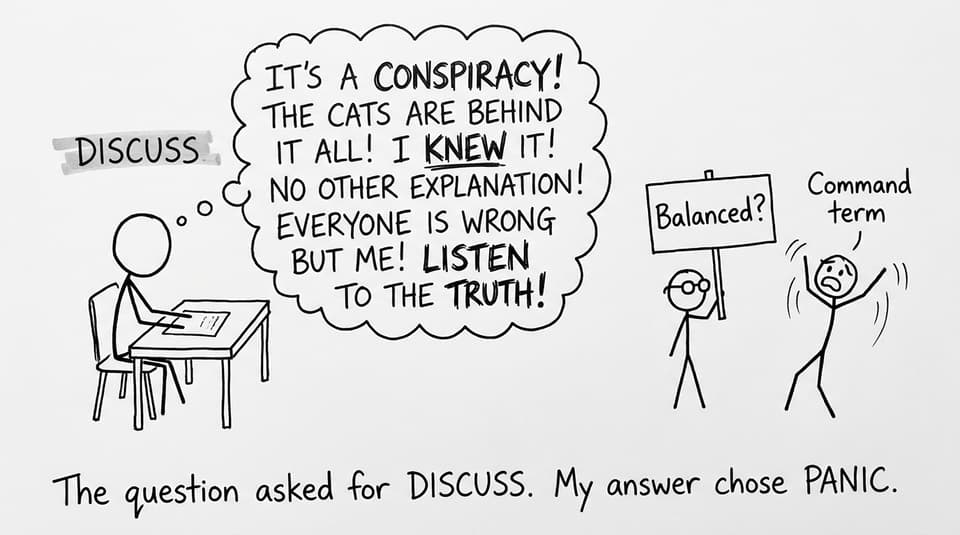
Discuss is not “say everything you know.” It’s “weigh viewpoints.”
A marker-friendly structure:
-
Define the key concept briefly (control the scope)
-
Present argument/viewpoint 1 with evidence
-
Present argument/viewpoint 2 with evidence
-
Address a limitation or condition
-
Conclude with a reasoned judgement
If you tend to write one-sided, train balance deliberately: for every claim, write a counter-claim. RevisionDojo helps you rehearse this under pressure with timed sets and feedback through the RevisionDojo app exam-prep workflow.
Evaluate (use criteria, not vibes)
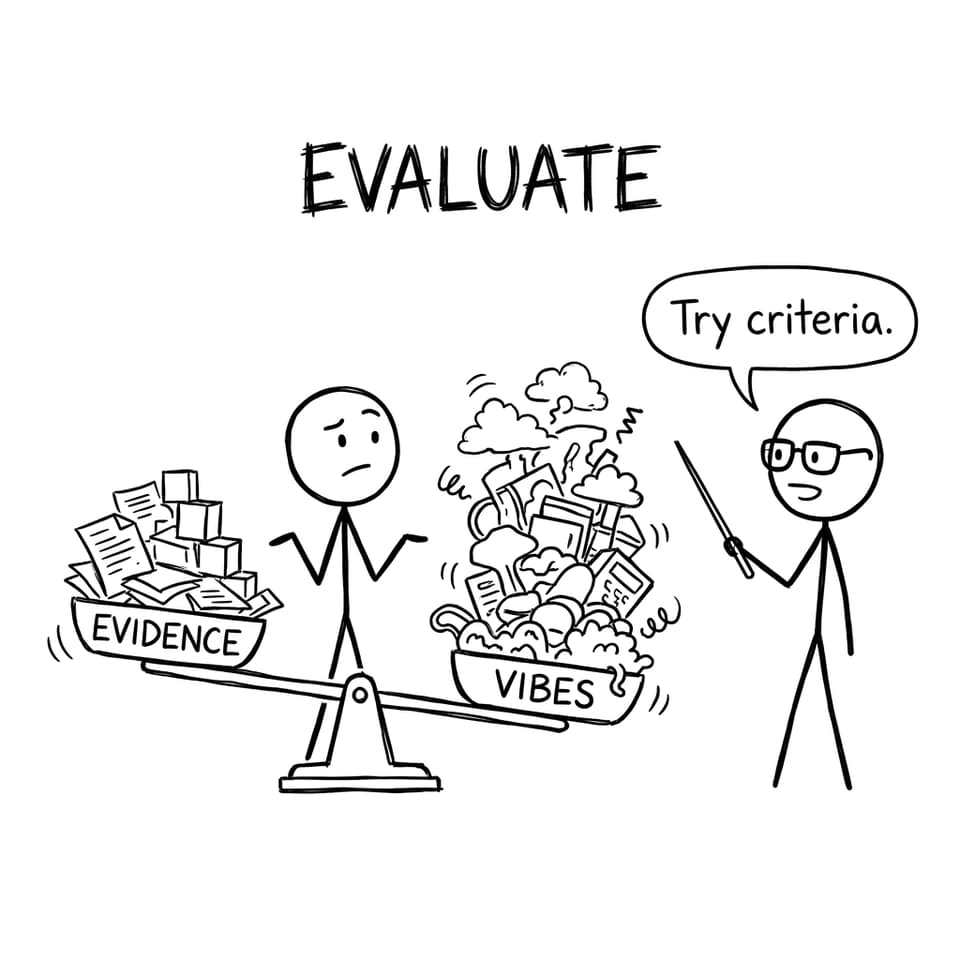
Evaluate means making an appraisal by weighing strengths and limitations, using evidence and a conclusion.
The secret weapon is criteria. Pick 2-3 criteria that make sense for the subject (accuracy, feasibility, efficiency, ethical impact, short vs long term). Then judge using them.
-
State the criteria
-
Apply evidence to each
-
Acknowledge limitations
-
Finish with a justified conclusion
When you want fast feedback on evaluation quality, RevisionDojo’s Grading tools and Tutors can turn “sounds good” into “earns marks,” especially for longer responses.
A simple practice loop: turn IB command terms into muscle memory
Most students try to “remember” command terms. The better strategy is to experience them repeatedly.
Here’s a lightweight loop you can run inside RevisionDojo:
-
Learn quickly with Study Notes (no rewriting marathons)
-
Lock definitions and structures with Flashcards
-
Drill one command term at a time using the Questionbank
-
Use AI Chat when you’re stuck on what the question wants
-
Build realism with Mock Exams and Predicted Papers
-
Review with Grading tools to see exactly why marks were lost
-
Use the Coursework Library to reduce background stress that steals revision focus
If exam practice is your missing piece, these two reads are helpful:
Conclusion: in IB, the command term is the contract
In IB exams, command terms are the clearest promise the question makes to you: “Do this kind of thinking, and you can earn these marks.” When you treat that promise seriously, your answers get calmer and more deliberate. You stop writing everything and start writing what’s needed.
If you want a single place to practise command terms the way IB actually tests them, build your loop in RevisionDojo: Study Notes for clarity, Flashcards for daily recall, Questionbank for repetition, AI Chat for quick unblocking, Grading tools for precision, Predicted Papers and Mock Exams for realism, plus the Coursework Library and Tutors when you need deeper support. Your content already matters. Now make your structure match the marks.