
For a split second, everything in sport feels harmless. Then someone lands stiff-legged, a tackle arrives half a beat late, or a wrist absorbs the wrong kind of bend. Nothing “mystical” happened. In IB SEHS, injury is often the moment a force arrives faster, larger, or in a direction that tissue cannot tolerate.
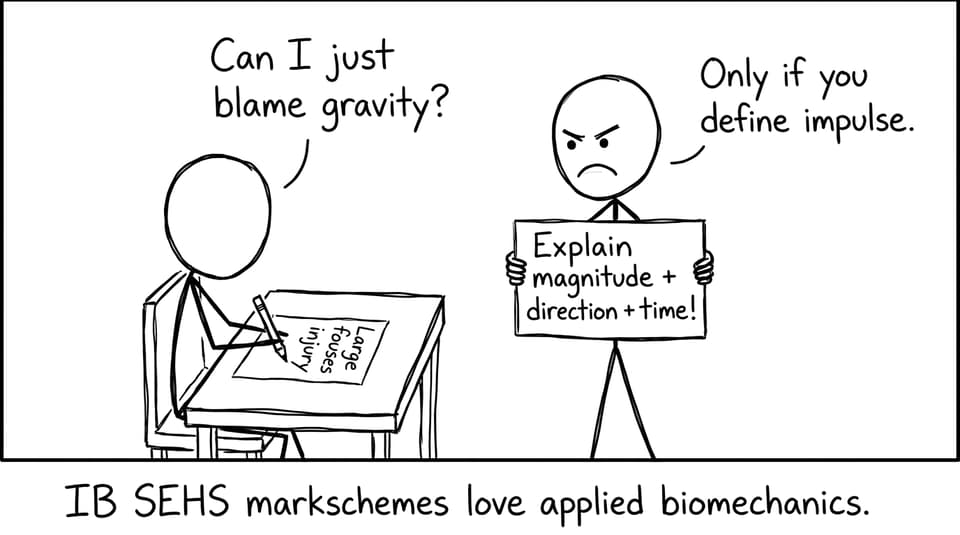
That’s the exam skill too: not just saying “big force = injury,” but explaining how magnitude, direction, and time change risk. If you can do that, your IB SEHS answers start sounding like the markscheme.
IB SEHS quick checklist: what to mention in an injury answer
Use this mini-framework when you see an injury scenario in IB SEHS:
-
Type of force: impact, ground reaction force, tension, compression, shear
-
Magnitude: how large is the force?
-
Time: is it applied suddenly (high loading rate) or spread out?
-
Direction & area: where does it travel through the body, and over how much tissue?
-
Technique/equipment: what reduces peak force or redistributes it?
For definitions and clean phrasing, keep the IB SEHS glossary nearby.
The forces that most commonly cause injury
In IB SEHS, you’re expected to link the mechanism to the tissue failure.
Impact and ground reaction forces
Impact forces show up in collisions, falls, or hard contacts with the ground. Ground reaction force is the “reply” from the floor when you push into it (and it can spike during landings). If you need a quick refresher, revisit Newton’s Third Law in sport.
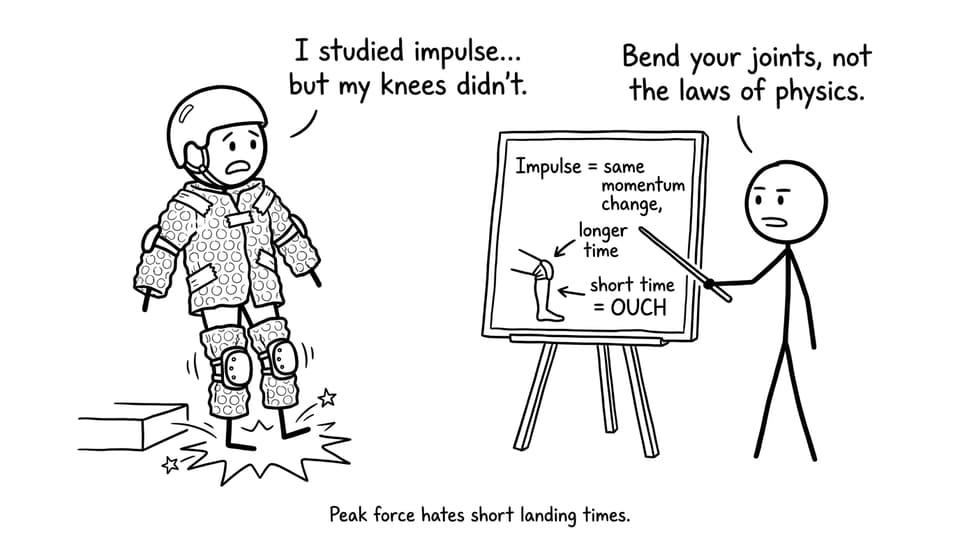
High peaks can overload bone and cartilage, or create joint trauma. In exam language: high force over short time increases peak stress.
Tension, compression, and shear
Some injuries are less about “getting hit” and more about how tissue is loaded.
-
Tension stretches tissue beyond its limit (common in muscle and ligament strains).
-
Compression squeezes tissue between surfaces.
-
Shear slides layers in opposite directions, often at joints.
RevisionDojo’s notes on compression, tension and shearing injuries give you the clean distinctions that score marks in IB SEHS.
Why impulse is the quiet hero of injury prevention
Impulse is the bridge between “physics” and “why coaches shout ‘soft knees!’” In IB SEHS, you can explain it simply: for the same change in momentum, increasing the time of impact reduces peak force.
That is why:
-
athletes flex hips, knees, and ankles on landing,
-
gymnasts roll instead of stopping suddenly,
-
padding and mats reduce injury risk.
If you want targeted practice applying impulse to scenarios, use the B.2 forces, motion and movement questionbank.
Technique and load distribution: where marks are won
Poor technique concentrates force through one joint or one tissue at the worst possible angle. In IB SEHS, describe the chain reaction:
-
stiff landing leads to higher GRF peak leads to more stress at the knee/ankle
-
poor cutting mechanics leads to increased shear/valgus moments leads to higher ligament risk
-
rounded back lifting leads to larger spinal loading and poor force distribution
For a broader map of biomechanics concepts (and what examiners tend to ask), see Conquering Biomechanics: SEHS Topic 4.
Repetitive forces and overuse injuries
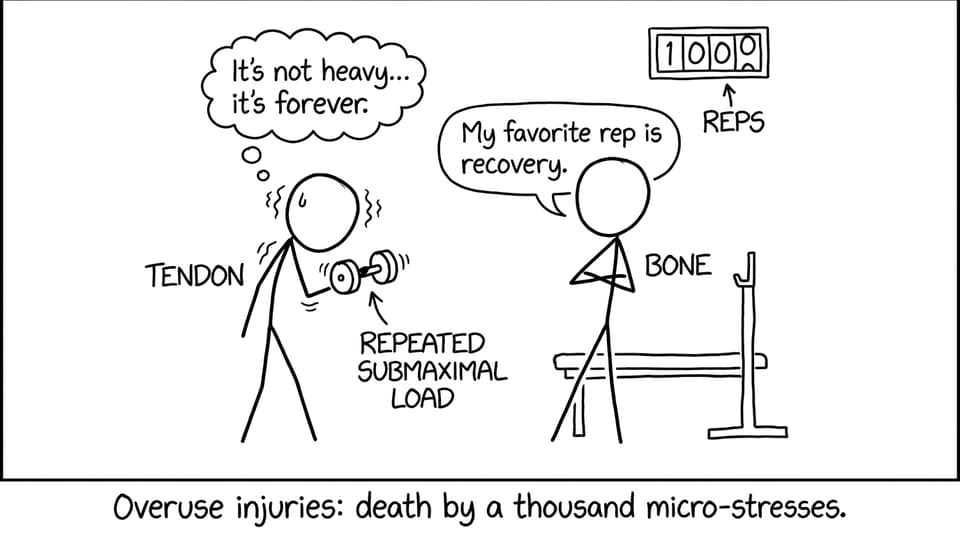
Not every injury is dramatic. Many are quiet accumulations: repeated submaximal loading plus insufficient recovery. In IB SEHS, link this to chronic injury development: micro-damage outpaces repair, leading to tendon pain, stress fractures, or persistent strains.
A clean comparison helps too: acute vs chronic sports injuries.
How to revise this fast with RevisionDojo
When forces and injury start blending together, structure your revision like an athlete trains: short, specific sets.
-
Use the B.3.1 Causes of injury notes to lock in mechanisms.
-
Drill exam application with the B.3.1 Causes of injury questionbank.
-
Reinforce definitions with the B.3.1 flashcards.
RevisionDojo also supports the rest of your workflow: Study Notes, Flashcards, AI Chat for quick clarifications, Grading tools to tighten explanations, Predicted Papers and Mock Exams for timed practice, plus a Coursework Library and Tutors when you need a human checkpoint.
Closing: make the force do the explaining
The simplest way to level up IB SEHS is to stop treating injuries as random bad luck and start treating them as predictable outcomes of force, time, and direction. When you can explain that relationship calmly, you’re not only safer in sport, and you’re clearer on paper.
If you want this topic to feel automatic, use RevisionDojo’s IB SEHS Questionbank, Study Notes, Flashcards, AI Chat, and Mock Exams to practise the exact kind of applied biomechanics explanations examiners reward.