

If you’ve ever watched a classmate float through a 5K while you’re bargaining with your legs by minute two, you’ve already met the core idea behind IB SEHS muscle fibre types. It’s not just “fitness.” It’s how the body chooses tools for the job: some fibres are built to last, others are built to explode.
In IB SEHS, muscle fibre types are a reliable way to explain differences in endurance, speed, strength, and fatigue across athletes and activities. Better still, they’re an easy place to earn marks if you compare clearly and apply to a specific sport.
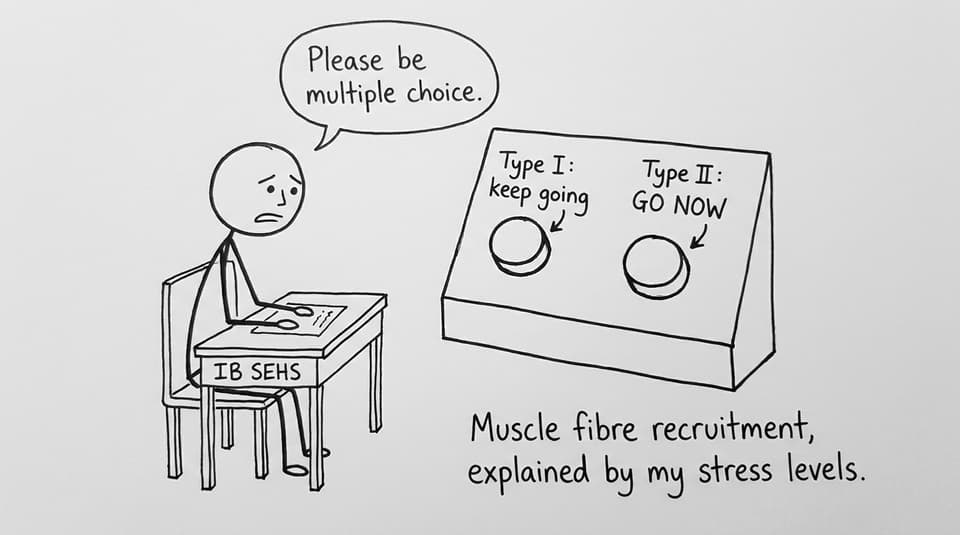
IB SEHS muscle fibre types: the quick checklist
Before you write any answer, run this mini-checklist (it stops you from listing random facts):
-
Identify the fibres: Type I (slow-twitch) vs Type II (fast-twitch)
-
Compare contraction speed, force, fatigue resistance
-
Link to energy systems: aerobic vs anaerobic
-
Apply to a sport: marathon, rowing, sprint, jump, throw
-
Finish with movement efficiency: right fibre recruited for the demand
If you want the syllabus-aligned version, keep RevisionDojo’s IB SEHS hub open while you revise: SEHS resources (new syllabus).
Slow-twitch (Type I) fibres in IB SEHS
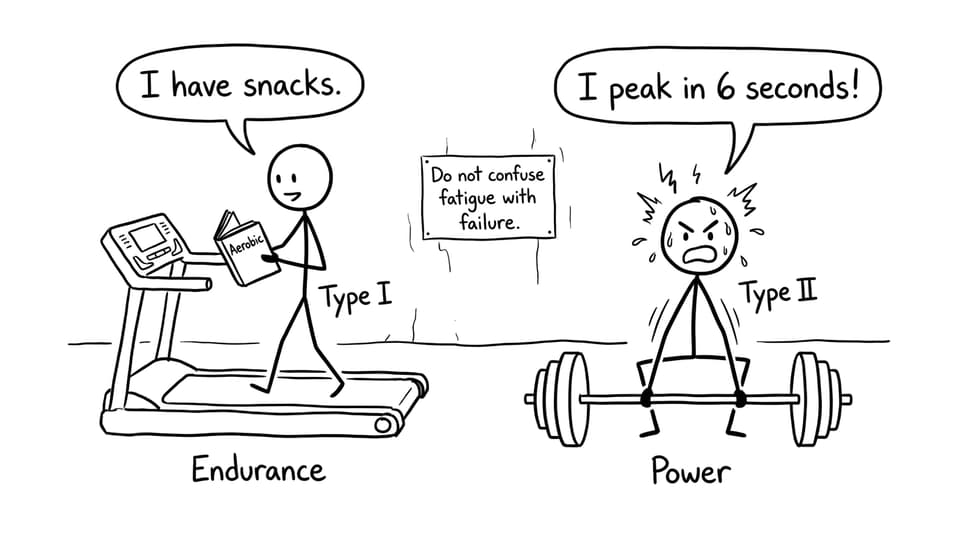
Type I fibres are the “steady engine.” In IB SEHS, you describe them as fatigue-resistant and suited to sustained effort.
Key points to explain (not just list):
-
High aerobic capacity (lots of oxygen use)
-
High fatigue resistance (they keep contracting longer)
-
Lower force output than fast-twitch
-
Slower contraction speed
Application idea: In long-distance running or cycling, Type I fibres support repeated contractions without rapid fatigue, so movement stays efficient over time.
For a deeper structure/function comparison, use: Slow vs fast twitch fibre types (4.1.4 notes).
Fast-twitch (Type II) fibres in IB SEHS
Type II fibres are the “burst engine.” In IB SEHS, they’re your explanation for speed and power, with the trade-off of quicker fatigue.
Key points to explain:
-
Rapid contraction (fast force production)
-
High force output (useful for power)
-
Greater anaerobic contribution (quick energy pathways)
-
Fatigue faster (efficiency drops during long efforts)
Application idea: In a 100 m sprint or a vertical jump, Type II fibres help generate high force quickly, maximizing acceleration and power when time is short.
Muscle fibre types and movement efficiency (what examiners want)
Movement efficiency is basically “spending the right energy for the right outcome.” In IB SEHS, the clean explanation is:
-
Endurance tasks lean on Type I because aerobic ATP production is sustainable.
-
Explosive tasks rely on Type II because force and speed matter more than long-term efficiency.
High-mark answers connect fibre recruitment to the scenario. If the question mentions fatigue, pace changes, or repeated sprints, that’s your cue to discuss how Type II contributes early but drops off faster.
To build broader biomechanics links, these help:
Training adaptations: what you can say in IB SEHS
A common IB SEHS trap is claiming training “turns Type I into Type II” (or the reverse). Keep it exam-safe:
-
Fibre distribution is largely genetic.
-
Training mainly improves the performance of the fibres you already have.
-
Endurance training boosts aerobic qualities; sprint/resistance training boosts fast-twitch function.
If you want targeted practice that mirrors examiner style, go straight to: Movement Analysis questionbank.

Exam tips for IB SEHS muscle fibre questions
Two habits separate average answers from high-scoring ones:
-
Compare + apply: Don’t just describe Type I and Type II, link them to a named movement.
-
Explain the consequence: “High myoglobin” matters because it supports aerobic work, which delays fatigue.
For an exam-writing framework, see: How to score full marks in B.1: IB SEHS.
Bring it home with RevisionDojo
Muscle fibre types can feel like “just another comparison,” but in IB SEHS they’re a shortcut to explaining real performance differences with clarity. When you revise, aim to connect fibre features to what happens in a race, a jump, or a repeated sprint, that’s where the marks live.
To lock it in, use RevisionDojo as your all-in-one IB SEHS system: Study Notes for clean explanations, Flashcards for fast recall, the Questionbank for exam-style practice, plus AI Chat and Grading tools to tighten your phrasing. Add Predicted Papers and Mock Exams near the end of your revision cycle, and you’ll walk into the exam knowing exactly how to apply muscle fibre types under pressure.
Explore more IB SEHS support here: All IB SEHS blog posts.