

There’s a moment in every sprint start where it feels like the track gives you permission to move. You drive your foot down and back, and somehow you surge forward. In IB SEHS, that “somehow” is one of the simplest ideas in biomechanics, and one of the easiest to misuse in an exam: Newton’s Third Law.
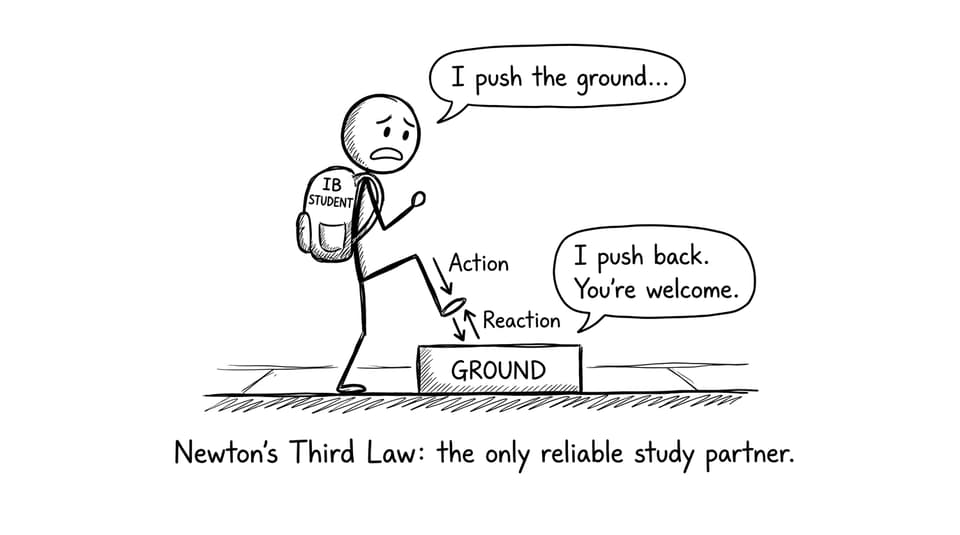
Newton’s Third Law states that for every action force, there is an equal and opposite reaction force. The trick, especially for IB SEHS answers, is to show you understand that these forces act on different objects, and that direction matters just as much as size.
IB SEHS quick checklist: what you must say
Use this mini-checklist when writing about Newton’s Third Law in IB SEHS:
-
State the law accurately (equal and opposite)
-
Identify the two objects (e.g., foot and ground)
-
Describe the action force direction (down/back, down, etc.)
-
Link the reaction force to the outcome (propulsion, take-off, braking, injury risk)
-
Use the term ground reaction force when the surface is the ground
If you want the syllabus-aligned version of the topic, start with the SEHS subject hub and then drill the same idea using the B.2 Forces, motion and movement Questionbank.
Newton’s Third Law in sport: action-reaction pairs that create movement
In sport, Newton’s Third Law shows up whenever an athlete interacts with something: the floor, starting blocks, a ball, a wall, or even water. In IB SEHS, a high-mark explanation usually names the pair clearly:
-
Action force: athlete pushes on the ground (or object)
-
Reaction force: ground pushes back on the athlete
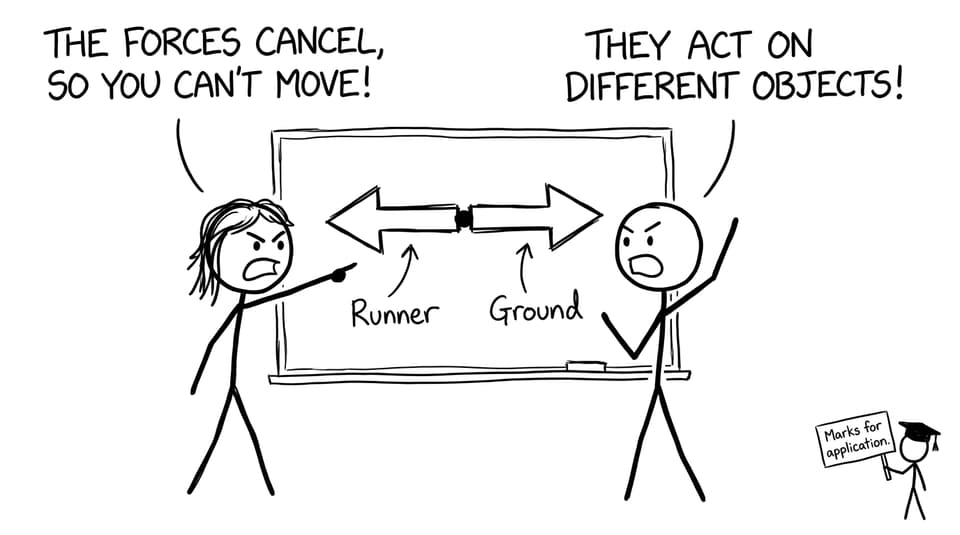
They are equal in magnitude and opposite in direction, but they act on different bodies. That one sentence fixes a common exam error: students claiming the forces “cancel out.” They do not cancel because they are not acting on the same object.
To deepen the full set of Newton’s laws in the course, use the B.2.1 Newton’s laws of motion notes and then practise with B.2.1 Newton’s laws of motion Questionbank.
Ground reaction force in running: why sprinters “push back”
Ground reaction force (GRF) is the reaction force from the ground on the athlete. In running, the athlete applies force into the ground, and the ground applies a reaction force back.
A sprinter is a clean IB SEHS example because their goal is acceleration. When the sprinter pushes down and backward on the track, the ground reaction force acts up and forward on the sprinter, contributing to forward acceleration. If the direction is wrong (too vertical, or too much braking), performance drops because the useful horizontal component of GRF is smaller.
For a broader revision path, pair this with How to Revise Forces and Motion so you practise the cause-and-effect language examiners reward.
Ground reaction force in jumping and landing: performance and injury
Jumping is Newton’s Third Law with fewer distractions. The athlete pushes down into the ground during take-off, and the ground reaction force pushes up on the athlete. Greater applied force (and effective technique) typically leads to a larger upward reaction and a higher jump.
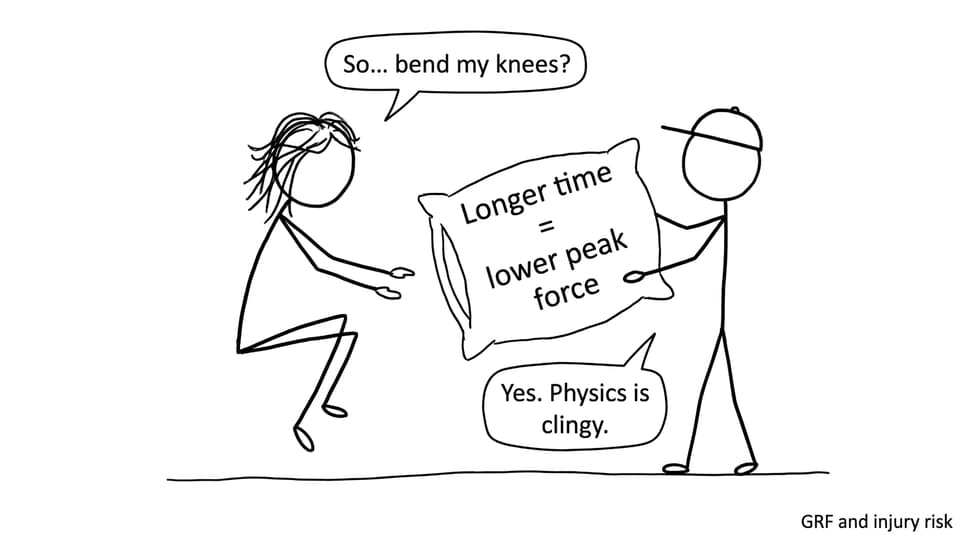
Landing matters just as much in IB SEHS because GRF spikes can relate to injury risk. Poor landing technique can increase peak GRF and loading rate, stressing joints and connective tissue. Better technique increases time over which forces are absorbed (often by greater knee and hip flexion), reducing peak force.
For an exam-focused injury link, read How Forces Cause Injury.
Exam sentence starters for IB SEHS (copy the structure)
Use these templates in IB SEHS short- and extended-response questions:
-
“The athlete applies an action force on the ground by pushing ____. The ground applies an equal and opposite ground reaction force on the athlete, which results in ____.”
-
“Because the action and reaction forces act on different objects, they do not cancel. The reaction force changes the athlete’s motion by ____.”
-
“Improved technique changes the direction/time of force application, which alters GRF and therefore ____ (performance or injury risk).”
Closing: turn Newton’s Third Law into marks
Newton’s Third Law in sport is not just a definition to recite. In IB SEHS, it’s a story of interaction: you push, the world pushes back, and movement happens because the reaction force acts on you. If you can name the objects, describe the direction, and link GRF to performance or injury, you are already writing like an examiner.
When you are ready to lock this in, use RevisionDojo as your home base: the Study Notes and Flashcards make the wording precise, the Questionbank and Mock Exams make it automatic, and AI Chat plus grading tools help you turn “I kind of get it” into consistent exam marks. For a broader map of biomechanics topics, bookmark Conquering Biomechanics: A Visual Guide to SEHS Topic 4 and keep building from there.