You notice it the first time your class runs fitness testing. Two people train the same number of weeks, eat roughly the same, sleep roughly the same… and still move differently. One floats through the endurance run. Another explodes off the line. A third looks built for contact and seems almost unfairly hard to push around.
In IB SEHS, this observation becomes a clean exam topic: body type and sport performance. But the best answers don’t turn into stereotypes. They explain tendencies, then evaluate the model and show you understand what really decides performance: training, skill, psychology, and environment.
If you want a quick home base for the syllabus, start with the IB SEHS resources hub. It frames topics like individual differences in the same language the exam expects.
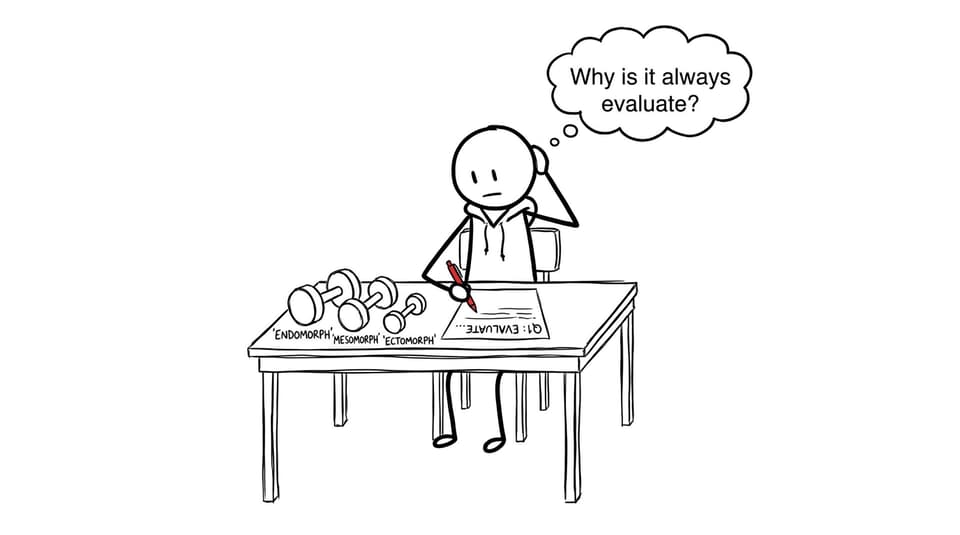
An IB student discovers every question is “evaluate”
Exam checklist: what to say (and what to avoid) in IB SEHS
Use this checklist to keep your IB SEHS answer sharp:
Define body type using somatotypes (endomorph, mesomorph, ectomorph).
Link each type to performance traits (mass, leverage, relative strength, economy).
Give a sport example, but phrase it as a tendency, not a rule.
Evaluate limitations: training adapts body composition; skill and technique matter; categories are simplified.
Finish with a balanced judgement about body type and sport performance.
For exam-style practice on applying concepts (not just memorising them), the free helps you rehearse that “describe + link + evaluate” rhythm.
In IB SEHS, “body type” usually means a person’s overall build and composition, discussed through somatotyping:
Endomorph: higher fat mass, rounder shape.
Mesomorph: muscular, naturally strong and powerful.
Ectomorph: lean, long-limbed, relatively low fat and muscle mass.
Most athletes sit somewhere between categories (for example, an endo-mesomorph). That nuance is part of high-mark IB SEHS writing about body type and sport performance.
Endomorphic athletes may carry more total mass, which can be helpful where stability, momentum, or absolute strength is valued. But extra non-functional mass can reduce relative power-to-weight ratio and increase energy cost in endurance or repeated sprint tasks. In IB SEHS, tie this to efficiency: moving more mass often means higher physiological demand.
Mesomorph and sport performance
Mesomorphs often suit sports requiring strength, speed, and power because higher muscle cross-sectional area supports force production. For IB SEHS evaluation, note that elite performance still depends on neuromuscular coordination, technique, and training quality, not just muscle.
Ectomorph and sport performance
Ectomorphs may show advantages in endurance because low mass can improve running economy and heat dissipation. However, low muscle mass can be a disadvantage where high force production or contact tolerance is crucial. In IB SEHS, keep your language careful: these are tendencies, not destiny.
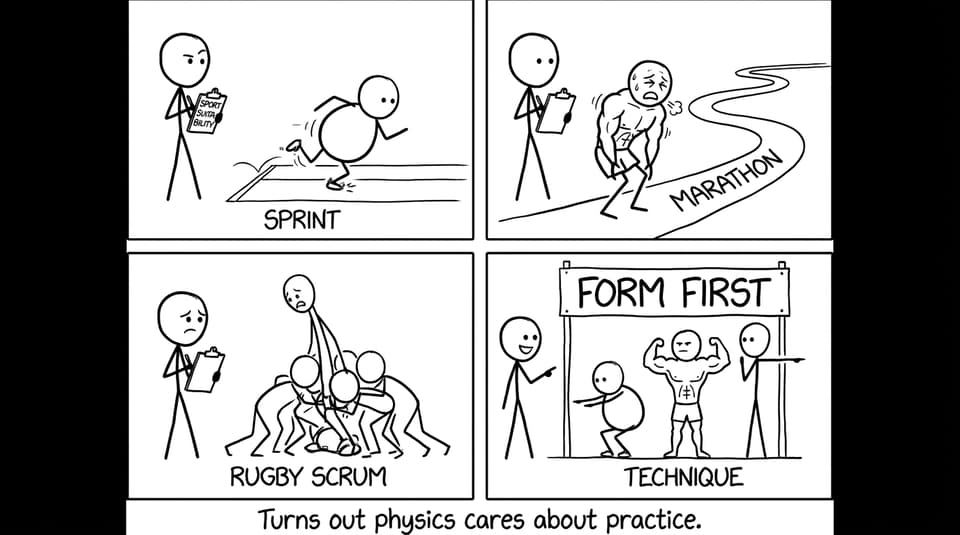
Everybody ends up at the “Technique” station
Sporting suitability: explain without overclaiming
When you connect body type and sport performance, it helps to match traits to demands:
Endurance events often favour leaner builds (commonly ectomorphic tendencies).
Power and sprint tasks often favour muscular builds (mesomorphic tendencies).
Contact sports may favour mixed builds where mass plus power matters.
The exam trap in IB SEHS is writing, “Mesomorphs are best at sport.” A better line is: “Certain physiques may provide a mechanical or physiological advantage, but training status, technique, and psychological factors can override initial differences.”
To practise the evaluation wording that examiners reward, work through timed sets on the IB SEHS papers page.
Limits of somatotypes (this is where marks hide)
Somatotypes are useful because they simplify complexity. They are also limited for the same reason.
In IB SEHS, strong evaluation of body type and sport performance includes these points:
Training changes body composition (fat mass and muscle mass can shift).
Skill and technique can be the biggest separator once athletes are trained.
Environment and opportunity shape who stays in a sport long enough to become elite.
Bring it home: turn “body type” into marks
In sport, body type can be a head start. In IB SEHS, it’s something better: a chance to show you can explain body type and sport performance clearly, then evaluate it like a scientist instead of labelling people.
When you’re ready to move from understanding to exam execution, use RevisionDojo’s Study Notes, Flashcards, AI Chat, Mock Exams, Predicted Papers, and the free Questionbank to practise applying the idea. For coursework support, the SEHS IA Guide and SEHS IA Grader can tighten your analysis and evaluation. And if you want model work, explore the SEHS Coursework Exemplars Library.
That’s the real advantage: not a “perfect” somatotype, but a perfect exam-ready explanation.
IB SEHS goal setting in sport made simple: goal types, SMART targets, common mistakes, and exam-ready tips using RevisionDojo practice tools.