
The night your brain rewrites the story
There's a particular kind of quiet that shows up before IB exams.
It's not the calm quiet of "I'm prepared." It's the tense quiet of "I should be doing more." You close your laptop and feel guilty. You open your notes and feel behind. You've revised for weeks, maybe months, and still your mind keeps asking the same question: What if none of this is enough?
Most IB students assume that feeling means something is wrong with their revision.
Often, it means something is right.
Because readiness isn't a feeling. Readiness is evidence. And in IB, evidence is usually quieter than fear.
A quick IB readiness checklist (evidence over vibes)
If you want a simple way to interrupt the "not ready" loop, use this checklist. It's not motivational. It's measurable.
- You can answer a set of exam-style questions and explain why your answers earn marks.
- You have a short list of recurring mistakes (not a vague sense of doom).
- You've practiced under time pressure at least a few times.
- You can recall key definitions/processes without rereading.
- You have a plan for the last 7 days that fits your energy.
If half of those are true, you're not "behind" in IB. You're in the normal middle zone where strategy matters more than hours.
For a calm, structured approach to the final stretch, see IB: How to Study in the Last 24 Hours (No Panic).
Why IB students feel unready (even with solid prep)
Your brain confuses anxiety with information
Anxiety feels like insight.
It produces urgent thoughts, worst-case images, and a constant itch to "just review one more topic." But urgency isn't accuracy. In IB, your brain is responding to stakes and uncertainty, not necessarily to your real level of preparation.
A useful reframe is this: anxiety is not proof you're unprepared; it's proof you care.
If anxiety spikes close to exams, you'll relate to How to Calm Anxiety the Night Before an IB Exam and the steadier routines inside it.
The IB syllabus is designed to feel infinite
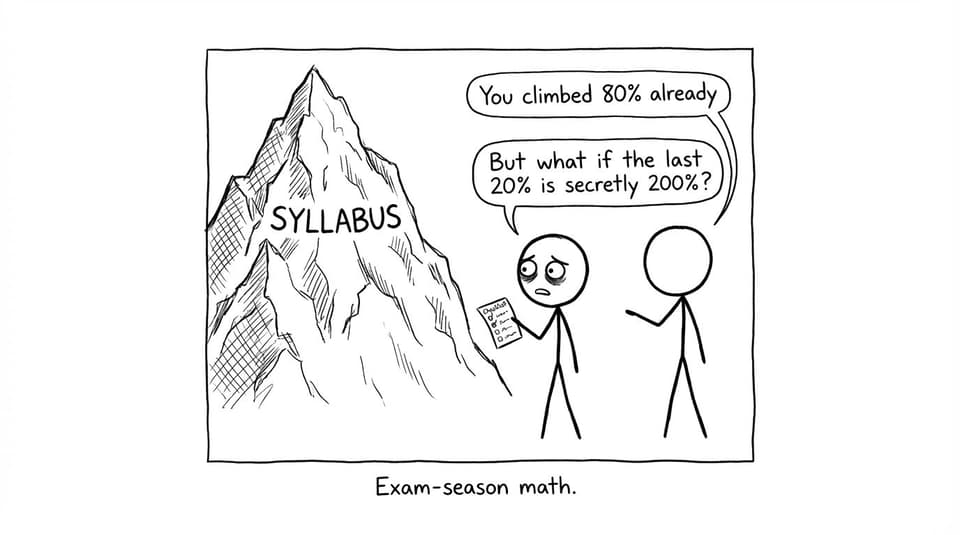
Even when you've covered most topics, your mind zooms in on what's missing.
That's partly because the IB syllabus is broad, and partly because revision reveals how much depth exists underneath each heading. You revise "macroeconomics" and discover ten sub-skills. You revise "calculus" and realize timing matters as much as understanding.
The feeling of not being ready is often your brain noticing complexity, not your brain diagnosing failure.
Familiarity creates calm, but revision often avoids realism
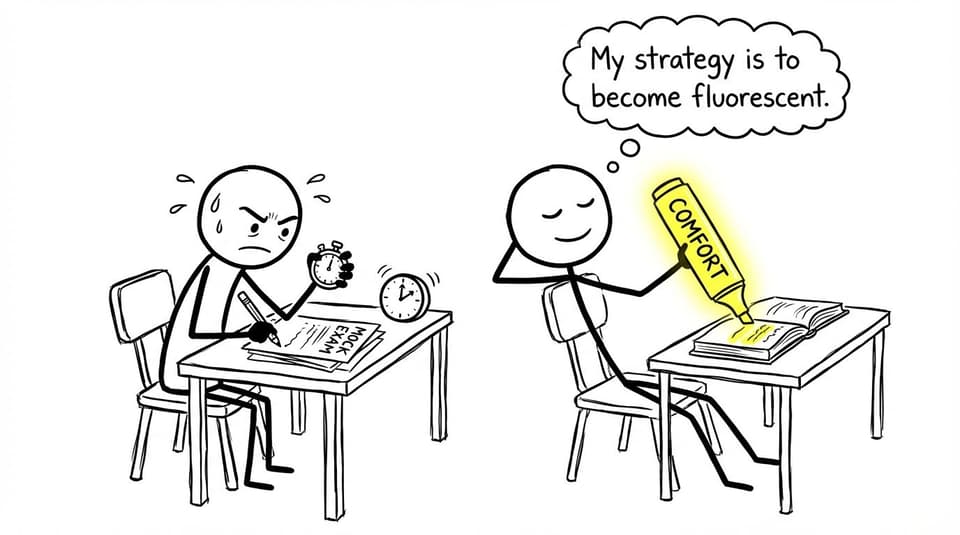
Here's the uncomfortable truth: many IB students do revision that looks productive but avoids the exact moment the exam will demand.
Rereading notes feels clean.
Highlighting feels controlled.
Watching videos feels safe.
But the IB exam asks you to produce.
So if you've revised a lot but haven't done enough exam-shaped practice, you'll feel unready because part of you knows you haven't tested the thing that matters most: performance under constraints.
RevisionDojo exists for that gap: it's built to turn studying into evidence using Study Notes, Flashcards, and a Questionbank, then make it realistic with Mock Exams and Predicted Papers (without you guessing what to do next).
The hidden reason you don't feel ready: you're chasing certainty
Most people don't want "readiness." They want certainty.
Certainty sounds like: I have covered everything and nothing will surprise me.
But the IB doesn't reward certainty. It rewards adaptable skill: reading command terms correctly, choosing the right structure, and collecting marks even when a question is unfamiliar.
So the goal changes:
- Not "I know everything."
- But "I know how to respond when I don't."
That is exactly why timed practice matters, and why feedback matters even more.
If you want a framework for building composure under pressure, read How to Stay Calm and Focused During Timed Assessments.
What to do when you feel not ready (a practical IB reset)
Swap reassurance revision for proof revision
When you feel behind in IB, your instinct is often to do the easiest thing to feel better.
Instead, do the smallest thing that produces proof.
A strong 45-minute "proof block" looks like:
- 10 minutes: skim RevisionDojo Study Notes for one micro-topic (not an entire unit)
- 25 minutes: do Questionbank questions on that micro-topic
- 10 minutes: review errors and write 3 "rules" (what you'll do next time)
This works because your brain stops arguing with vague feelings when you hand it concrete results.
If you want the full system explained, start with RevisionDojo App: The Smarter Way to Prep for IB Exams.
Use Flashcards to stop forgetting from impersonating failure
A lot of "I'm not ready" is just forgetting.
In IB, forgetting is normal because you're carrying multiple subjects, multiple formats, and multiple years of content. The fix is not more rereading. It's retrieval.
That's what Flashcards are for: quick recall sessions that make forgetting visible and manageable. The best part is psychological: when you can retrieve key definitions or processes, your confidence becomes grounded.
If you're building a daily routine, the free starting point is Notes + Flashcards + Question Bank (Free).
Practice under time pressure, but in small doses
Full-length papers are useful, but you don't need to drown in them to feel ready.
Try "timed fragments":
- 20 minutes: one data-response
- 25 minutes: one long-answer plan + opening paragraph
- 30 minutes: one section of math problems
Then review with intention. RevisionDojo's Mock Exams and Grading tools make this review less emotional and more diagnostic: where exactly are marks being lost, and what pattern keeps repeating?
Use AI Chat like an "unstuck button," not a crutch
Every IB student knows the spiral:
You miss one concept. You search for it. You open ten explanations. An hour disappears. Confidence drops.
This is where AI Chat helps best: not by replacing your thinking, but by shortening confusion.
Good prompts look like:
- "Here is my 6-mark answer. Mark it strictly and tell me what to add for the last 2 marks."
- "Quiz me on this subtopic with five short questions and increase difficulty."
- "Explain this in IB language and then give me one exam-style question to test it."
The rule is simple: clarification, then practice.
Reduce open loops from coursework
Sometimes you feel unready for IB exams because something else is quietly draining your attention: an IA draft, EE edits, TOK comments.
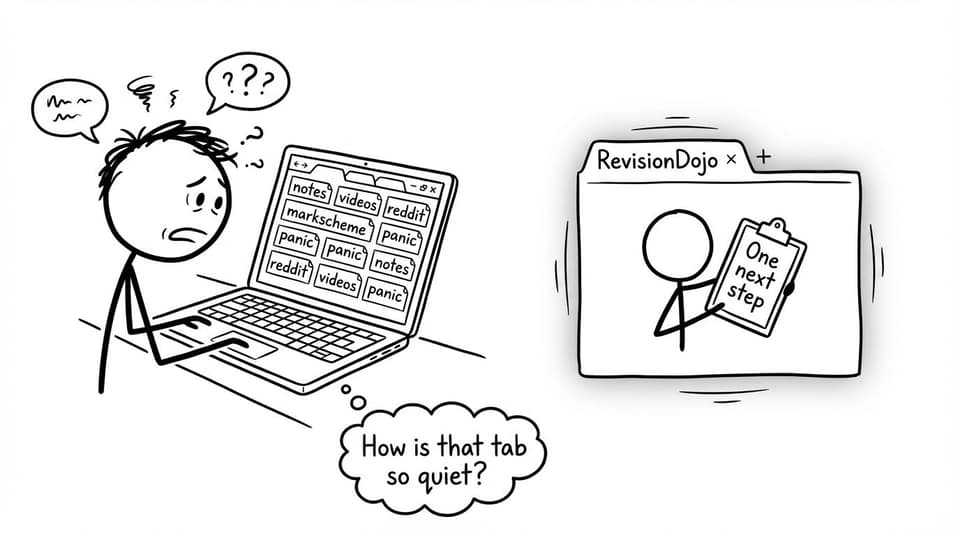
Open loops create background stress. The brain treats unfinished work like a tab that won't close.
This is where RevisionDojo's Coursework Library and Grading tools are underrated. You can compare your work to strong models, get rubric-aligned feedback faster, and stop guessing. If you need human diagnosis, Tutors can convert that feedback into an actual next-week plan.
For the mental side of surviving this season, How to Stay Sane During IB Exam Season is a solid companion.
The mindset shift that actually helps: readiness is a stack, not a switch
Readiness in IB is built from layers:
- Knowledge (do you understand the content?)
- Recall (can you retrieve it?)
- Technique (can you match command terms and markschemes?)
- Timing (can you do it fast enough?)
- Recovery (can you reset after a hard question?)
Most students have more layers than they think. But confidence is the loudest layer, and it often lags behind.
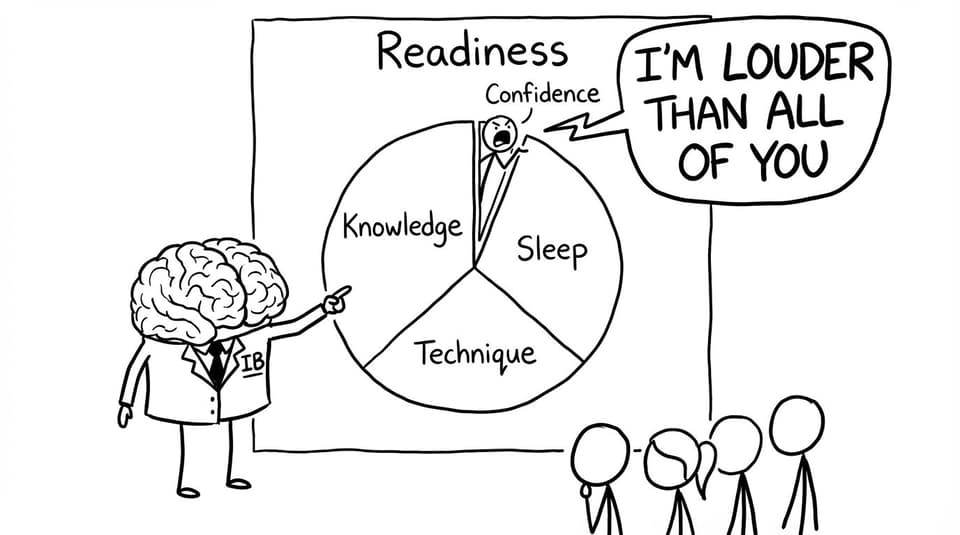
When you say "I'm not ready," you might only mean: "My confidence layer is not caught up yet."
And confidence only moves when you give it evidence.
Closing: your IB brain is asking for evidence, not reassurance
Feeling not ready for IB exams is rarely a sign you've failed.
More often, it's your mind asking for one thing: proof.
So give it proof in small, repeatable blocks. Use Study Notes for clarity, Flashcards for recall, Questionbank for exam-shaped practice, AI Chat when you're stuck, and build realism with Mock Exams and Predicted Papers. Tighten your feedback loop with Grading tools, reduce background stress with the Coursework Library, and lean on Tutors if you need a human plan.
If you want one place where that entire IB workflow is already built, make RevisionDojo your default tab for the next seven days. Not because you need more motivation.
Because you need more evidence.