

If you’ve ever refreshed your marks spreadsheet at 1:00 a.m. like it might reveal a hidden 7, you already know the strange math of IB Stress. It’s not only the workload. It’s the uncertainty: Am I actually on track? Is my “good” Paper 2 a fluke? What if the grade boundaries shift?
A solid IB grade predictor doesn’t eliminate uncertainty, but it turns panic into something you can work with: a number, a range, and a plan. Used well, it’s like budgeting. You stop guessing where your points went, and you start deciding where your points should come from.
And if you want the quickest way to make that shift, start with RevisionDojo’s calculator and build your estimate from evidence, not vibes: IB Grade Calculator.
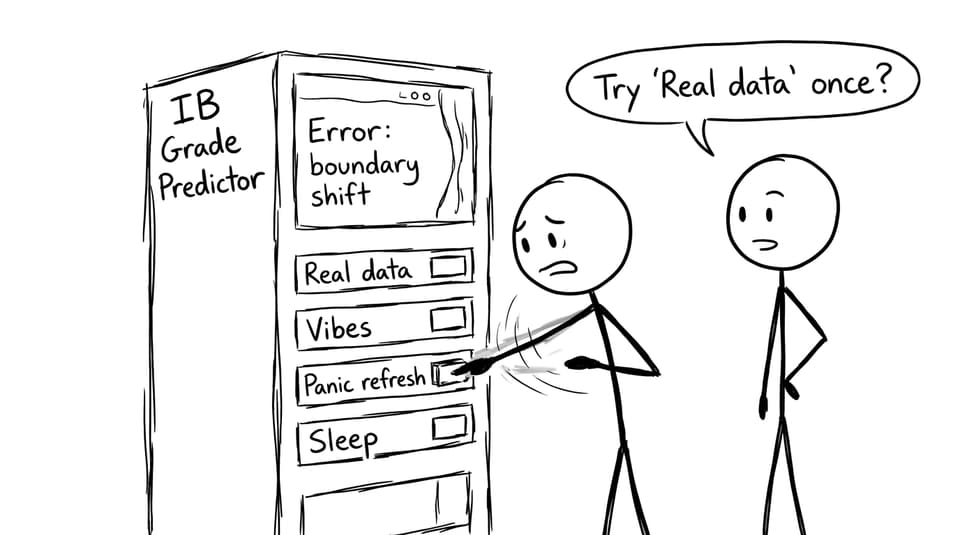
What an IB grade predictor actually does (and why IB Stress likes it)
An IB grade predictor estimates your final IB Diploma score out of 45 using your current marks, expected performance, and grade boundaries. In practice, it converts your component marks into 1--7 grades for each subject, adds them up, then includes up to 3 core points from TOK and the EE.
The reason this calms IB Stress is simple: anxiety loves blanks. A predictor fills in the blank with a best estimate, then shows you which inputs matter most.
If you want a deeper walk-through of the logic, this guide pairs well with the tool itself: How to Predict Your IB Scores in 2025.
Quick checklist: what you need before you predict
Before you touch any IB grade predictor, gather the pieces that make your estimate honest:
-
Your subject choices and levels (HL/SL)
-
Realistic timed marks (from school assessments, timed sections, or mocks)
-
Your best estimate for coursework level (IAs in particular)
-
Your TOK and EE predicted grades (A--E)
-
The correct exam session and timezone for boundaries
That last item is where IB Stress often spikes. Students compare themselves to the wrong boundary set, then conclude they’re “falling behind” when they’re just using the wrong conversion table.
How the RevisionDojo IB Grade Predictor works
RevisionDojo’s predictor is built around the reality of how the diploma is computed: components, boundaries, and totals.
Inputs: subjects, components, TOK, and EE
You select six subjects, choose HL/SL, then enter marks by component where available (papers and IA). You also enter TOK and EE predicted grades, because core points can move your total more than people expect when totals are tight.
To keep your overall workflow in one place, many students pair the calculator with RevisionDojo practice tools: Study Notes for fast clarity, Flashcards for recall, and the Questionbank for exam-style accuracy.
If you’re new to the platform, start here: RevisionDojo for IB.
Outputs: total points plus a decision map
A useful predictor doesn’t just show “38/45.” It shows where those points are coming from, and where the easiest upgrades might be.
This is where IB Stress becomes practical. Instead of “I’m bad at chemistry,” you get “Paper 2 is dragging me across a boundary.” That’s a fixable sentence.
IB Stress and grade boundaries: how to think like a calm analyst
Grade boundaries can shift slightly between sessions. That doesn’t mean predictions are useless. It means your prediction should be a range, not a prophecy.
A strong approach:
-
Convert your marks using current or recent boundaries
-
Create a low--mid--high estimate (especially if your marks vary)
-
Update weekly or biweekly, not daily
If you want a clean method to avoid overreacting, keep this nearby: IB Predicted Grade Calculator: Step-by-Step Guide.
The “range mindset” reduces IB Stress fast
When students feel IB Stress, they often treat one disappointing score as destiny. A range mindset says: one data point is information, not identity.
If your timed sets cluster around a 5/6 boundary, your real job is to stabilize performance. Not to rewrite your entire life plan.
How to use an IB grade predictor without spiraling
An IB grade predictor is most powerful when you use it to choose your next week, not to judge your last week.
Use it to find the highest-leverage points
Ask:
-
Which subject is closest to the next grade boundary?
-
Which component is weighted heavily (and currently weak)?
-
Where do I lose marks by error type (concept, method, command term, time)?
Then build your plan around those answers using RevisionDojo’s toolchain:
-
Questionbank for targeted topic practice and exam technique
-
Mock Exams and Predicted Papers for timed realism
-
AI Chat when you’re stuck and need a fast unblock
-
Grading tools when your marks depend on structure and criteria
To learn how top scorers structure that loop, read: How 45-Point IB Students Prepare for Exams.
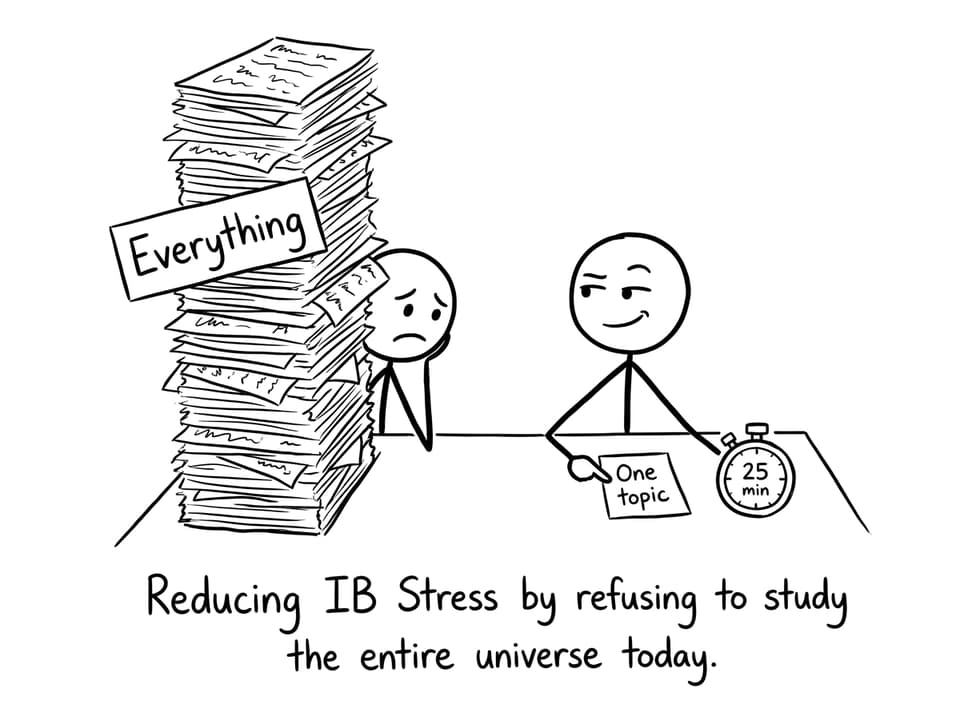
Re-run predictions on a schedule, not on feelings
If IB Stress is high, re-checking your predicted score becomes a coping mechanism. It feels productive, but it’s really reassurance-seeking.
A healthier rule:
-
Update your IB grade predictor once per week
-
Only after you’ve done at least one timed set per subject (or one priority subject)
If you’re trying to study hard without burning out, this helps: How to Study for IB Mocks (Without Burning Out).
Don’t forget the core: TOK and EE still count
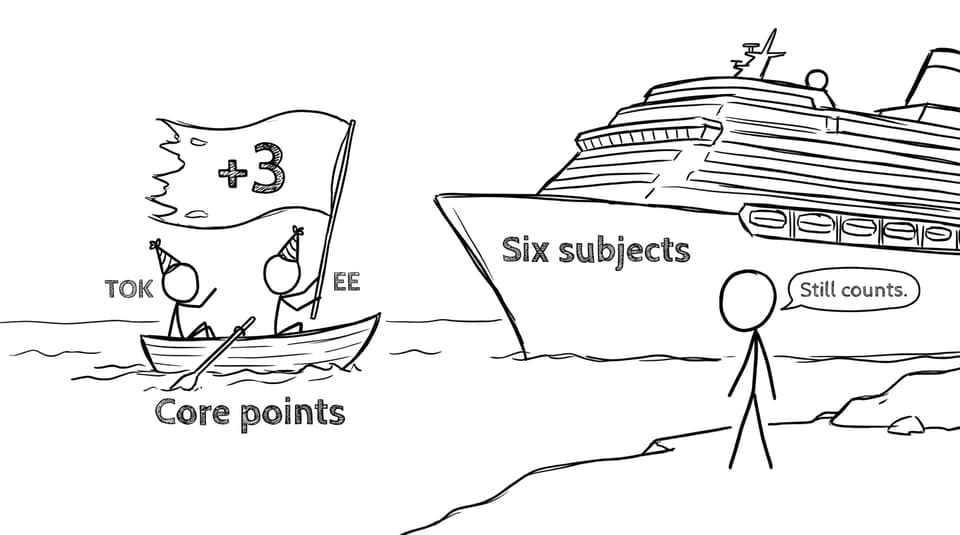
TOK and the EE can add up to 3 core points. When your university offer is tight, those points aren’t “extra.” They’re structural.
If you’re using an IB grade predictor, include TOK and EE honestly, even if it’s uncomfortable. IB Stress grows when you hide the parts of the score you’re afraid to measure.
For TOK support, RevisionDojo has a dedicated hub: IB Theory of Knowledge Resources.
For EE planning and structure, start here: IB Extended Essay Guide.
Common mistakes that make IB Stress worse
These are the predictable traps:
-
Using guessed marks instead of timed evidence
-
Ignoring coursework reality (especially IAs)
-
Switching strategies weekly based on one score
-
Treating the predictor as a verdict instead of a dashboard
If you feel yourself sliding into panic-mode, it helps to adopt a simpler routine for the final hours of the day: Perfect Night-Before Routine for IB Exams.
Conclusion: turn IB Stress into a weekly plan
IB Stress doesn’t disappear because someone tells you to “stay calm.” It fades when you replace uncertainty with a system: measure, predict, adjust, repeat.
Use an IB grade predictor like you’d use a compass. Not to blame yourself for where you are, but to choose the next right steps.
Open the IB Grade Calculator, enter your most realistic marks, include TOK and EE, and treat the output as your planning dashboard. Then build the week inside RevisionDojo with Study Notes, Flashcards, Questionbank, AI Chat, Grading tools, Predicted Papers, Mock Exams, the Coursework Library, and Tutors when you need a human reset.
That’s how you estimate your score accurately and lower IB Stress at the same time.