
IB stress is rarely about one bad day. It’s usually a slow build: six subjects moving at once, deadlines that don’t wait, and the quiet fear that you’re always behind.
But here’s the twist most IB students only learn after the exams: the program is stressful in predictable ways. And when stress is predictable, it’s manageable. You don’t need superhuman discipline. You need a system that turns “I should be revising” into clear next steps, small proof, and repeatable calm.
In this guide, we’ll answer the real question: how stressful is IB, really?. then move into practical strategies to manage IB stress during exam prep, with simple routines you can sustain on tired days.
How stressful is IB (and why it feels personal)
IB has a reputation for intensity because it asks you to do multiple kinds of hard things at the same time:
-
Breadth: you’re studying across disciplines, not just one track.
-
Depth: HL subjects demand genuine understanding, not memorization.
-
Performance: the program rewards exam technique, structure, and timing.
-
Parallel deadlines: coursework, core components, and revision overlap.
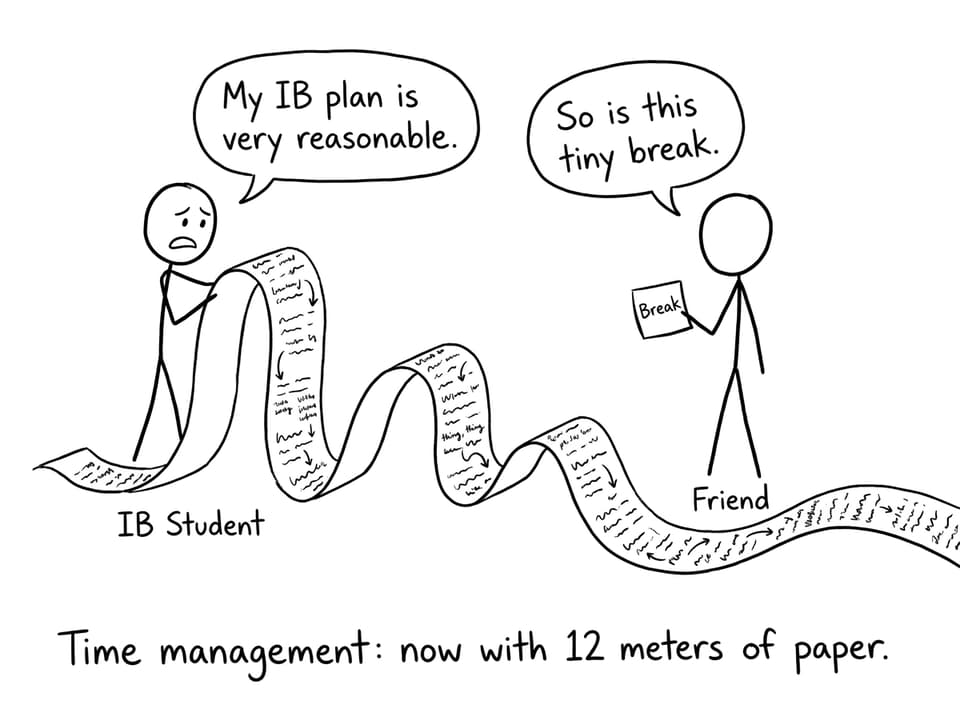
The stressful part is that your brain interprets “too many moving parts” as danger. That’s why IB stress can feel emotional even when you’re doing “fine.” You might be working daily and still feel behind, because the workload isn’t just large, but it’s fragmented.
A good stress plan doesn’t fight that reality. It simplifies it.
Quick checklist: a calm IB stress plan in 10 minutes
Use this as your reset when everything feels loud:
-
Pick one IB subject.
-
Pick one paper skill (definitions, calculations, data response, essay evaluation).
-
Set a timer for 25 minutes.
-
Do active recall: flashcards or exam-style questions.
-
Review mistakes and write one “error rule” (a sentence that prevents the same error).
-
Take a real break (water, food, short walk).
-
Decide tomorrow’s first task before you stop.
This is the backbone of the RevisionDojo workflow: Study Notes for clarity, Flashcards for daily recall, Questionbank for targeted practice, AI Chat for quick “unstuck” moments, and Grading tools to make feedback feel concrete rather than vague.
If you want a deeper motivation reset, bookmark: IB Stress: How to Stay Motivated Without Burning Out.
The most common causes of IB stress
The workload is heavy, but the switching is heavier
Students often blame the volume. The bigger issue is switching costs: you move from an HL essay to a lab write-up to TOK reflections, and each task requires a different mental posture.
A practical fix is to study in “single-skill blocks.” Instead of “revise Biology,” decide “do Topic X multiple-choice questions” or “plan one Paper 2 paragraph.” Revision becomes smaller, and stress drops.
RevisionDojo helps here because the Questionbank can be filtered by topic and difficulty, which turns the abstract idea of “study” into a startable set. Explore: Questionbank.
Internal deadlines create background stress
Even when you’re revising for IB exams, coursework can hum in the background like an app you forgot to close. That mental load is real.
This is where rubric clarity matters. When you know what “good” looks like, you stop endlessly polishing.
Use RevisionDojo’s Grading tools for faster feedback loops, and the Coursework Library when you need examples that make expectations feel tangible. If you’re stuck, Tutors can save weeks by diagnosing one recurring issue.
Exam season amplifies uncertainty
The scariest part of IB isn’t always the content. It’s the question: “What if I revise the wrong thing?”
Uncertainty fuels anxiety. Certainty comes from evidence.
That’s why timed practice matters. It turns fear into data: pacing, weak topics, recurring command terms.
For a realistic routine, see: How to Study for IB Mocks (Without Burning Out).
Managing stress in IB: the “proof loop” that calms your brain
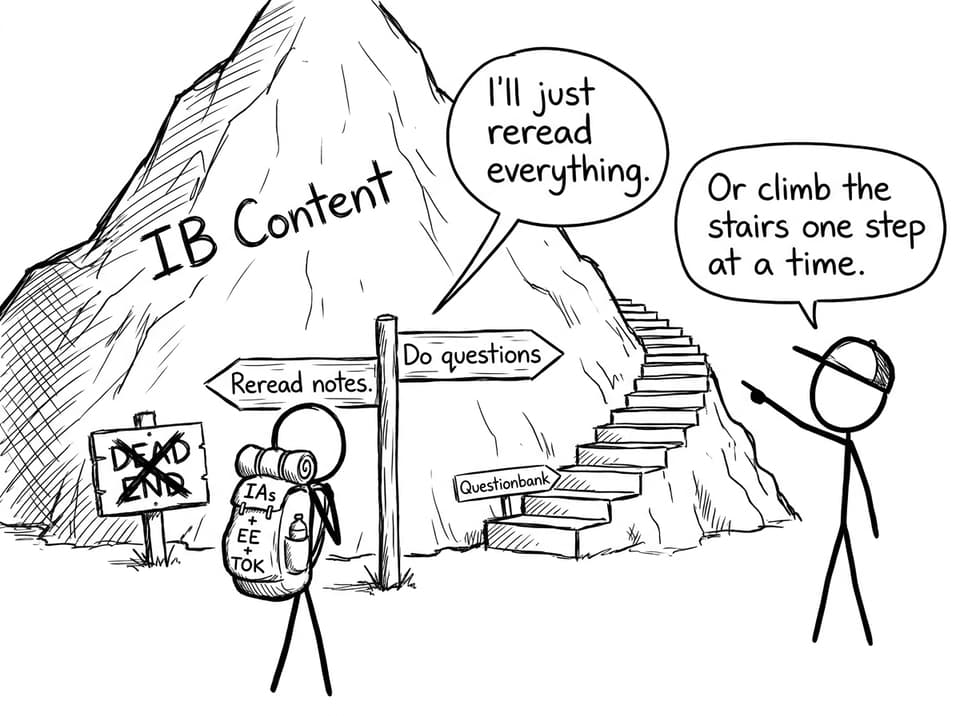
If you’re preparing for IB exams, the goal isn’t to feel confident first. It’s to create proof until confidence shows up.
Use a 3-step loop (clarity → attempt → correction)
Clarity (10-15 min)
Patch one gap with concise materials, not an entire chapter. Use RevisionDojo RevisionDojo for IB to keep the scope tight.
Attempt (20-40 min)
Do exam-style practice immediately. This is where the brain learns.
Correction (10-15 min)
Review mistakes and write 1-3 “error rules,” like:
-
“I must define the key term before I explain the process.”
-
“Units first, substitution second, answer last.”
This loop is also why a good AI Chat tool matters: it prevents a 3-minute confusion from turning into a 45-minute spiral. Use RevisionDojo’s AI Chat when you’re stuck, then immediately prove it with another question set.
To build the full system, read: RevisionDojo App: The Smarter Way to Prep for IB Exams.
Make flashcards your “minimum viable day”
On high-stress days, the win is consistency, not heroics. A short flashcard session keeps recall alive so you don’t pay interest later.
Use spaced repetition with: Flashcards or the deeper overview: IB Flashcards with Spaced Repetition (SRS).
If you want to tighten technique, this article pairs well with the routine: Why You Feel Not Ready for IB Exams (Even If You Are).
Stress management habits that actually help during IB exam prep
Sleep is not optional in IB, it’s a strategy
When you sleep less, you don’t just feel tired. You reduce recall accuracy, increase emotional reactivity, and make studying feel heavier than it is.
A realistic IB target is consistent sleep timing over perfect hours. Even small improvements, like like a fixed wake-up timethat can reduce stress.
Movement is the fastest “state change” tool
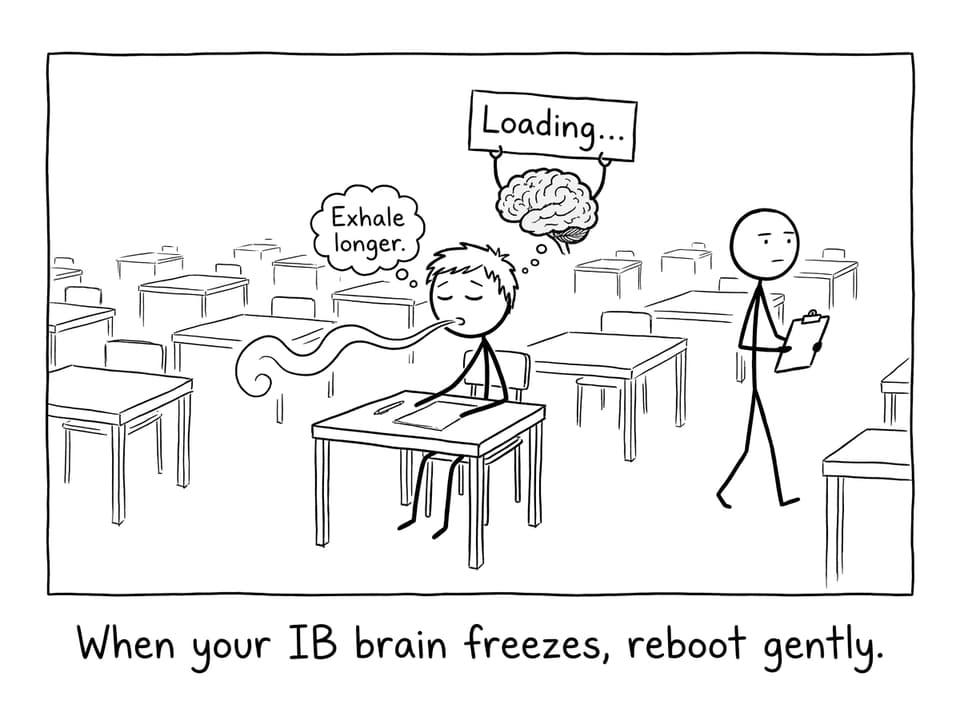
When stress spikes, your thoughts follow your physiology. A 10-20 minute walk, light stretching, or a short workout can reset attention and reduce anxiety.
If you need permission to have a life during IB, this helps: Guilt-Free Hobbies for IB Students During Exam Prep.
Practice under time pressure early (in small pieces)
A common trap is waiting until you “know everything” before doing timed work. In IB, timing is a skill, not a final exam-day performance.
Start with timed fragments:
-
8 minutes on one hard short-response
-
20 minutes on one data-response
-
25 minutes outlining an essay + first paragraph
Then scale up into weekly mock blocks. If you want clarity on how to think about predicted sets, read: IB Predicted vs Specimen Papers: What They Mean.
For exam anxiety specifically, keep this nearby: Exam Stress Management Tips for IB Candidates.
Conclusion: IB is stressful, but it doesn’t have to be chaotic
IB will challenge you. That’s part of why it’s respected. But the students who feel the calmest aren’t the ones who “never stress”, but they’re the ones who turn stress into a plan, and a plan into proof.
If you want that proof loop in one place, RevisionDojo is built for it: Questionbank for exam-style practice, Study Notes for fast clarity, Flashcards for daily recall, AI Chat for instant help, Grading tools for rubric-aligned feedback, Predicted Papers and Mock Exams for realistic pressure training, plus a Coursework Library and Tutors when you need deeper support.
Start small today: pick one IB topic, do one 25-minute proof block, and let the next step be obvious.