When a child is struggling in MYP History, the first instinct is often to add more revision. Yet history is rarely difficult because a student has not worked hard enough. More often, the real problem is hidden beneath the grade. They may know the events but struggle to explain significance. They may understand a source but not evaluate it. They may have good ideas but lose marks because their response lacks structure.
Helping a child struggling in MYP History begins with identifying the particular skill that needs support. MYP Individuals and Societies assessment covers four equally weighted areas: knowing and understanding, investigating, communicating, and thinking critically. Once the difficulty is visible, support can become calmer and more practical.
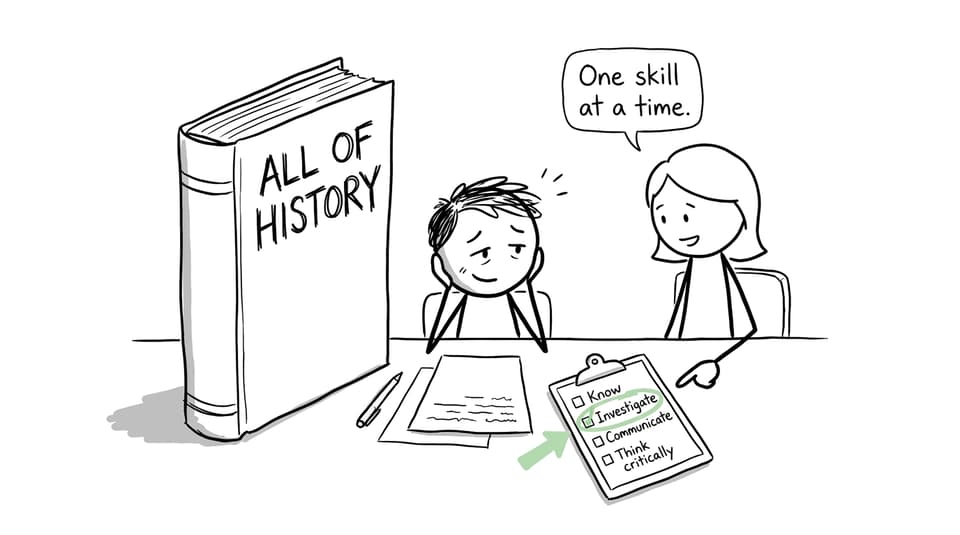
A simple checklist for parents
Use one recent assignment to ask:
- Does my child understand the main events, concepts, people, and vocabulary?
- Can they explain cause, consequence, change, continuity, and significance?
- Can they investigate a focused question using relevant sources?
- Can they communicate a clear argument?
- Can they evaluate perspective, value, and limitation?
- Do they understand the teacher's feedback?
You do not need to solve every weakness immediately. One focused conversation is usually more useful than a general instruction to "revise history."
Start with the difficulty, not the subject
A child who says, "I am bad at history," may be describing several different experiences. Perhaps they forget dates, cannot turn knowledge into an argument, find source questions unpredictable, or freeze when writing under time pressure.
Ask them to show you one difficult question. Instead of beginning with the mark, ask, "What did you think the question required?" and "Which part felt hardest?" This makes the conversation diagnostic rather than judgmental.
Match the practice to the problem. Use short retrieval sessions for missing knowledge, paragraph plans for unclear writing, and individual unfamiliar sources for weak evaluation. More work is not automatically better work.
Rebuild knowledge through connections
History becomes easier to remember when facts belong to an explanation. For one topic, ask:
- What changed, and why?
- Who was affected?
- What were the consequences?
- What remained the same?
- Why was the development significant?
Rather than memorising isolated facts about the Industrial Revolution, for example, connect technology, labour, urbanisation, living conditions, and political responses. Ten minutes explaining one relationship may be more valuable than an hour of rereading.
RevisionDojo's MYP History resources offer Study Notes, Flashcards, lessons, and practice questions. Read one short section, close it, and ask your child to explain the idea in their own words.
Make source analysis concrete
Students are often told to "analyse" without being shown what analysis involves. Use a repeatable sequence:
- What does the source communicate?
- Who created it, when, and where?
- What were its purpose and intended audience?
- How does its context affect its meaning?
- What is it valuable for investigating?
- What can it not establish confidently?
This resembles OPVL, but the acronym should support thinking rather than replace it. A primary source is not automatically useful, while a source with an obvious perspective is not automatically worthless. Its value depends on the investigation.
Read RevisionDojo's guide to analysing historical sources, then examine a speech, photograph, poster, law, or statistic. Ask for one precise value and one precise limitation. Keep the exercise short enough to remain focused.
Practise the four MYP skills separately
Assignments can feel overwhelming because they combine several skills. Isolating each one makes improvement easier to see.
Knowing and understanding
Ask your child to explain a topic without notes. Encourage accurate terminology, but correct one important misunderstanding at a time.
Investigating
Turn broad interests into focused questions. "What caused the war?" is too wide. "How far did economic pressures influence the decision to enter the war?" provides a clearer research direction.
Communicating
Before drafting, ask for a one-sentence answer and two supporting reasons. This creates an argument before the student must manage paragraphs and evidence.
Thinking critically
Ask, "Is there another interpretation?" or "What evidence might change your view?" These prompts encourage evaluation without turning the conversation into a debate.
For focused examples, use RevisionDojo's materials on Ideas and Ideologies, Trade and Global Exchange, or Supranational Institutions. Choose material matching the school unit rather than trying to cover everything.
Turn feedback into one action
Feedback such as "develop analysis" is not yet a study plan. Translate it into a visible behaviour:
- "Add detail" becomes "include one specific piece of evidence per paragraph."
- "Explain sources" becomes "connect the source's purpose to its value."
- "Improve structure" becomes "plan the thesis and paragraph points first."
- "Use terminology" becomes "select three terms and use them accurately."
RevisionDojo's Questionbank supports targeted practice, while AI Chat can prompt clearer explanations. Flashcards help with essential vocabulary, but recall should always lead to application.
Protect confidence and involve the school
Separate the student from the result. "This response shows that source evaluation needs work" identifies a changeable skill. "You are struggling with history" can sound permanent.
Keep sessions short and predictable. A routine might include 15 minutes of review, 10 minutes of retrieval, and 10 minutes answering one question. Consistency usually helps more than exhausting weekend sessions. The orientation in space and time guide can also help families understand MYP's conceptual approach.
If focused practice does not help, ask the teacher which criterion needs attention and what a stronger response would contain. School expectations and assessment schedules can vary. RevisionDojo's Grading tools, Coursework Library, and Tutors can add individual support while complementing teacher guidance.
A calmer way forward
Helping a child struggling in MYP History does not require becoming their private teacher. Find the skill, practise it briefly, and use feedback to choose the next step.
RevisionDojo supports this process through Study Notes, the Questionbank, Flashcards, AI Chat, Grading tools, Predicted Papers, Mock Exams, the Coursework Library, and Tutors. Used selectively, these resources provide structure without making home feel like another classroom. The goal is not more pressure. It is a clearer path from "I cannot do history" to "I know what to practise next."