

A glycoprotein is a protein with one or more covalently attached carbohydrate chains. In IB Biology, you should know that membrane glycoproteins project carbohydrates from the extracellular surface and contribute to cell recognition and cell adhesion. Exam answers earn marks by connecting this asymmetric structure to a specific function.
The idea is small enough to fit on a flashcard. Yet it sits at the intersection of carbohydrates, proteins, membranes, immunity, and tissue formation. That makes it unusually useful to examiners: a short question can reveal whether you understand biology as a connected system or as a list of definitions.
What you need to know for IB Biology
The current IB Biology course, first assessed in 2025, includes the structure and function of glycoproteins and glycolipids within B2.1 Membranes and membrane transport. The required focus is controlled: carbohydrate structures linked to proteins or lipids, their position on the extracellular side of membranes, and their roles in cell recognition and adhesion.
Use this checklist when revising:
- Define the molecule as a protein with a covalently attached carbohydrate chain.
- Place the carbohydrate on the extracellular side of the plasma membrane.
- Link structural variation in carbohydrate chains to specific recognition.
- Explain how surface molecules help cells identify or attach to one another.
- Distinguish a glycoprotein from a glycolipid.
- Label the structure correctly on a fluid mosaic model.
- Apply the concept to unfamiliar cells, tissues, or experimental data.
For the surrounding syllabus context, begin with RevisionDojo’s B2.1 membranes and membrane transport hub. It connects this detail to the larger membrane model rather than leaving it as an isolated fact.
Glycoprotein structure explained clearly
The word itself gives you the starting point: glyco refers to carbohydrate, while protein identifies the main macromolecule. The carbohydrate component is often a short, branched oligosaccharide chain attached covalently to the protein.
In a plasma membrane, the protein may be embedded in or associated with the membrane. Its carbohydrate chain faces the extracellular environment. This orientation is not arbitrary. Carbohydrates are added and modified as membrane proteins move through the endomembrane system, and the resulting topology places the chains on the cell’s outer surface after vesicles fuse with the plasma membrane.
You do not normally need a detailed account of N-linked and O-linked glycosylation for a standard B2.1.9 response. For deeper understanding, however, N-linked carbohydrates attach through selected asparagine residues, whereas many O-linked carbohydrates attach through serine or threonine residues. Use that detail only when a question provides relevant biochemical context.
The exam-ready principle is simpler:
Protein component + covalently attached carbohydrate chain + extracellular orientation.
Review integral and peripheral membrane proteins if you are unsure how proteins can be positioned relative to the bilayer.
Why carbohydrate chains matter
A cell membrane is not merely a border. It is also a surface through which a cell presents information about itself.
Cell recognition
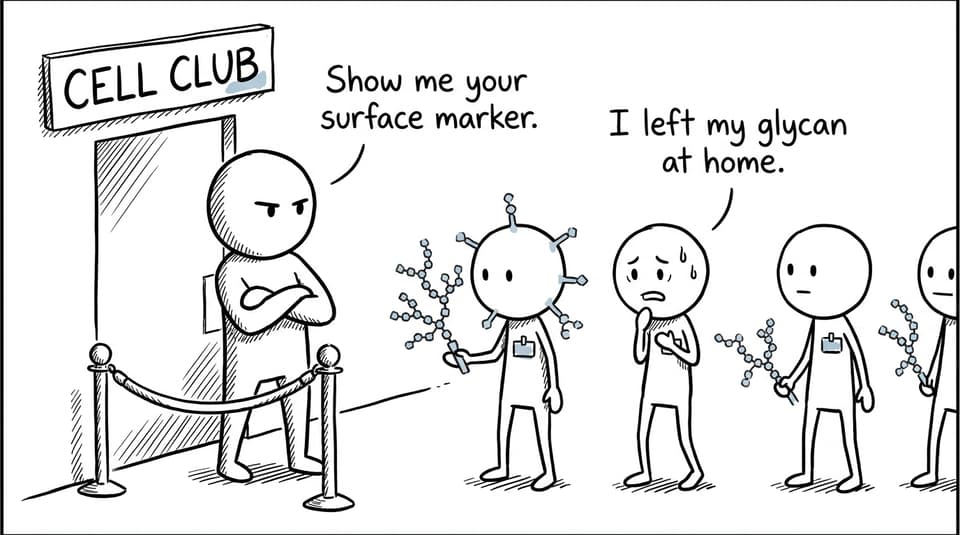
Carbohydrate chains can vary in sequence, composition, and branching. This variation creates specific surface patterns that other cells or molecules can recognize. A complementary receptor may bind to a particular surface marker, allowing cells to distinguish among potential interaction partners.
This specificity is why the common “identity badge” analogy works, provided you explain the mechanism. Do not stop at saying that the molecule is an ID tag. State that its exposed carbohydrate chain has a particular structure that can bind selectively to another molecule.
RevisionDojo’s focused cell-to-cell recognition notes provide a concise review of this relationship.
Cell adhesion
Cell adhesion allows cells to attach to neighboring cells or interact with extracellular material. Surface glycoproteins can participate in selective binding, helping cells remain organized within tissues.
The important reasoning chain is:
- The carbohydrate chain is exposed outside the cell.
- Its three-dimensional structure permits specific interactions.
- Binding links cells or supports communication between them.
- Repeated interactions contribute to tissue organization.
This is a stronger explanation than simply writing “glycoproteins stick cells together.” The latter gives a result but no biological mechanism.
Receptors and signalling
Many cell-surface receptors are glycosylated proteins. A receptor’s protein region may bind an extracellular signalling molecule and initiate an intracellular response, while attached carbohydrates can influence folding, stability, localization, or molecular interactions.
Be careful with terminology. Not every glycoprotein should automatically be described as a receptor, and not every receptor question requires discussion of its carbohydrate chain. Answer the function shown or described in the question.
Glycoproteins and glycolipids compared
These two membrane components are easy to confuse because both carry extracellular carbohydrates.
| Feature | Glycoprotein | Glycolipid |
|---|---|---|
| Molecule carrying the carbohydrate | Protein | Lipid |
| Carbohydrate location | Extracellular surface | Extracellular surface |
| Typical IB functions | Recognition, adhesion and some receptor interactions | Recognition and membrane-surface identity |
| Position in a membrane diagram | Attached to a membrane protein | Attached directly to a lipid |
A useful test is to trace the carbohydrate chain back to its anchor. If it connects to a protein, identify a glycoprotein. If it connects to a lipid in the bilayer, identify a glycolipid.
See the fluid mosaic model study page for notes, questions, flashcards, and video tutorials that place both structures in a complete membrane.
How glycoprotein questions appear in IB exams
Questions may ask you to identify a labelled component, describe its structure, explain its function, annotate a membrane diagram, or interpret an unfamiliar investigation. The command term determines how far your answer must go.
- State: Give a short fact without explanation.
- Describe: Give relevant characteristics or an account of what occurs.
- Explain: Connect structure, mechanism, and consequence.
- Compare and contrast: Give similarities and differences with clear reference to both items.
Worked exam-style example
Question: Explain how membrane glycoproteins contribute to cell-to-cell recognition. [3 marks]
Model answer:
- Glycoproteins have carbohydrate chains attached to proteins in the plasma membrane.
- The carbohydrate chains project from the extracellular surface and have specific structures.
- Complementary molecules on other cells bind to these chains, allowing cells to recognize particular cell types.
Each sentence performs a different job: structure, orientation, then function. That is more reliable than writing a long paragraph containing the same idea three times.
Data-based variation
Imagine that an enzyme removes exposed carbohydrates from the surfaces of cultured cells. The treated cells subsequently form fewer aggregates than untreated cells.
A sound interpretation would be that removing the carbohydrates disrupted specific surface interactions involved in adhesion. You could conclude that extracellular carbohydrates contribute to aggregation under the tested conditions. You should not conclude that all adhesion depends exclusively on them, because membrane proteins, junctions, and extracellular components may also be involved.
That final distinction matters. Strong data answers separate what the evidence supports from what it does not prove.
Practise this style of reasoning in the IB Biology Questionbank, then use the grading feedback to identify missing links in your explanations.
Common mistakes that lose marks
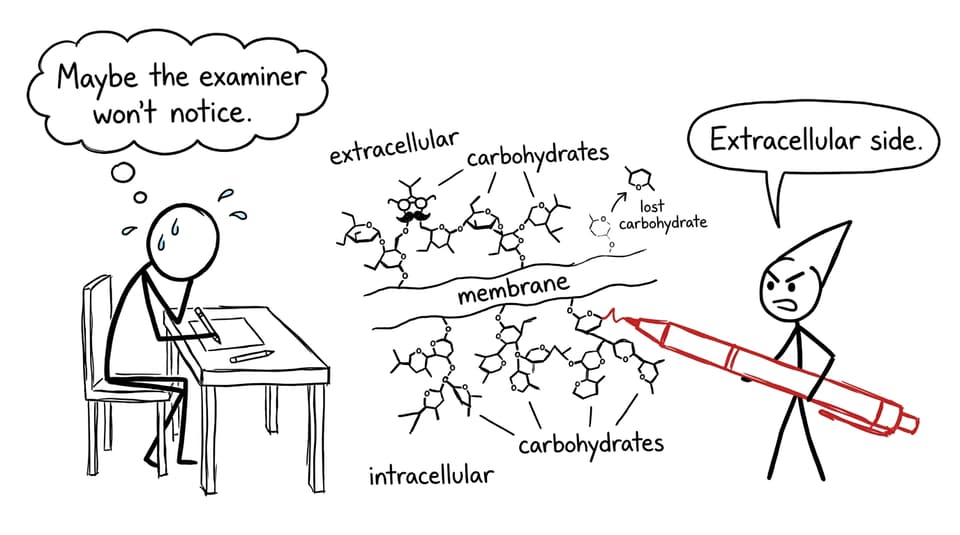
Drawing carbohydrates on both sides
In a plasma membrane diagram, place glycoprotein and glycolipid carbohydrate chains on the extracellular side. Randomly adding them to the cytoplasmic surface ignores membrane asymmetry.
Confusing the protein with the carbohydrate
The entire molecule is not a carbohydrate. It is a protein carrying a carbohydrate component. Use wording that preserves both parts of the structure.
Treating recognition and adhesion as synonyms
Recognition concerns identifying or selectively interacting with another cell or molecule. Adhesion concerns attachment. The processes can be connected, but they are not identical.
Writing only an analogy
“ID badge” is memorable, not complete. Convert it into biology by mentioning an exposed, structurally specific carbohydrate chain and complementary binding.
Overexplaining irrelevant biochemistry
Advanced glycosylation details will not rescue an answer that fails to state extracellular location or biological function. Secure the syllabus-level marks first.
Ignoring the command term
A definition may satisfy “state,” but it is rarely enough for “explain.” For explanation questions, move from feature to mechanism to outcome.
A practical revision method
Use a four-step loop rather than rereading the definition:
- Recall: Write the definition from memory.
- Draw: Sketch a bilayer and correctly orient one carbohydrate chain.
- Explain: Produce a three-sentence structure-to-function answer.
- Apply: Interpret an unfamiliar recognition or adhesion experiment.
RevisionDojo’s topic flashcards on cell recognition help with retrieval, while the Biology visual cheatsheets support rapid diagram review. Once the concept feels secure, attempt a timed set from the B2.1 membrane Questionbank.
Revision becomes powerful when each resource has a role. Use Study Notes and the Coursework Library to build context, Flashcards to retrieve definitions, the Questionbank to apply them, and AI Chat or Tutors when a misconception refuses to move. Grading tools reveal whether your wording earns marks, while Mock Exams and Biology Predicted Papers help you use the knowledge under time pressure.
Quick-reference summary
- A glycoprotein consists of a protein with a covalently attached carbohydrate chain.
- On plasma membranes, its carbohydrate projects from the extracellular surface.
- Structural variety enables selective molecular interactions.
- Key IB functions are cell recognition and cell adhesion.
- A glycolipid carries its carbohydrate on a lipid rather than a protein.
- In explanations, connect structure, location, specificity, and biological consequence.
- In diagrams, never place the carbohydrate chain on the cytoplasmic side.
This topic is a reminder that marks often hide inside relationships. One carbohydrate chain means little in isolation. Place it on the correct side of a membrane, connect its shape to selective binding, and the whole idea becomes coherent.
Use RevisionDojo to repeat that journey from recall to application. Learn the model, draw it, explain it, test it, and let your mistakes tell you what to revise next.