

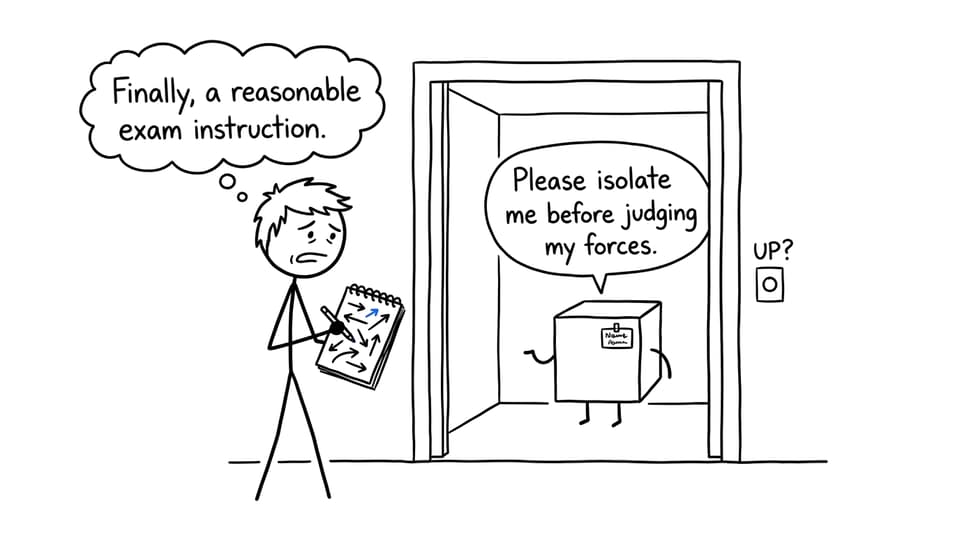
Free body diagrams isolate one object and show every external force acting on it as a labelled vector. In IB DP Physics, use them to identify forces, resolve components, find the resultant force, and apply Newton’s laws. Include only genuine forces acting on the chosen body, not motion arrows, acceleration, or an additional resultant-force arrow.
A force problem often looks difficult because the page contains too much information. A slope, rope, engine, rough surface, and accelerating object may all appear at once. The diagram is where that noise becomes structure. Draw it correctly, and much of the algebra has already been decided.
The current IB DP Physics course explicitly expects students to draw and interpret these diagrams, including forces shown at their point of application or at the centre of mass where appropriate. This skill sits primarily within Topic A.2, so keep the IB Physics A.2 Forces and Momentum notes nearby while revising.
The five-step method to remember
For almost any translational force problem:
- Choose one body or system. State exactly what you are isolating.
- Identify every external interaction. Look for gravity, surfaces, ropes, fluids, springs, fields, or applied pushes and pulls.
- Draw and label force arrows. Their directions must be correct, and their relative lengths should reflect known relative magnitudes.
- Choose useful axes. On a slope, use axes parallel and perpendicular to the surface.
- Apply Newton’s second law by direction. Write and before substituting values.
This sequence matters. Starting with before deciding which forces belong in is like adding a column of numbers before deciding what the numbers measure.
What belongs on free body diagrams?
Every arrow must answer a simple question: what external object or field exerts this force on the selected body? That interaction-based view is explored further in how forces arise from interactions.
| Force | Direction to draw |
|---|---|
| Weight, | Vertically downward, toward the planet’s centre |
| Normal force, | Perpendicular to the contact surface |
| Tension, | Along a taut rope or cable, pulling away from the object |
| Friction, |
Do not draw velocity or acceleration as forces. Do not include a force exerted by the selected object on something else. If two bodies matter, draw two separate diagrams.
Worked example: a block on an inclined plane
Consider a 5.0 kg block on a frictionless slope inclined at 30° to the horizontal. Find its acceleration and the normal force. Use m s⁻².
Isolate and label the block
Only two forces act on it:
- weight , vertically downward
- normal force , perpendicular to the slope
There is no friction because the question states that the surface is frictionless. There is also no separate force called “motion down the slope.” Motion is an outcome, not an interaction.
Choose the positive x-axis down the slope and the y-axis perpendicular to it. Resolve weight rather than resolving the normal force:
- parallel component:
- perpendicular component:
Apply Newton’s second law
Parallel to the slope:
m s⁻² down the slope.
Perpendicular to the slope, the block has no acceleration:
N.
Notice that the normal force is not equal to the weight. It balances only the component of weight perpendicular to the surface. For more targeted applications, use the A.2 Forces and Momentum Questionbank after reviewing the method.
Worked example: apparent weight in an elevator
A 60 kg student accelerates upward at 1.5 m s⁻². Find the normal force exerted by the elevator floor.
The student experiences two forces: upward normal force and downward weight . Taking upward as positive:
N, or approximately 679 N.
The student’s weight remains . What changes is the normal force, which is what a scale would measure. This distinction is commonly hidden behind phrases such as “apparent weight,” “scale reading,” or “contact force.”
How this skill appears in IB Physics questions
The syllabus expectation goes beyond producing a neat sketch. You may need to:
- identify an omitted or incorrectly directed force
- infer whether forces are balanced from arrow lengths
- resolve a force into components
- calculate acceleration from the resultant force
- determine tension, friction, drag, or a normal force
- explain an action-reaction pair using two different bodies
- identify which real force provides an inward resultant in circular motion
- combine force analysis with energy, momentum, or rotational mechanics
In longer calculations, your drawing should lead directly to a symbolic equation. Write the equation before inserting numbers. This exposes sign errors and gives the examiner a clear record of your reasoning.
For broader revision, the IB Physics resources hub combines Study Notes, Flashcards, lessons, videos, and topic practice. A short explainer video can help you see how the diagram becomes an equation, but follow it by reproducing the method without assistance.
Common exam mistakes and how to fix them
Assuming the normal force always equals weight
That equality applies only in particular situations, such as an object on a horizontal surface with no other vertical forces and no vertical acceleration. On a slope, in an elevator, or under an angled pull, calculate it from the perpendicular or vertical force equation.
Drawing Newton’s third-law partners together
Action-reaction forces act on different bodies. If Earth pulls a ball downward, the ball pulls Earth upward. Only the first force appears when the ball is the selected body. The pair should not cancel on one diagram.
Treating static friction as automatically equal to
Static friction adjusts up to a maximum: . Use equality only when the object is at the limiting point of slipping. Dynamic friction for a sliding body is modelled as in the IB guide.
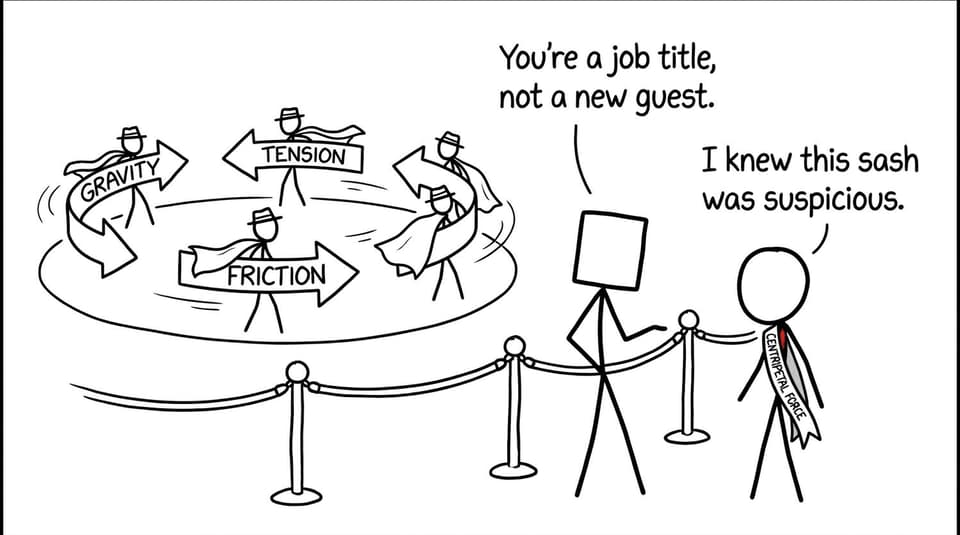
Adding “centripetal force” as an extra arrow
Centripetal force is the name for the inward resultant, not automatically an additional interaction. Gravity, tension, friction, or a normal force may provide that resultant. The IB Physics circular motion and gravitation guide develops this distinction.
Resolving a force while keeping the original arrow
Once a force has been replaced by perpendicular components in your calculation diagram, do not count the original force as well. Otherwise, you include the same interaction twice.
A fuller error checklist is available in IB Physics Forces and Momentum common mistakes.
Quick-reference exam checklist
Before moving from your diagram to the algebra, ask:
- Have I isolated exactly one body or clearly defined system?
- Does every arrow represent an external interaction?
- Are all forces labelled unambiguously?
- Is weight vertical rather than automatically perpendicular to a slope?
- Is the normal force perpendicular to the surface?
- Does friction oppose relative sliding or the tendency to slide?
- Have I excluded velocity, acceleration, and resultant-force arrows?
- Are my axes chosen to reduce unnecessary components?
- Have I written a separate force equation for each axis?
- Do the final direction, unit, and magnitude make physical sense?
Turn the diagram into an exam habit
Knowing the rules is not the same as recognizing them under time pressure. Use RevisionDojo’s Physics Questionbank to practise one force pattern at a time, then test whether the method survives inside mixed questions. Finish with IB Physics Predicted Papers and mock sets under realistic timing.
RevisionDojo is the ultimate IB resource because the whole improvement loop lives in one place: Study Notes and Flashcards build recall, the Questionbank develops application, AI Chat and Grading tools explain errors, and Predicted Papers and Mock Exams build exam stamina. The Coursework Library and Tutors provide deeper support when independent revision is not enough.
The enduring lesson is simple. Do not begin by searching for an equation. Begin by deciding what the world is doing to one chosen object. Draw that honestly, and the equations become much easier to trust.